|
Notify me of new HIR pieces!
Adolf Hitler |
|||||||||||||
|
THE PROBLEM OF JEWISH An HIR series
Short Preface When Hitler came to power in 1933 outrages against
the German Jews began immediately. This provoked a storm of protest all over the
world. But, especially, it provoked ordinary Jews to organize to boycott
German goods and services and sink the German economy. Many gentiles
(non-Jews) joined them. This brought the Third Reich to its knees and within
an inch of destruction. Hitler barely survived. What saved him? The established Jewish leaders did. To those who don’t know Jewish history (almost
everybody) this is amazing, inconceivable. In fact, it was normal. This
article will cover the 1933 crisis, relying on the massively detailed work of
Jewish historian Edwin Black, who documents what happened in The Transfer
Agreement: The Dramatic Story of the Pact Between the Third Reich and Jewish
Palestine (1983, Carroll & Graf). But in order to give a
satisfactory account of why Jewish leaders behaved the way they did in 1933,
I will begin briefly by explaining the context of the Jewish experience as
they came out of the Middle Ages into the modern world, for without this
context what happened in 1933 is difficult to comprehend. If you would like to jump straight to the 1933
boycott, you may do so with the hyperlinked table of contents below. Then,
having seen what happened, you may come back to the first section -- entitled
"The Background" -- for a full historical understanding of why the
Jewish leaders betrayed the Jews so dramatically. Table of Contents
|
|||||||||||||
________________________________________________________
The push for Jewish assimilation in the 19th century
|
|||||||||||||


|
|
|
Is this article useful? Help us do
more with a donation . |
|
|
Because there really are no new ethical concepts
that are exclusive to Hasidism as such, there isn’t here a dramatic
‘revelation’: Hasidism is thoroughly conservative. What Hasidism injected
into the mystical Jewish tradition of Kabbalah is an element it did not have
and which most other mystical movements possess: the saint, defined more than
anything as a good man, who in the Jewish version also works for social
justice, and whose authority emanates from the perception of his ethics and
his presumed direct, often ecstatic, link to God. There is also the detail
that a Zaddik’s authority is dynastic, for it is
transmitted from father to son (and in some cases to son-in-law). In this
manner, Hasidic communities were created around different Zaddik
dynasties.
“Never before
in Judaism was there such a large movement motivated by the concept of a
leadership which serves as a religious, mystical intermediary between Man and
God. The only exception is the Sabbatian movement
of the 17th and 18th centuries, which believed that its messiah, Shabtai Zvi, was an
intermediary between the people of Israel and the Godhead, an idea which was
presented especially in the works of Nathan of Gaza, the prophet of Shabtai Zvi.”[26]
Shabtai Zvi had been a complete disaster, for after convincing
astonishingly large multitudes all over the Jewish world that he was the
long-awaited Messiah, he demonstrated that he was in fact an enemy of Judaism
who wanted to abolish Jewish Law, and in the end converted to Islam, a religion that
considers it pious to murder recalcitrant Jews or else make them slaves of
the Muslims.[26a] It is true that Hasidism shares with the Sabbatean
movement the element of charismatic leadership, but in another sense Hasidism
is the very antithesis of Shabtai Zvi, for it means to preserve the Jewish Law. In a
certain way, the Hasidic movement harnessed the feverish desire of the Jewish
masses for a charismatic leadership -- amply demonstrated in the Sabbatean movement -- and used it to preserve traditional
Judaism, neutralizing the threat present in Sabbateanism
and later reverberations. Orthodox Jews, too, have their judo moves.
Precisely because Hasidism is an injection of
charismatic leadership into Jewish mysticism, it went in a direction contrary
to rationalism. The traditional rabbis had always been in general
rationalists and many of them were passionately in love with science, but
science “was notably less popular among the Hasidim.”[27] It
should not surprise us that the rationalist currents in Jewish orthodoxy
perceived a threat in Hasidic mysticism, thus giving birth to “the struggle
of the Mithnaggedim or the traditional Talmudic
Jews, against Hasidism.”[28] For example,
“Rabbi Elijah [Ben Solomon Zalman],” the Vilna Gaon, a great enthusiast of science, “was the chief
figure in the traditionalist campaign against the Hasidim in the late
eighteenth century, and one of his major criticisms was what he perceived as
Hasidism’s anti-intellectualism. This, he argued, was antithetical to the
essential rationalism of Jewish belief and would inevitably lead to a falling
away from basic Jewish tenets.”[29]
The reaction of the mitnagdim
against the Hasidim “was to be one of the contributory factors of the Haskalah movement” of the maskilim.[30]
But whereas the mitnagdim sought to protect
the rationalism in Jewish Orthodoxy from the charismatic influences of
Hasidism, the Haskalah rationalism of the maskilim, inspired by the European Enlightenment,
took from Enlightnment figures their antipathy
toward religion as such, launching an attack against Jewish Orthodoxy itself,
including the traditional orthodoxy that the mitnagdim
were defending. “Maskilim transformed Sabbateanism into a metaphor for Hasidism, the immediate
object of their polemics, as well as other aspects of contemporary Jewish
life, such as rabbinism and kabbalism,
which they regarded as obscurantist, and which they hoped to reshape and
reform.”[31] For the maskilim to paint Hasidism with the colors of Sabbateanism was to perpetrate a great injustice. An even
greater injustice was to paint in this way the rest of Jewish orthodoxy,
which had always been of a rationalist and non-charismatic tendency. Why were
the maskilim doing this? Because, they said,
they wanted to “restore the Jewish people to the world of reality,”[32]
and this position required that Orthodox Judaism be represented as unreal:
a mystical outburst of hysterics along the lines of Shabtai
Zvi. This is how they justified their alliance with
the Christian ruling classes that were working so hard to erase Judaism from
the face of the Earth.
These efforts were destroying what had been a Golden
Age of Orthodox Judaism in Eastern Europe.
Many Jews took refuge in Eastern Europe, in the 16th
and 17th c., from the anti-Jewish mass killings, forced conversions, and
expulsions that took place in Western Europe during the Middle Ages. Thanks
to the autonomy that the Polish kings allowed, the Jewish comunity
in these lands came closer than any other to a complete realization of an
Orthodox Jewish society, a full expression of its compendium of Talmudic
laws.[33]
The beginning of the end came at the end of the 18th c., when the Polish
state was dismembered and divided between Prussia, Austria, and Russia (it
would not be recreated until after WWI).
There were maskilim
-- assimilated, upper class Jews -- who now became leaders of the effort to
destroy Jewish Orthodoxy in Russia. The Jewish upper classes avoided having
to give their children to the Russian army by kidnapping lots of poor Jewish
children who were taken often at the age of 7 or 8, would be educated by the
Russian state, and would then begin a 25-year military service. Many were
converted to Christianity.[34] The Russian
experience was traumatic, especially when the infamous pogroms began. But it
was the alliance of the maskilim with the
Christian ruling clases in Germany that would
have the gravest historical consequences.
Jewish assimilation in German lands
____________________________________
The Jews in Prussia and Austria were all that
remained after the humble Jews in whom the government saw no great utility
had been expelled, and after various policies had abolished the independence
of the rabbis in German lands, forcing the Jews to integrate into the legal
framework of the state. So the German Jewish communities “typically remained
small and relatively affluent and their leading figures tended to be well
connected with centers of power and other elite elements in the surrounding
society.”[34a]
From this position resulted certain pressures:
“contacts with the higher echelons of the larger society, and the allure of
those echelons, unhappiness with the disabilities that followed on being
Jews, and the absence of a sizable and strong Jewish community with communal
institutions...led a number of Jews to abandon their Judaism and either
themselves convert or baptize their children,” in this way completing their
integration with the German elites.[35]
“Philosophically, assimilationists no longer considered themselves Jews
living in Germany. Instead, they saw themselves as Germans who, by accident
of birth, were Jewish.”[36]
The consequences of adopting this vision quickly
made themselves felt: of the 550,000 Jews who were emancipated between 1869
and 1871 in German lands, by 1930 a total of 60,000, or 10%, had relinquished
all ties to Judaism either through apostasy, by being raised without any
Jewish identity in mixed marriages, or simply by turning away completely from
the Jewish community.[37] And many of
those who retained some form of Jewish identity were assimilating anyway. The
German Jewish minority viewed the recently annexed Polish Jews -- Orthodox,
comparatively poor, and Yiddish speaking -- with horror, for they
considered them “obstacles whose reform was necessary to win over the
surrounding society to a more benign attitude toward Jews.”[38]
They looked at Polish Jews and thought: ‘No wonder Christians hate us.’ And
this meant that “they were predisposed to blame ‘Polish’ Jews for the
persistence of anti-Jewish prejudice and Jewish disabilities should they
reject proffered programs of self-reform.”[39]
“The support
given by Prussian and Austrian maskilim to
Joseph II’s efforts to push Jews out of their established occupations was
aimed essentially against the Jews of Galicia, or Austrian-controlled Poland.
And these pro-reform Jews did not perceive reform of Polish Jewry as simply a
pragmatic step but chose to construe it rather as the exchange of an
intrinsically primitive, corrupt, degenerate life for a better, more
wholesome one.
...various maskilim worked to advance Prussian,
Austrian, and even Russian steps to dismantle the vestiges of autonomy that
persisted in the formerly Polish territories, impervious to the damage they
were doing to the Jewish communities in those regions.”[40]
The maskilim didn’t
merely advocate state education for the Jews but wanted to restrict their
religious education, and beyond this “embraced the attacks on Talmudic
studies that had for centuries figured prominently in anti-Jewish indictments
of Jewish religious learning and practice,” representing the study of the Talmud
like the Christian antisemites did: as “primitive,
arcane, and even corrupting, and certainly inconsistent with Jewish entry
into the modern world and participation in the surrounding civil society.” In
the maskilim’s conception of Judaism the
Jews had, as before, the obligation to enlighten the world with their ethics,
but this would no longer make reference to the Talmudic system of laws; the
Jews would simply practice better than anybody the universal humanitarian
ethics of the European Enlightenment (which, ironically, had been inspired by
a Talmudic scholar: Baruch Spinoza).[41] In
this way, the assimilated Jews would become energetic defenders of the rights
of everybody except their Orthodox brethren. For the maskilim were not looking to enrich Judaism
but “to woo non-Jewish opinion and win assimilation into surrounding cultures
and societies.”[42] Because the maskilim wanted to feel ethical and at the same
time satisfy the antisemites with whom they were
assimilating, they had to represent the destruction of Judaism as a way to
better the modern world. In this way, they adopted practically all of the
prejudices of the Christians against the Jews, including those accusations
concerning their occupations, which would become the central axis of modern antisemitism: the Jews love money, and their money
gives them power.
It is absurd, in principle, to fault a people for
earning their life in a particular way so long as this is not a criminal endeavor,
and the Jews were not criminals. But it is an even greater absurdity here
because the Jews had been forced to earn their living as moneylenders.
There was no choice involved. The artisan guilds of the Middle Ages excluded
the Jews, and the political class forbade them from owning land. How were
they supposed to earn a living if they could be neither farmers nor artisans?
The Church did not allow Christians to lend money, because this was
supposedly a sin, and the moral censure of the Church made it convenient to
force the Jews into this profession, as it generated another structural
advantage for the mobilization of antisemitism.
This is how many Jews became moneylenders.
“Moneylending
became the occupation of Jews at all financial levels. Wealthier Jews were
the financiers of royalty, nobility, and even churches and monasteries;
poorer Jews forced out of trade and crafts turned to extending small loans to
the traders and craftspeople...”[43]
Given that moneylending was a sin to Christians, it
isn’t very difficult to see where the prejudice against the supposed
‘capitalist materialism’ and ‘lack of productiveness’ or ‘parasitic nature’
of the Jews came from. (In any case, it was a Western European phenomenon;
the Eastern European Jews, the great majority, were in fact overwhelmingly
artisans because of the greater liberties that had traditionally existed in
the East under the Polish kings.)
But even though the accusations were absurd, the maskilim embraced them, alleging that their Jewish
brethren had supposedly been corrupted by their trade in money. One
assimilated and ‘modernizing’ German Jew who made this argument a pillar of
his philosophy was Karl Marx. “Marx argued, along with various Jew-baiters at
the time, that it is not simply that Jews are coarsened by their involvement
with commerce but, rather, that the Jews and their religion are immutably
materialistic and degenerate and this drives them to engage in trade.”[44] It
is hardly a coincidence that Marx’s father should have converted to
Christianity, baptizing young Karl when he was six. We have here the
prototype of the assimilated Jew, who wants to demonstrate to Christians that
he is truly on the other side, a ‘good Jew,’ acceptable because he attacks
his ‘former’ people. Marx was quite loud and proud in his displays of antisemitism.
“In his essay
‘On the Jewish Question’ (1844), Marx argues that the Jewish mind is too
limited and Jewish thinking too concrete to have fashioned a true religion.
Instead, it produced a pseudo-religion whose practical expression is
materialism and occupation in trade. Also as a consequence of their limited
nature, the Jews are incapable of creativity and lack aesthetic sensibility...
Marx writes in the essay, ‘What is the worldly cult of the Jews? Huckstering.
What is his worldly god? Money... That which is contained in an abstract form
in the Jewish religion -- contempt for theory, for art, for history, and for
man as an end in himself -- is the real, conscious standpoint of the man of
money.’”[45]
Naturally Marx blamed the Jews for the very
capitalism that his ideology was meant to extirpate from the world, so the
essence of Marx’s program was actually the “liberation of the world from the
ethos of the Jews!”[46] And the more
Marx was attacked for being a Jew, the more he strove to demonstrate that he
really wasn’t, ramping up the volume of his antisemitic
attacks.
I hardly find it a coincidence that Marx, founder of
a false ‘left’ that was thoroughly anti-liberal and would re-enslave
the workers wherever it succeeded, murdering them also by the millions,
should have been a ferocious antisemite. The Law of
Moses that Marx so thoroughly despised, after all, was born, according to Exodus,
in a slave revolution against an oppressive Egyptian kind, and is
therefore designed with great care to protect the rights and liberties of
ordinary workers.[47] Judaism is the
real left, if anything is. If Marx was an enemy
of the Jewish constitution, he couldn’t really be a friend of the workers,
and the trajectory of his ideology stands in evidence: hardly anything in
history has been worse for the workers than Marx’s ideology.
The biggest irony of all this is that by the end of
the 19th c. and beginning of the 20th, “[the] Jewish pursuit of assimilation
was being met with the shrill antisemitism purveyed
by the new antisemitic political parties in Germany
and Austria,” showing that assimilation was not actually the panacea against
anti-Jewish hatred that the proponents of assimilation imagined.[48]
Theodore Herzl, an assimilated Jew, reacted to this reality by becoming a
nationalist Jew and launching the Zionist movement as a worldwide and
politically relevant phenomenon. But many other assimilated Jews, finding
themselves in limbo, rejected by the Christian society they had tried to
assimilate to, and incapable of solidarity with a traditional Jewish
community they had abandoned and attacked, concluded that they must really be
plagued by an intrinsic inferiority that could not be shaken. Coming thus to
the logical end of their ideology, they arrived at that singular phenomenon:
hatred of their own selves, culminating in the pathos of that absurd --
though ideologically consistent -- curtain call of suicide. It was the case,
for example, of Otto Weininger, who converted to
Christianity in 1902, followed by his family. A year later he argued in Sex
and Character that women were inferior in everything, devoting also a
chapter to Jewish inferiority. He went out of his way to point out that he
was a Jew and not excluded from his own condemnations. A year later he took
the logical step and killed himself.[49]
Once the preceding context has been digested, it is
possible to understand what follows. The great pressures on the Jews during
the 19th c. that produced the above processes of assimilation -- especially
in German lands -- sliced in two the Zionist movement. This rupture, as we
shall see, made very difficult the defense of the Jewish people when, in the
context of the German onslaught, patriots confronted traitors in the Jewish
leadership.
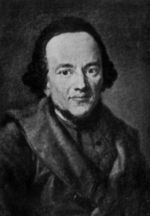
Moses Mendelssohn
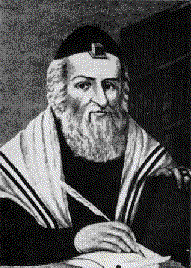
Elijah ben
Solomon Zalman
( the Vilna Gaon )

The Polish-Lithuanian
Commonwealth
at its greatest extent
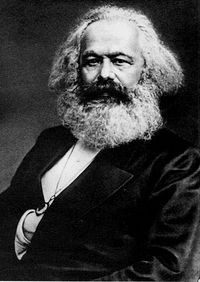
Karl Marx
________________________________________________________
The Zionist movement splits
________________________________________________________
Those most in danger from the growth of so-called
‘political antisemitism’were the more
traditionalist Jews of the East, the great majority (90%). We should not be
surprised, therefore, that support for the Zionist movement came especially
from the masses of the Russian and Polish Jews. But those who were in a
position to lead the movement were the assimilated upper class Jews in
Western Europe, people such as Theodore Herzl. The founder of the Zionist
movement worried especially about the Eastern European Jews, but he was an
exception, and the growing dispute between assimilated and Orthodox Jews
would pruduce a gash in the Zionist movement
separating the two sides. This was to be expected because everybody was
conscious that the future was being constructed, and those who militated for
modernizing assimilation did not want Orthodoxy in the Jewish future.
The first great seismic movement would come when
Chaim Weizmann and Theodore Herzl threw their weight in opposite directions,
each on his tectonic plate.
Weizmann vs.
Herzl/Jabotinsky
______________________________
“Chaim Weizmann was a member of the community of
young Russian Jews who had been locked out of universities in Russia because
of czarist numeri clausi
and had gone to Germany to study,” where the assimilationist movement among
‘educated’ Jews was strongest. Weizmann had joined the Zionist movement but,
influenced by the Russian socialists -- ‘modernizing’ Marxists with a fiercely
anti-religious ideology drenched in antisemitism --
allied with other Zionists of equal temperament, broke with Herzl, and split
the Zionist Organization, creating the so-called Democratic Faction. “Herzl,”
though not himself a religious Jew, “was worried about the potential
large-scale defection of Orthodox Russian Jewry from the Zionist cause in the
face of the Democratic Faction’s anti-religious agenda, [so he] hurriedly
organized a meeting of supportive Russian Zionists, both Orthodox and nonreligous, in Vilna in February, in 1902. A religious
Zionist party, Mizrachi, was formed at the meeting
as a counterweight to the Democratic Faction within the Zionist
Organization.” Soon this party gained the allegiance of many Zionists groups
all over Russia, something that Weizmann didn’t like at all, and which led
him to declare: “The rabbinical party is organizing itself in Jesuit fashion,
and I think of their machinations with disgust. Everything is vulgar and
foul.”[50]
When Herzl died in 1904, at age 44, Weizmann managed
to become the leader of the Zionist Organization because Max Nordau, Herzl’s
ally, refused to take the helm. This was a catastrophe. In line with his
Marxist ideology, Weizmann began working to purge the Zionist Organization of
anything that was “clerical, bourgeois, and conservative.”[51] He
wanted to import into Palestine only “an elite... uninfected with the dross
of Jewish bourgeois capitalism or traditional religiosity [in order to]
construct a Jewish socialist utopia in Eretz
Israel.”[51a] This left out
the Eastern European Jews who most needed a place of refuge, the majority,
and stood Herzl on his head. Weizmann was quite explicit in a letter he wrote
in 1918 that he didn't want any Eastern Jews in Palestine and worried that if
the Jews were forced out of Europe, “we shall have all the miserable refugees
who will be driven out of Poland, Galicia, Rumania, etc., at the doors of
Palestine. We shall be swamped in Palestine and shall never be able to set up
a community worth having there.” Later he would declare publicly that the
Jews of Europe, whom Herzl had founded the Zionist movement to save, were
“economic and moral dust in a cruel world.” He did not mean to save them:
“The old ones will pass; they will bear their fate or they will not... Only a
branch will survive” (his branch).[51b]
|
|
|
Is this article useful? Help us do
more with a donation . |
|
|
The leader of the rebellion against the policies of
Weizmann and his ally David Ben-Gurion was Vladimir Zeev
Jabotinsky. Jabotinsky
wanted to organize, under protection of an imperial power, and fast, the
immigration of many Jews to Palestine so that they could make them a majority
there and declare a state that would protect the Jews who were being attacked
with violent pogroms in Eastern and Central Europe. This was, precisely,
Theodore Herzl’s strategy. But Jabotinsky injected
a thoroughly military spirit. He had begun by organizing Jewish self-defense
forces among the Russian Jews so they would not be passive victims of the
pogroms. When WWI exploded, “he was convinced that Jews’ participation in the
armed struggle” -- a Jewish Legion contributing to the conquest of the Middle
East -- “would give them a claim to the spoils of war” after the victory, and
they would be able to build their state.[52]
“It took almost three years of single-minded effort on the part of Jabotinsky and much agitation on the part of others to
bring the Jewish Legion into being,” a force that rose to 5000 Jewish
soldiers.[53] But the
British rapidly disbanded the Jewish Legion when they created the British
Mandate and the Jews were once again without defense. When, with British
encouragement, the Arabs launched a wave of terrorism against the Jews in
1920, “Jabotinsky again
organized the Haganah self-defense forces
which, many years later, became the nucleus of the Israeli army.”[54]
Whereas Weizmann wanted, in his words, nothing more
than “a place where they [his Jews] formed an important part of the
population... however small this place might be. For example, something like
Monaco, with a university instead of a gambling-hall,”[62a]
condemning once a gain a handful of Jews to live without protection in antisemitic lands, Jabotinsky
wanted lots of Jewish immigration to Palestine, and fast, in order to acquire
as much land as possible and create there a militarily capable majority that
could declare a State.
Whereas Weizmann was a Marxist who rubbed shoulders
with, and waxed sycophantic towards, anti-Zionist millionaires whom he wanted
to include in an expanded Jewish Agency to help him develop Palestine, Jabotinsky was “unalterably opposed” to any such
ideological oxymoron, and though he much preferred the free market to
socialism, he “did not embrace capitalists -- especially the very rich --
without reservation,” the way Weizmann did.[62]
In historical context it is obvious that Jabotinsky was right about everything. In Palestine Hajj Amin al
Husseini, the local Arab leader, created by the British as a tool of
oppression against the Jews, was already
intimidating or murdering all opposition to him among the Arabs, leaving only
those who allied with his project of extermination. The Jewish immigrants who
escaped the Russian pogroms had merely come to the Palestinian pogroms. The
exile (Galut) had not ended. Without a policy
to create a true Jewish state with a Jewish majority, and a military self-defense
policy to confront the violence of Husseini, there would not be a long-term
solution. This was Jabotinsky's argument.
The Jewish Agency
___________________
The main problem for Jewish security was that
Weizmann and Co. were allied not with the Jewish people but with the British
elite. “The Jewish Agency, led by [David] Ben-Gurion, [Moshe] Sharett et al.,” had been created by the British,
in 1923. Ostensibly the British had done this to implement the mandate given
by the League of Nations: “to prepare a homeland for Jews in Palestine.”[55]
But “in reality, the Jewish Agency simply acted as an alter ego of the
Zionist Organization, coordinating most of its important policy decisions in
advance with London.”[56] The Jewish
Agency didn't have any authority that the British Government didn't choose
graciously to concede: “The Mandate authorities did not recognize the Jewish
Agency as having any governmental authority in Palestine, but the Agency was
widely viewed by the Jews of Palestine as their de facto government.”[56a] In
Perfidy,
Ben Hecht explains it like this:
“The British
government asked the leaders of Zionism to submit for British approval a
coterie of Jews who would be acceptable as chiefs of the new Jewish Agency.
The coterie was submitted and blessed with British sanction. Thereafter the
Jewish Agency became the Jewish face for the British rule of Palestine -- a
sort of caricature of authority to which Jews could give their loyalty... It
was not an elected body, but an appointed one. And just as it had been
established by British approval it could be dissolved by British disapproval...
[and] it remained unwavering in its loyalty to British policy.”[57]
What was this British policy to which the leadership
of the Jewish Agency would remain “unwavering in its loyalty”?
This British policy did not limit itself to
sabotaging the project of creating a Jewish state, creating for this
purpose the terrorist Hajj Amín al Husseini and assisting his attacks against innocent Jews in Palestine, then
using this violence as an argument to restrict Jewish immigration and reduce
radically the territory where Jews had a right to settle.[58]
Neither did this policy stop at forbidding entry to Palestine to any Jew who
didn’t possess the equivalent of £1000 ($5000), which closed the doors to the
impoverished Russian and Polish Jewish masses, many of them Orthodox.[59]
Beyond this, the British ruling class, allied with other European elites,
would set in motion a policy of so-called ‘appeasement’ that would allow
Hitler to take over the European continent practically without having to draw
his sword, producing a pan-continental right-wing coup that would lead to an anti-Jewish
genocide whose chief architect would be, precisely, the British creation Hajj
Amin al Husseini.[60]
And the British would assist this genocide, closing the doors of Palestine to
the desperate European Jews, and condemning the Hungarian Jews whom it could
have easily saved to die in Auschwitz, in addition to doing all sorts of
diplomacy to prevent, in general, the rescue of Jews.[61]
The loyalty of Weizmann and his allies to British policy would extend even to
cooperating with the destruction of Hungarian Jewry
the last point.
Jabotinsky's
Revisionists, by contrast, launched a passionate resistance against British
policies. Natually, the British wanted to be rid of
them, so Weizmann and Ben Gurion, always faithful
to their masters, launched one attack after another against Jabotinsky's movement. And so it came to pass, in the
same year of 1923 in which the British asked Weizmann to create the Jewish
Agency, that Jabotinsky “dramatically resigned not
only from his executive position, but from the Zionist Organization in a
dispute over Weizmann’s leadership.”[63] He
would later return to dispute the leadership of the Zionist Organization.
The Zionist
Organization
________________________
The Zionist Organization was a king of landless
State containing various parties that disputed among themselves the
government of the Organization; Zionist Jews all over the world, so long as
they contributed the symbolic shekel, had a right to vote, and the votes
decided the proportional representation of the various parties in the Zionist
Executive. One important party was the General Zionists, where “Faction ‘B,’
identified with Chaim Weizmann, worked closely with the Labor Zionists.”[66]
The main labor party was David Ben-Gurion's Mapai,
which began to dominate the entire political structure of the Zionist
Organization and he Jewish Agency in Palestine. The only Zionist parties that
consistently and doggedly opposed the policies of the Weizmann/Ben-Gurion/Mapai axis were Jabotinsky’s
Revisionist Party and the religious Mizrachi Party.
That Jabotinsky had the
right idea was demonstrated in the tremendous
terrorist wave of 1929, when it became clear that the
Zionist leaders in Palestine would not aggressively use the Haganah that Jabotinsky
had created to defend the Jews from Husseini's
attacks, and that they were giving in to the British policy that used that
violence -- which the British themselves encouraged -- to tell the League of
Nations that building a Jewish homeland was impractical. So, “from 1929 on, a
fundamental change occurred in the organizational structure of the Zionist
movement... [with a] consolidation of political parties,” with the
Revisionists on one side and the labor movement on the other.[64]
“...the schocking impact of the 1929 riots bestowed an advantage
on Jabotinsky’s militant opposition... [for] Jabotinsky could remind the voters of his previous
cautions that the Zionist leadership was leading the movement into a blind
alley, and the voters could see for themselves the truth of his statements.
As the leader of the fighting opposition, he was now at the height of his
renown, while Weizmann, the President of the Zionist movement, had been
obliged to resign.”[65]
From the beginning, Jabotinsky
had wanted his Revisionists to secede from the Zionist Organization and form
their own, but in spite of the Revisionist Party being his creation, and
himself a very popular leader, the majority of his followers wanted to stay
and dispute the leadership. At the 17th Zionist Congress, in 1931, Jabotinsky formulated a platform he called the ‘ultimate
objective’ which demanded that the Congress commit to the establishment of a
Jewish state, on both banks of the Jordan, with a Jewish majority. If the
Congress accepted this, he had won, “if not, then this was not a true Zionist
movement and the Revisionists would draw the appropriate conclusion and
secede.”[67]
In the elections that decided the proportional
representation of the deputies to the 1931 Congress, the Revisionists won 21%
of the vote, tripling their support -- a consequence of the blow to the Weizmann/Labor
Zionist prestige after the 1929 debacle. But Weizmann and his allies had much
support still. Because Jabotinsky had promised that
the Revisionists would leave the Zionist Organization if his ‘ultimate
objective’ were rejected, and because Weizamnn,
Ben-Gurion, and allies, despite the risks, preferred that they leave,
“Ben Gurion had summoned up all his persuasive powers to
prevent Mapai delegates from supporting [Jabotinsky’s] proposal. ...[then,] at the height of the
tension, a cable arrived from Palestine, sent by Eliyahu
Golomb and Saadia Shoshani, stating that the acceptance of the ‘ultimate
objective’ proposal could spark an Arab pogrom in Palestine. The timing of
the cable aroused suspicion, particularly among the Revisionists. However, it
helped sway the vacillators, and the proposal was rejected.”[68]
It was of course false that the Arab pogroms against
the Jews had anything to do with the policies of the Zionist Organization
(unless we should speak of the positive incentive for Arab pogroms in the
near-total inaction of the Jewish Agency when Arabs came to kill Jews). Hajj Amin al
Husseini wanted to exterminate Jews: period.
If 10,000 more came to Palestine, or 10,000 fewer, to him it was the same: he
wanted to kill them all. If they established a state or merely came to till
the land, it was the same: he would kill them all. So the only way to protect
the Jews was to follow Jabotinsky’s lead: create a
Jewish majority, and be well armed and prepared in order to defend from the
inevitable antisemitic attacks. But Mapai had defeated this option. “[Jabotinsky]
expressed his deep contempt for the Congress by the dramatic act of tearing
up his membership card after the vote, declaring: ‘This is not a Zionist
Congress.’” But his followers didn’t want to leave the Zionist Organization,
arguing that, since they had just tripled their support, they would soon have
control of the movement. At the same time that the Labor movement was
unifying, consolidating and organizing, the dispute over what to do divided
the Revisionists.[69]
There would be a high price to pay for this, for two
years later, in 1933, Adolf Hitler would rise to power in Germany, and the
Revisionists, despite their best intentions, would fail -- partly thanks to
their internal divisions -- to save the boycott movement against the Germans
that came within an inch of destroying Nazism. Mapai,
partly thanks to its superior organization, successfully sabotaged the
boycott and saved the Nazis (as we shall see). But Mapai
didn't do this all by itself -- the Jewish leaders in the United States and
Europe contributed enormously. These were for the most part assimilated Jews,
and in particular Reform Jews, so to round out the context we will cast a
look upon the main characteristics of the Reform movement.
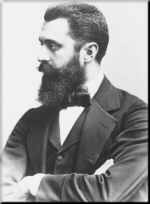
Theodore Herzl
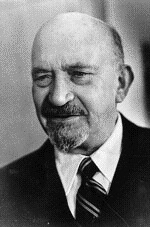
Chaim Weizmann
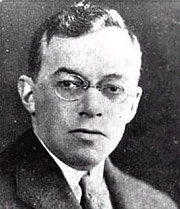
Vladimir Zeev
Jabotinsky
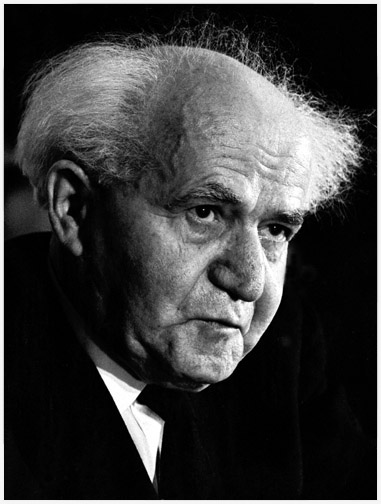
David Ben-Gurion
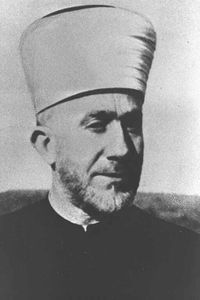
Hajj Amin al Husseini
________________________________________________________
Reform Judaism
________________________________________________________
The militant assimilationists wanted “to bring
Jewish religious practice more into conformity with Christian practice,” and
so they shoved the Talmud to one side and placed a greater emphasis “on the
Hebrew Bible, which is sacred to both faiths.” They also wanted “to reform
the book of prayer and to replace Hebrew with German,” and “sought to impose
on Jewish religious practice at least a superficial resemblance to Protestant
practice, with the expectation that this would make the Jews’ religion seem
less alien to their neighbors and thereby win Jewish acceptance.” They
represented all this as a way of “shedding the primitive and tainted for the
progressive and modern and good.” They were also in favor of “removing from
the liturgy all reference to Zion and Jerusalem and anything else that might
suggest Jewish nationhood” in conflict with patriotism toward the countries
they were living in.[70] Many
assimilated German Jews thought that “Jewish ethnic identity” -- the very
thing that made Jews a distinctive culture: their adherence to the system of
Talmudic laws -- “should be denied”; at the same time, however, they “saw
quintessential value in the tenets of Moses. These German Jews developed
Reform Judaism.”[71]
The consequences
of Reform Judaism
______________________________________
In 1922, in an article entitled ‘The Mission of
Reform Judaism,’ Samuel Cohon, a defender of this
movement, explained it like this:
“Reform
Judaism represents the latest phase in the evolution of Jewish religious
thought. It grew out of the post-Mendelssohnian
intellectual endeavor to adapt the historic faith of Judaism to the changed
conditions in Jewish life, following the French Revolution. Its pioneers,
Jacobson, etc., were called upon to fight apostasy on the one hand and rigid
orthodoxy on the other. Originating in Germany, the Reform Movement spread to
other West European countries, and found an especially congenial home in
democratic America. Its theology, as formulated by Abraham Geiger and his
followers, is based on reason and on the scientific study of the Bible,
Talmud, and Jewish tradition. Through its renewed emphasis on the ethical
side of life, Reform Judaism has added new vigor to the age-old religion of
Israel.”[72]
As we see in Samuel Cohon’s
defense, officially Reform Judaism was supposedly opposed not only to
orthodoxy but to apostasy. In other words, it represented itself as
the way to save Judaism: “Advocates of reform often argued against critics
that reform was necessary to retain Jews who found traditional Orthodoxy
incompatible with the demands of modernity and would otherwise be lost to the
community.”[73] But
obviously, there was something else, here. As Cohon
explains, Reform Judaism was a “post-Mendelssohnian
intellectual endeavor,” meaning that it was inspired and led by the maskilim who followed Moses Mendelssohn and who,
unlike him, didn’t feel any love for traditional Judaism. Max Lilienthal, for
example, the main maskil allied with
the Tsarist government to destroy Jewish orthodoxy in Russia, “emigrated to
the United States in 1845 and became a prominent Reform rabbi there.”[74]
“Certainly,” concedes another defender of Reform
Judaism, “some of the changes made Jewish life look more Christian: the organ
music, the new synagogue architecture, [and] the regular sermon.”[75]
The vestments of Reform rabbis also imitate the garb of Protestant pastors.
So in the superficial details as in the deeper questions -- such as the
removal of the Talmud -- Reform Judaism was going in the direction of
Protestant Christianity. Was this really the way to prevent apostasy
to Christianity? Or was this, more likely, an intermediate step that
facilitated conversion? The statistics speak for themselves: today more
than 50% of Jews raised in Reform Judaism marry gentiles, and in general
they do not educate their children in Judaism -- not even Reform Judaism.[76]
This trend could be seen from the very start: “even many of Reform Judaism’s
pioneers ultimately converted to Christianity.”[77]
Cohon
explains above that the theology of Reform Judaism was “formulated by Abraham
Geiger and his followers.” Certain aspects of Abraham Geiger’s ideology are
made clear by his reaction to what happened in 1840, when the medieval blood
libel -- the accusation that the Jews were supposedly in the habit of
stealing Christian children to torture them to death and perhaps eat them in
satanic rituals that celebrated the murder of Jesus -- was revived against
the Jews of Damascus, who were accused of murdering a Capuchin monk and his
Muslim servant to use their blood in their rites.
“A number of
prominent European Jews spoke out forcefully against the libel and several
joined a delegation to Egypt to bring their concerns to the authorities
there, as Damascus was then under the control of the Egyptian ruler Mohammed
Ali. Among the delegates were Moses Montefiore, a leading figure in British
Jewry, and the French Jewish statesman Adolph Cremiuex.
But Abraham Geiger, a key founder of Reform Judaism, was critical of the
delegation. Geiger declared: ‘For me it is more important that Jews be able
to work in Prussia as pharmacists or lawyers than that the entire Jewish
population of Asia and Africa be saved, although as a human being I
sympathize with them.’”[78]
Geiger worked very hard to demonstrate to the ruling
class in Prussia that he didn’t have any interests that could be interpreted
as pan-Jewish, going to the extreme of opposing an international effort to
defend the Damascene Jews from lies that had produced antisemitic
mass killings in the Middle Ages. The Jews in the Muslim world were Orthodox,
not reformed; Geiger did not care whether they were saved -- or at least
their very lives were less important to him than the freedom of a Prussian
Jew to open a pharmacy. One is entitled to wonder what this ‘sympathy’ was
that Geiger claimed to feel, “as a human being,” for the Jews of Asia and
Africa.
Reform Judaism in
the United States
____________________________________
As Cohon also explains,
Reform Judaism flourished especially in the United States, when many German
Jews immigrated there during the 19th c. The three most important Jewish
organizations in the US were the American Jewish Committee, B’nai B’rith, and
the American Jewish Congress, and the first two were vehicles for German
Reform Jewry.
“Both the
American Jewish Committee and B’nai B’rith were founded by well-to-do German
Jews with a special outlook. Like other European Jews, the Germans immigrated
en masse following the political upheavals of the mid-nineteenth century. But
unlike their East European counterparts, the Germans clung to their original
national identity [as Germans], and were economically more
established. Moreover, many German Jews believed they were so-called Hofjuden, or courtly Jews, and that coreligionists
from Poland and Russia were ‘uncivilized’ and embarrassing. The bias was best
summarized in a June 1894 German-American Jewish newspaper, the Hebrew
Standard, which declared that the totally acclimated American Jew is
closer to ‘Christian sentiment around him than to the Judaism of these
miserable darkened Hebrews.’”[79]
The Jewish multitudes that had immigrated from
Eastern Europe, resenting the prejudices of the hofjuden
in the American Jewish Committee and B’nai B’rith, formed the American Jewish
Congress in 1917. The next year WWI ended and a combined delegation of the
Committee and the Congress went to negotiate Jewish rights at Versailles,
“but the Committee leaders split off from other American Jewish groups...when
-- in the Committee view -- the proposed rights [for the European Jews!]
went ‘too far.’” A new map of Europe was being created at Versailles that
would supposedly create nationally homogenous states, guaranteeing the rights
of those minorities left stranded within the new ‘nation-states.’ Committee
leaders were opposed to the Zionist insistence that Jews be considered a national
minority with the right to its own state -- in Palestine. This was
consistent with the central purpose of the maskilim,
which was to abolish all representation of the Jewish people as a nation,
for what they frankly wanted to do was make the Jews disappear into the
Christians. But “American Jewish Congress leaders,” that is to say, the representatives
of the Jewish orthodox masses in the United States, “returned from Versailles
in triumph. They had helped create a Jewish homeland.”[80]
By the time Hitler took power in 1933, “the Congress
stood as the most representative and outspoken Jewish defense organization.
In contrast, B’nai B’rith functioned as little more than a fraternal order...
And the Committee, in 1933, basically represented the interests of about
three hundred and fifty prominent Jewish members.” In other words, the
democratic force representing the Jewish masses in the United States was the
American Jewish Congress, in the hearts of whose members,
“predominantly East Europeans” burned the love of Judaism. Comparatively
speaking, the Congress was not so well endowed, financially, despite its vast
membership, because the members were for the most part unwealthy
Jews, whereas “the Committee and B’nai B’rith -- which often acted as a
binary lobby -- were respected, influential, and adequately financed, with
access to the most powerful circles of American government and business.”[81]
The US experience repeated the German pattern: the
upper class maskilim Jews who opposed
Orthodox Judaism were assimilating to the American upper classes and
supported their policies. These were Jews whose process of assimilation in
Germany had already produced a German ethnic identity: they felt
themselves to be more German than Jewish, and they loved Germany more than
Judaism (many of them frankly despised Judaism). In the American upper
classes, at the time, the ideology of the biological superiority of the
Germans, eugenics, was immensely popular (the Anglo-Saxons were a
Germanic tribe, so they felt included), especially among those who held the reins
of industrial and government power.[82]
These American eugenicists would sponsor the growth of German eugenics,
especially after 1918, and it would become German Nazism.[82a]
For the German Jews who dominated the American Jewish Committee and B’nai
B’rith, their opposition to Orthodox Judaism, their identification with, and
assimilation to, the eugenicist Christian upper classes, and their primary
identity as Germans made it unlikely that they could oppose Adolf Hitler’s
regime in defense of the European Jews.
|
|
|
Is this article useful? Help us do
more with a donation . |
|
|
But the foregoing does not yet fully explain why
Hitler succeeded.
We must also explain why the American Jewish Congress, which was very good at
organizing big protests, and whose membership was full of Orthodox Jews who
wanted to fight Nazism, failed when the moment came to lead the 1933 boycott
against Germany that almost destroyed the Nazis. The main reason was this:
although the Congress represented especially Orthodox Jews who had emigrated
from Polish and Russian lands, the founder and leader of the organization,
Stephen S. Wise, was a Reform rabbi. There was a ‘spy’ at
the summit.
Reform Rabbi Stephen Wise
___________________________
When Stephen Wise is mentioned it is common to hear
that he was heavily involved in progressive causes such as the defense of the
rights of Jews, women, organized labor, and blacks. But Stephen Wise was also
quite close to radical eugenicist Woodrow Wilson, who pioneered New Jersey’s
state eugenics law and who was an ally of the Ku Klux Klan.[83]
Wise’s best friend was Louis Brandeis, an assimilated Jew who became Supreme
Court Justice and voted in favor of the eugenicist fraud that legalized
forced incarceration and sterilization for lower-class non-‘Aryans’ deemed
‘feebleminded’ in the US.[84] But the most
important point is that Wise would ally with Roosevelt’s policy, betraying
the Jews during the Holocaust -- and
with great energy, launching one attack after another against the Jews of the
Jabotinsky movement who wanted to save their
European brethren from slaughter.[85]
How to reconcile Wise's reputation as a defender of
the less fortunate with these other aspects of his career? We have seen that
there was a pnchant for strong contradictions among
militant assimilationist Jews: 1) they ingratiated themselves with the
Christian upper classes; 2) they adopted a project of modern and progressive
universal ethics; but 3) they absorbed and made theirs the worst antisemitic prejudices, in complete contradiction with
the modern liberal ethics they so proudly defended. Wise’s friendships with
powerful reactionaries followed from the first point. His efforts to defend
the weak, from the second. And his behavior towards the Jewish menace, from
the first and the third.
It was Wise’s very prestige as an advocate of the
weak, and as a Jewish leader, that made him so effective sabotaging the
defense of the Jewish people -- precisely what the US ruling class wanted. It
was confusing for many well-meaning gentiles who wanted to combat antisemitism when Stephen Wise -- the most
important Jewish leader in the United States, and with a reputation for
defending the oppressed -- told them that this was counterproductive or
unnecessary. Of course, given that Wise was president of the American Jewish
Congress, and given that this organization had the most members and also the
most militant, where even many of the top leaders wanted to fight Hitler, Wise
could not openly declare himself against defending the Jewish people. Which
is to say that Wise carefully balanced himself on a tightrope, for he needed
to maintain his leadership position in the antinazi
protest movement at the same time that he sabotaged it. But despite the
difficulties imposed by the structure of his situation, his was a dramatic
performance, and comparable to what Neville Chamberlain would later do: when
a boicot was about to destroy the Nazis in 1933,
Wise, who had it within his power to destroy Hitler, in fact saved the German
dictator and forsook the European Jews.
This will not surprise those who understand that
Stephen Wise's ideology was in fact that of Chaim Weizmann:
“Reform Rabbi
Stephen Wise, the undisputed leader of organized American Jewry, called
[Vladimir Zeev] Jabotinsky
a ‘traitor’ for preaching evacuation of over a million eastern
Jews. ...Furthermore, Wise claimed, the Jabotinsky
movement was guilty of bringing unselected, ‘unsuitable’ Jews to Palestine.
As the United Palestine Appeal’s director Henry Montor
[an ally of Wise] wrote, ‘No responsible person has ever said that Palestine
could hold all the millions of Jews who need shelter.’ Montor
condemned those who ignored the ‘need’ for selecting Jews ‘worthy’ of settling
in Palestine: ‘I think it is fair to point out that many who have been
brought into Palestine by the Revisionists [sic] have been prostitutes and
criminals.’”[85a]
Once Stephen Wise's ideology is understood, it is not
so difficult to explain his performance during the dramatic boicot that the Jews of all the world set in motion, with
their gentile allies, and supported by Jabotinsky's
revisionists, against Adolf Hitler's regime.
What has been documented up to here, then, is
sufficient context to understand why Chaim Weizmann, David Ben-Gurion, and
Stephen Wise sabotaged the aforementioned boicot,
saving Nazism. The story of the 20th c. has been written so tendentiously,
however, that few Jews are even aware that this boicot
-- a worldwide event -- even took place, much less are they aware of
how it was betrayed. That
story now follows, below.
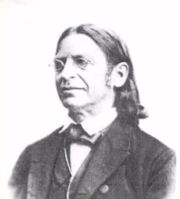
Abraham Geiger
( founding theologian of Reform Judaism )
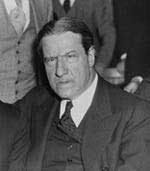
Rabbi Stephen Wise
________________________________________________________
1933: The Jewish boycott against the Nazis
________________________________________________________
In 1933 Hitler was first named interim chancellor.
Then he burned the Reichstag and blamed it on the leftists in order to
declare emergency powers with which to ‘protect’ Germany, he said, from an imminent
leftist revolution. With such powers he forbade everybody from any political
campaigning during the elections -- except the Nazis, who did it with the
support of the state, and deploying their paramilitary menace. Only thus, and
in the context of an anti-communist (and anti-Jewish) hysteria, in the middle
of a Great Depression that was especially acute in Germany due to the
policies of the Western powers, and with the support of other conservative
parties, was Hitler, just barely, able to produce a governing majority.
In that interval, after Hitler was named chancellor
but before the elections, the main American Jewish leaders got together to
discuss what they would do. Two representatives of the American Jewish
Congress, Stephen Wise’s organization (see section above on Reform Judaism),
wanted protests to show the Germans that there would be consequences if they
voted for Hitler’s party. But “the men of B’nai B’rith and the American Jewish
Committee rejected this,” and at that meeting it was decided that they would
wait and see what happened.[86]
There was hardly any need to wait. In the campaign
the Nazi stormtroopers were already attacking the
Jews. When the Central Verein (the biggest Jewish
organization in Germany) published a report of the antisemitic
attacks -- on the 5th of May, the day the elections were held -- and
predicted there would be more violence, the Nazis immediately consummated the
prophecy by sacking their offices. After counting the votes the Nazis took
control of all German institutions and “on March 8 and 9, Hitler’s Storm
Troopers smashed into the provinces and towns,” with “carefully orchestrated
anti-Jewish actions in Essen, Magdeburg, and Berlin.”[87]
Goering had met twice with the leaders of the
Central Verein to assure them that everything would
calm down, for the Nazis were quite worried of the American reaction. But
this American reaction was brewing already: on 12 March the American Jewish
Congress approved a program of protests and marches that would culminate in a
massive demonstration in Madison Square Garden on the 27th. One
vice-president of the Congress, Dr. Joseph Tenenbaum,
told the reporters that there would be a great boycott against Germany if the
violence against the Jews did not abate. With the speed of lightning, the
assimilated German Jews of the American Jewish Committee, with their
assimilated German Jewish allies in B’nai B’rith (see section above on Reform Judaism),
called a meeting of the three main Jewish organizations, stating their
categorical opposition to any protest, and especially to a boycott. What
would Stephen Wise do? He could not take the same position, quite, because
his own people -- overwhelmingly Eastern European (more traditional) Jews --
were demanding action, so he came as close as he could: he opposed a boycott
as such and said that his friend, Louis Brandeis, Supreme Court Judge, was advising
not to bother the new president Franklin Roosevelt (an acquaintance of
Wise’s) with this yet. Neither did Wise want a march, and he proposed timidly
instead that they sign a joint protest declaration, and no more. But a
crushing majority of his Congress voted for marching, and so the Congress
leaders were informed the next morning that “the Committee-B’nai B’rith
binary would dissociate itself from the Congress -- indeed from any organized
Jewish protest against Hitler.”[88]
I must emphasize the context. The dailies on both
sides of the Atlantic were reporting the atrocities against the German Jews,
and precisely during these dates, Hitler was approaching the climax when the
Reichstag would vote on the Enabling Act to give him absolute power within
the German Reich (the law was voted on March 23). A worried Goebbels wrote in
his diary: “The horrors propaganda abroad gives us much trouble.”[89]
Should the Nazis fail to employ the desperate Germans because their
anti-Jewish policies produced an international boycott, Hitler’s future would
be abolished. Therefore, the hurried reaction of the Committee and B’nai
B’rith leaders -- and within his limitations, of Stephen Wise -- was
benefiting Hitler. In fact, it was rescuing him, because his position
was quite fragile.
It was not just Stephen Wise and the leaders of the
Committee and B'nai B'rith. Wealthy Jews in the United States were in general
opposed to defending their European brethren. For example, Adolph Ochs, from
an assimilated German Jewish family, and maried to
Effie Wise, daughter of Rabbi Isaac Meyer Wise (important in American Reform
Judaism), was the owner of the New York Times. Early on, “[he] had
established a pattern of limiting discussion of the Nazi's depredation of the
Jews, [and] when, shortly after Hitler's ascension to power, the paper was
challenged to open its letter columns to the plight of Germany's Jews,
publisher Adolph Ochs refused. He explained that to do so would generate too
much mail and would require, under Times rules, that he give equal
space to the other side.”[89a] Poppycock.
Moral heroes are rarely the powerful, the rich, or
the strong, because heroism requires confronting the special interests that
keep these people in their positions -- they have a lot to lose. It should
not surprise us, therefore, that it was a tiny Jewish organization, closer to
the pulse of the masses, the Jewish War Veterans, that voted unanimously on
18 March to launch a national boycott of German goods and services. This was
the 'mouse that roared,' and from this point onwards an amazing confrontation
began between the Jewish masses and their leaders: ordinary Jews participated
with joyous energy, agitating and organizing to grow the boycott and destroy
Nazism, while their wealthy, established leaders made passionate efforts to
sabotage it all. The Jewish masses would come quite close to defeating
Hitler, but he got away by the skin of his teeth, thanks to the established
Jewish leaders. All of this is documentad with
great detail by Jewish historian Edwin Black in his monumental work: The
Transfer Agreement: The Dramatic Story of the Pact Between the Third Reich
and Jewish Palestine. I will rely mostly on his work.
A transatlantic
betrayal
_______________________
The Jewish War Veterans wanted to produce a fait accomplit and bring the rest of the Jews to join
their boycott declaration of 18 March. They had to convince Stephen Wise
because the people of the Congress, even the leaders, were almost all
agitating for a boycott -- only Wise, at the top, interposed himself. To
resist, Wise supported himself with what the Jewish leaders in Europe were
doing.
On 19 March “a group of European Jewish organizations
analogous to the American Jewish Committee and B’nai B’rith” -- which is to
say, steered by upper-class Jews who assimilated to the Christian ruling
classes, and quite distant from the Jewish masses -- called a conference in
Paris. What was their purpose? They “tried to stifle the growing protest
movement on the [European] Continent inspired by the American Jewish
Congress.” The Paris decision was unanimous against any protest, so the
“Committee people in New York could now tell the Congress that Jewish
organizations closest to the trouble in Europe agreed that there should be no
public agitation against Hitler.” People from the Committee rushed that night
to the emergency planning conference of the Congress to urge calm.”[89b]
They were not well received. On the contrary,
“[their] words of caution were emphatically rejected by the [Congress]
delegates who well knew that the Committee had become a megaphone -- via
friends and family relations [in Germany] -- for Nazi pressure on the
American anti-German protest movement.” The Congress membership cheered and
celebrated that it would confront the Nazis, and “J. George Freedman,
commander in chief of the Jewish War Veterans, ...proudly announced his
organization had already -- on its own initiative -- commenced the national
anti-Nazi boycott.” Joseph M. Proskauer, from the
Committee, turned livid and attacked the proposal saying that a boycott would
endanger the German Jews even more, which produced loud polyglot disapproval
in English, Yiddish, and Russian.[89c]
“Stephen Wise,” the reluctant leader of the excited
Congress, then “stepped in to avoid total humiliation for the Committee,”
promising that the protest declaration would be rewritten. And so, “through
Wise’s counsel, the Congress did not declare a boycott.” The tiny Jewish
War Veterans organization decided then and there that, despite the opposition
of Stephen Wise, they would organize the boycott themselves, and other
leaders of the American Jewish Congress attached themselves informally to the
effort.[90]
Wise was trying to contain an avalanche in his own
organization.
The leaders in
Palestine
________________________
Also on 19 March the swastikas were unfurled in the
German consulates in British Mandate Palestine. “Angry Tel Aviv Jews prepared
to storm the consulates and burn the new German flag. But Zionist leaders
were afraid to provoke the Nazis.” Why? According to Edwin Black, “lest
Berlin suddenly clamp down on Zionist organizing and fundraising activities
in Germany.”[90a] I find this
explanation strange and in any case insufficient.
Allow me to point out the following. The two main
leaders of the Jewish Agency -- David Ben-Gurion and Moshe Sharrett -- would later, in the 50s, launch themselves at
the head of the Israeli government against the elderly Malchiel
Greenwald, suing him for supposed slander in order to defend Rudolf Kastner of Greenwald’s charge that Kastner
had helped Adolf Eichmann butcher 800,000 Hungarian Jews. Why did Ben-Gurion
and Sharrett attack old Malchiel
Greenwald? Because, as was
demonstrated at the trial (which Greenwald won), David Ben-Gurion and Moshe Sharrett were implicated in Kastner’s
crime, just as their ally Chaim Weizmann, first president of Israel, was
implicated too.[91] It
is useful to keep in mind that the Labor Zionist leaders of the Jewish Agency
would go to these extremes of collaboration during the Holocaust when we try
to understand their resistance to any anti-Nazi protest in the year 1933 (see
the section above on the
split within the Zionist movement for an
explanation of the differences between Labor and Revisionist Zionism)..
It is important to keep in mind that the ideology of
these Labor Zionist leaders was not the ideology of the common Jew.
“[T]he Yishuv -- that is, the Jewish population of Palestine --
was not following the direction of the Zionist Organization leadership.
Despite official Zionist calls to abstain from anti-Nazi activities..., the
rank and file said no. As early as February 1933, Jewish newspapers in
Palestine began urging a boycott, and merchants in great numbers complied.”[92]
There was a clear parallel to the situation in the
United States. Not only because the American Jews were asking for a boicot that their leaders were resisting, but becasue their main leader, Stephen Wise, “was a
cornerstone activist in the American Zionist movement.”[93]
Wise led the General Zionist party, and his right-hand man Nahum Goldmann led the Radical Zionist Party. Both parties were
more or less aligned with the Mapai Party of Labor
Zionist leader David Ben-Gurion.
The Jewish masses
join the boycott
___________________________________
The pressure of the Jewish masses all over the world
for a boycott was actually tremendous. The Jews of Vilna, a city that in
those days was in Poland and populated predominantly by Poles and Jews,
organized a pro-boycott demonstration on 20 March. Astutely, because there
were lots of rumors that the Nazis were planning to attack Poland (Hitler had
hinted that he would occupy the Polish Corridor in order to give himself to
the German city of Danzig), the Jews of Vilna gave their anti-Nazi boycott a
strong flavor of Polish national defense. In this way they broadened their
appeal and produced a model of Jewish-Christian alliance that -- despite
widespread antisemitism (for the Catholic Polish
population was heavily antisemitic) -- could be
forged in the rest of Europe against the Nazis. This naturally contributed to
the prestige of the pro-boycott efforts of the Jewish War Veterans in New
York.[94]
But the leaders of the American Jewish Committee and
B’nai B’rith condemned the boycott excitement in the American Jewish Congress,
giving the US government all the political protection it needed to do
nothing, for these were “the influential and prominent leaders of the Jewish
community.”[95] Congress
leader Stephen Wise himself “assured the State Department that he would not
demand American diplomatic countermeasures until the department could verify
the atrocity reports.”[96] Verify what?
The antisemitic outrages were happening in broad
daylight. Wise was giving the antisemites who were
all over the State Department a way out. And they took it.
Undersecretary of State William Phillips, after his
interview with Wise, gave a press conference in which he announced:
“Following the
visit of Rabbi Stephen S. Wise, the Department has informed the American
Embassy at Berlin of the press report of mistreatment of Jews in Germany...
[and] the deep concern these reports are causing in this country. The
Department has instructed the Embassy to make...a complete report of the situation.”[97]
The words “following the visit of Rabbi Stephen S.
Wise” were perfectly unnecessary, and they do not seem innocent to me. To
some these words communicated that the “deep concern” was certainly not being
felt in the US government. To others, influenced by the propaganda of the
worldwide antisemitic movement, which accused ‘the
Jews’ of being a powerful and nefarious influence that controlled the US
government behind the scenes, it seemingly confirmed that their antisemitic fantasy was real. And what would the State
Department’s ‘report’ consist of? “In truth, no investigation took place.”
Secretary of State Cordell Hull simply asked his chargé d’affaires in Berlin, George A. Gordon, “for an
encouraging report -- justified or not -- to soothe angry Jewish
groups.”[98]
“‘We are
under heavy pressure to make representations on their [the Jews’] behalf to
the German government,’ [said Hull to Gordon]. Hull added that he didn’t want
to make any such protests, but if some assuasive statement [suggesting that
things were not so bad in Germany, and getting better] could be issued to the
press, it might help cancel the ‘monster mass meeting’ Wise [that is to say,
the American Jewish Congress] had scheduled for March 27.”[99]
Gordon communicated to Hull what was really going
on: that soon the Jews would be expelled from the professions, that the
denials from the Nazis that they were oppressing the Jews were “absurd,” and
that the denials coming from Jewish groups had almost certainly been coerced.
With perfect cynicism, Gordon suggested to Hull that he back himself up,
anyway, with the coerced denials of the German Jews, and with the phony Nazi
denials, when he told the American public that nothing much was going on. He
also gave Hull the material that he needed. Beyond this, Gordon “held
meetings with several of his counterparts in the Berlin diplomatic community,
obtaining a consensus against any efforts in their countries to use
diplomatic channels as a medium of protest against Adolf Hitler.”[100]
Ordinary Jews then struck another blow: the Jewish
War Veterans staged a protest march on 23 March in New York, at the same time
that the Reichstag was conferring absolute power on Adolf Hitler. The
march was a staggering success. Many important figures joined the effort,
and the response of the masses was electrifying.
“In
solidarity, W.W. Cohen, vice-president of the American Jewish Congress,
accepted the position of parade marshal. He participated at his own
initiative, since Stephen Wise was still reluctant to commit the Congress to
a boycott per se... [But] Cohen’s visibility nevertheless associated the
powerful Congress with the JWV’s banners and placards declaring economic war
with Germany.”[101]
The boycott kick-off generated lots of press and
recruited the support of many Jews and non-Jews, igniting also the enthusiasm
of prominent people. Worldwide excitement recalled the outraged reaction 35
years earlier to the slanderous accusations against Alfred Dreyfus (a Jewish
officer in the French Army falsely accused of treason), and the more recent
reaction that had defeated Henry Ford’s antisemitic
propaganda campaign with a Jewish-led boycott against Ford Motor Co.[102] In
Warsaw there was much discussion about whether Poland should join the boycott
of the Vilna Jews and the Jewish War Veterans in New York. “Boycott movements
were also fast developing in Lithuania, France, Holland, Great Britain, and
Egypt.” Immediate results could be seen against the German steamship lines in
New York, and the British trade unions and leaders of the Labor Party were
covering London with signs that read: BOYCOTT GERMAN GOODS. Several firms
were canceling already their German orders. The next day, 24 March,
pro-boycott signs could already be seen in London’s exclusive areas.[103]
The Nazi reaction
_________________
The Germans were quite worried, and Goering summoned
to his office the leaders of the three main German Jewish organizations. The
Zionists were not invited, according to Black because the Nazis hated the
Zionists. But the Nazis hated all Jews. I find more logical another reason
that Black also provides: “In 1933...Zionism in Germany was a mere Jewish
fringe movement.”[104] In other
words, the Nazis didn’t think that the Zionists had much influence. In any
case the Zionists quickly mobilized and managed to secure an invitation for
Kurt Blumenfeld, the president of the German
Zionist Federation.
Goering kept them standing and accused them of being
responsible for all the agitation against Germany. He threatened them,
saying: “Unless you put a stop to these libelous accusations immediately, I
shall no longer be able to vouch for the safety of the German Jews.” Like a
typical Nazi, Goering had unwittingly satirized himself: if you keep saying
that we attack the Jews, we'll attack the Jews. Goering wanted them to go to
London and the US to convince the Jewish leaders that nothing was going on. Brodnitz, from the Central Verein,
didn’t dare say that, in fact, “his vice-president Ernest Wallach was already
in the United States trying to dissuade the [American Jewish] Congress.”[105]
The Zionist Blumenfeld then declared that they had
a worldwide organization and therefore could influence things. The link was
obvious because Stephen Wise, leader of the American Jewish Congress, was a
very important Zionist leader in the US, founder of the American Federation
of Zionists in 1897, and had been named the year after that the US secretary
of the world Zionist movement.[106]
“Once uttered,
the words forever changed the relationship between the Nazis and the
Zionists. It was suddenly clear that the Jewish group the Reich had been
ignoring was, in fact, the one it should be negotiating with in its efforts
to combat the Jewish presence in Germany. After all, both Nazis and Zionists
agreed that Jews did not belong in Germany.”[107]
After the meeting, Blumenfeld
and the other three carried out Goering’s orders, immediately mobilizing
their organizations to inundate Great Britain and the United States with
denials of the reports of mistreatment of Jews. They traveled to London and,
from there, the very morning of March 27, spoke to Wise and begged him to
cancel the demonstration that was planned for that day in Madison Square
Garden.[108] Ernest
Wallach from the Central Verein, when he learned of
Goering’s order, also begged Stephen Wise that if he could not cancel the
demonstration he should at least try to quiet down the emotions.[109]
Goering’s envoys were not fooling anybody: Bernard
Deutsch, president of the American Jewish Congress, declared the effort to
convince them that nothing was going on “pitifully unconvincing” and Wise
(who was the ‘honorary’ president but all the same the real leader) couldn't
disagree. The patriotic Jewish pressure on Wise was very strong, and so
neither could he cancel the 27 March demonstration, even though the leaders
of the other two important Jewish organizations pressured and attacked him,
and even though Secretary of State Cordell Hull was feeding him false reports
that everything was improving in Germany.[110]
What Wise could do, however, within limits,
was quiet down the emotions, like Ernest Wallach was asking him to do.
The Madison Square Garden demonstration was an
amazing, monster success. In the climax speech, Wise defended the
protest event he was presiding and condemned the mistreatment of Jews in
Germany, for he could hardly do otherwise. But Wise, whose excessive
histrionics were quite famous, “surprised many by discarding some of the
dramatic techniques he often employed,” and “at first he [even] spoke in
conciliatory tones.” He neither ridiculed nor threatened the Nazis, as the speakers
before him had done, and he did not mention the word ‘boycott.’ In
fact, “No direct word about a boycott against Germany was actually mentioned
at Madison Square Garden. Neither was the budding Jewish War Veteran’s boycott or the Polish boycott encouraged at the
rally, even though it was an opportunity to expand those movements vastly. The
decision was Stephen Wise’s.” And why that decision? Because Wise first
wanted to see what the State Department would do, says Edwin Black. That’s
what Wise said, but to repeat his explanation as if it were obviously true,
with zero comment, strikes me as uncritical. Wise was very well
informed and equally well connected, so he simply had to understand that he
had already guaranteed the total inaction of the US diplomats.[111]
In spite of Wise, the ant-Nazi boycott began to
surge with great enthusiasm, and days after the boycott declaration the
Jewish War Veterans could already show $2 million in canceled German orders. The
Nazis, very worried, reacted like Nazis: coinciding with the New York
demonstration, they announced a retaliatory boycott against the German Jews
that would begin 1 April unless the campaign against Germany ceased.
Naturally, the Nazi enthusiasts in the ranks just couldn’t wait, so there
immediately began a fever of unofficial boycotts and expulsions against the
German Jews right after the announcement. This is something the Nazis were
going to do anyway, but they weren’t planning to start in 1933: the worldwide
reaction had precipitated things for Hitler.[112]
This worldwide reaction, I emphasize, came from
the Jewish people, and their allies in the Gentile (non-Jewish) populations.
They did not have the support of the main Jewish leaders, and neither could
they count with the Western gvernments.
Adolf Hitler
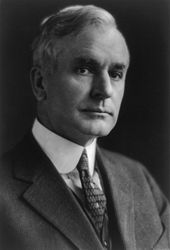
Cordell Hull
( US Secretary of State )
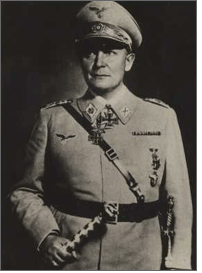
Hermann Goering
________________________________________________________
Rushing to satisfy Hitler
________________________________________________________
At that time, Hitler’s cabinet had a majority of
non-Nazi members and they were all opposed to the boycott against the Jews,
because already by 29 March it was obvious that Hitler’s retaliation against
the German Jews was becoming the oxygen, in big gaping mouthfuls, of the
anti-Nazi combustion all over the world, growing the boycott that threatened
to destroy the Third Reich’s economy (let’s not forget that the world was
trying to recover from the Great Depression -- this was the worst possible
time to be the victim of a boycott). And, anyway, to boycott the German Jews
was for the Nazis to shoot themselves in their jackboots because the Jews
played an important role in the German economy, and many ‘Aryans’ whom the
Nazi Party had promised to employ ended up jobless when the Jewish businesses
went broke.[113] Germany could
not win this fight. But Hitler never made decisions
because they were good for Germany.
The people around
Hitler beg him to desist
__________________________________________
Hitler promised that his boycott would take place
with discipline, and without violence.[114] An
empty promise, because nobody really could contain the Nazi masses: a bloody
pogrom was in the offing that would confirm all the accusations people were
making abroad.
“A Leipzig
newspaper had already warned Jews against defiance or provocative
self-defense. ‘Should a shot be fired at our beloved leader, all Jews in
Germany would immediately be put against the wall, and bloodshed would result
which, in its ghastliness, will exceed anything the world has ever seen.’”[115]
The internal pressure on Hitler was growing. In his
cabinet, only Frick, the Interior Minister, and Goering were in favor of the
anti-Jewish boycott. By 30 March even a rabid Nazi such as Hjalmar Schacht was insisting with his führer that it had to be canceled. “The
Justice Ministry warned that the boycott was patently illegal and that the
courts might enjoin the entire affair.” The Foreign Minister, Konstantin von Neurath, was especially preoccupied and recruited
President Hindenburg to exert some pressure on Hitler. When he saw that he
could not convince him, Neurath presented his
resignation, which meant Hindenburg would probably also resign, bringing down
the entire government.[115a]
|
|
|
Is this article useful? Help us do
more with a donation . |
|
|
This finally forced Hitler to ‘compromise’: if in
the next 12 hours the Jewish leaders abroad and the Western governments
publicly declared that they would not participate in an anti-Nazi boycott, he
said, he would cancel his own boycott against the German Jews. In reality
Hitler had conceded nothing: from the beginning he had said that he would
launch his anti-Jewish boycott if the agitation against him continued; now he
was saying that he would cancel his boycott only if the agitation against him
ceased. Can you spot the difference? But it worked. Neurath
withdrew his resignation and promised to obtain the declarations that his führer demanded.[116]
The Western
governments mobilize to save Hitler
________________________________________________
At the same time, the leaders of the US State
Department were communicating with their German counterparts, saying to them:
“it is not the purpose of this government to interfere...in the domestic
concern[s] of Germany.”[117] Translation: the US
government was not opposed to the anti-Jewish attacks but wanted to save
Nazism from the effects of its own policies. The British government, though
it was being pressured by the House of Commons and the public, also
communicated that it didn’t wish to intervene against the Nazis.[118]
The German Hans Dieckoff
then told US chargé d’affaires George Gordon
of his führer’s ‘new’ ultimatum; Gordon
recommended to Cordell Hull that he quickly make the declaration Hitler was
demanding. At the same time, “German officials were telephoning their
embassies in London, Washington, and Paris, urging similar declarations from
Jewish leaders as well as the governments of England and France.”[119]
The Western governments were walking a tightrope, for they “struggled to
compose public statements that would not outrage their citizenry and yet
satisfy Hitler” -- a difficult feat because the Western publics were getting
angrier and angrier, and they were organizing ever more effectively to
destroy the Nazis.[120]
The Western
governments comply with
Hitler's ultimatum
_________________
When it became known that Hitler was demanding
formal declarations from Jewish leaders against the anti-Nazi boycott,
“Berlin Zionists sent an urgent telegram to the Zionist Organization in
London asking for such a proclamation. The cable reached Rosenbluth,
Lichteim and Tietz [the
Zionist Jews Goering had sent to London] about midnight on March 30.”[139]
Prodded by Chaim Weizmann, these people succeeded in getting Lord Reading --
a prominent Jew who had been making much noise against Germany in the House
of Commons -- and Lord Herbert Samuel, also Jewish, to make a joint
declaration saying that “we deprecate exaggerated reports of occurrences [in
Germany] or any attempts to boycott German goods.” Following this the British
Foreign Minister John Simon gave the German ambassador a letter supporting
that declaration.[140] The British
government, and Jewish leaders in Britain, had complied with Hitler’s
ultimatum.
(Lord Herbert Samuel was a Jewish member of the
British aristocracy (he even became Viscount) who in 1921 had been High Commissioner
for Palestine, which is to say British ruler of Palestine. On Winston
Churchill’s orders, who was then Colonial Secretary, Samuel had elevated Hajj
Amin al Husseini to the post of Mufti of Jerusalem after Husseini
demonstrated that he could organize massive terrorist waves against innocent
Jews.[141] Edwin Black
explains that Samuel was “a great friend of the Zionist movement,” which
really means that he was a Weizmann and Mapai
sympathizer.)
Goering’s Zionist envoys also “dispatched cables to
Stephen Wise and the Jewish Agency in Jerusalem, instructing them to notify
Adolf Hitler formally that no anti-German boycott would be organized.” They
did this in the name of the Executive Committee of the Zionist Organization,
but without consulting that body. When the Zionist Executive realized what
had happened it sent a message to the Jewish Agency that it should wait a
bit, but by then the message had been sent. The newspapers in Palestine
published what the Jewish Agency had done, and this “changed the nature of
the boycott in Palestine. It quickly became a grass-roots trend spreading in
spite of Zionist leadership. Hence, it was no different from the
boycott in America and many other countries. People wanted to boycott and
fight. Leaders refused.”[142]
In the United States Stephen Wise did not denounce
the boycott but he did not support it either. He kept silent. Edwin Black
interprets this as an anti-Nazi posture: Wise refused to pronounce the
capitulation Hitler had demanded in his ultimatum. But it was politically
impossible for Wise to produce such a declaration, because he was leading an
American Jewish organization whose members, the most numerous, were also
those most eager to confront Hitler. In this context, Wise’s behavior can
once again be interpreted as a sabotage of Jewish self-defense that went as
far as the structure of his political situation allowed. The bulk of the
evidence will allow us to decide, later, which interpretation is more
reasonable.
The leaders of the American Jewish Committee were
not under such pressure from their members, and they quickly declared
themselves against the anti-Nazi boycott. The president of that organization,
Cyrus Adler, said on 31 March, right on time to satisfy Hitler’s ultimatum,
that “The American Jewish Committee, of which I am president, has taken no
part in protest meetings. No responsible body in America has suggested
boycott. We have been and are doing all in our power to allay agitation.”
Soon the German embassy was communicating to Neurath
in Berlin that American Jewry had complied.[143]
But even though he was being given precisely what he
had demanded, to Neurath’s astonishment Hitler
refused to cancel the anti-Jewish boycott.
At the eleventh hour came the declaration that the
United States government planned to publish the next morning, which
declaration 1) asserted that the accusations against Germany had been
“exaggerated,” 2) condemned the incipient boycott, and 3) affirmed that “by
showing a spirit of moderation ourselves [refraining from an anti-Nazi
boycott] we are likely to induce a spirit of moderation elsewhere [we can
convince the Nazis to cancel their anti-Jewish boycott].” So now Roosevelt
had also complied with Hitler’s ultimatum. The US government didn’t want to
be embarrassed, so it explained that the publication of this statement was
conditional on Germany’s own promise to cancel the anti-Jewish boycott.
Hindenburg was recruited to pressure Hitler and this time a change was
forthcoming. However, to protect his prestige with the Nazi troops salivating
already with the prospect of hurling themselves on the Jews, Hitler did not
cancel his boycott but instead proposed a brief moratorium: if by 5 April he
could see that the agitation against the Third Reich had significantly
diminished, then he would dissolve the boycott. “However, the drive to expel
Jews from their professions and destroy their place in German society would
begin at once.”[144]
In the end there wasn’t even a moratorium. What the
Nazis did a few hours later was announce that the boycott would limit itself
to 1 April, and they promised it would take place without violence. (From the
point of view of American popular culture, April 1st was an appropriate date
for such Nazi promises, for on this date Americans by tradition pull the most
spectacular hoaxes on each other and then have a good laugh, so you are never
supposed to believe anything that people say on April 1st.) Since the boycott
had not been cancelled, the American and British governments were unable to
publish their statements, but in any case, the US government, abasing itself
before the Nazis, apologized in case the problem had been their own delay!
On the official boycott day, April 1st, there was
plenty of violence.[145]
________________________________________________________
Rushing to save Hitler
________________________________________________________
At the same time that all of the above was happening,
the Labor Zionists launched another strategy. They understood that without
the Nazi pressure the German Jews would never go to the Middle East because they
were not Zionists. They saw an opportunity, therefore, in the Nazi
persecution.
The plan
_________
For the Labor Zionists, Edwin Black explains, “in a
macabre sense, things were ideal [because] the German Jews were not
impoverished Russian peasants [who tended to be Orthodox] or lower-class
Polish merchants with few valuables [and who also tended to be Orthodox]”[121]
The German Jews had abandoned Judaism and had much wealth that could be used
to develop Palestine. There was also a confluence of interest with the Nazis,
because they were looking to rid themselves of the German Jews and to them
Palestine was “a remote, self-run concentration camp,”[122]
Such harmony!
For the Labor Zionists the thing to do was obviously
to save Hitler by sabotaging the anti-Nazi boycott and thus gain a position
from which to negotiate with the Nazis the exit of the German Jews to
Palestine And so those who considered the Nazi persecution “in a macabre
sense...ideal” set to work and “immediately contacted Zionist leader Chaim
Weizmann.” The next day, 30 April, Weizmann was already “talking with wealthy
British Jews, including Anthony Rothschild, Lord Reading, Lord Sieff of the Marks and Spencer department stores, and Pinchas Rutenberg,” speeding
off to Palestine right after that. Great things were in the air. “His secret
plans included meetings with Arab, British, and Zionist leaders to discuss a
solution on a vast scale.”[123]
“German Zionism as a movement...considered itself
Weizmann disciples,”[124] and it was
precisely a group of prominent German Zionist immigrants to Palestine,
associated with Georg Landauer, the director of the
Zionist Federation of Germany in Berlin, who set in motion the most ambitious
plan to save Hitler.[125] The proposal
to the Nazis would be to sabotage the boycott in exchange for letting the
German Jews leave with the minimum the British required to enter the Mandate
territory (£1000), using the rest to buy German goods needed in Palestine.[126]
Nobody would ask the German Jews what they wanted to do with their lives:
“Jews would be allowed to bring [some of their] assets out of Germany to
rebuild their lives, but only if they liquidated their European existence and
rebuilt those lives in Palestine.”[127]
Weizmann’s Zionists could hardly pull anything like this off without the
Nazis.
Sam Cohen, a wealthy Jewish financier who
“maintained apartments and hotel rooms” in Berlin, Prague, Tel Aviv, Vienna,
Warsaw, and London, but whose permanent address was “an opulent castle in
Luxembourg,” and who had a company, Hanotaiah, with
agricultural developments in Palestine, was selected to negotiate with the
Nazis.[128] Because Cohen
was not part of the Zionist government, it could be denied that the Zionist
Organization was involved in his activities if these were discovered by the
patriotic Jews leading the antinazi boycott
movement. Cohen was was a friend of Nahum Goldmann, Stephen Wise’s right-hand man in the American
Jewish Congress and the World Jewish Congress, and he had financed an
important project of his.[128a]
Cohen's plan was the following: let every German Jew
who wishes to go to Palestine take the £1000 entry requirement; the rest of
his money will go, in part, directly to the German Treasury, while the
remainder will stay in a blocked account that will be used to buy German
goods with which to develop Palestine (Sam Cohen was no fool: his company
would have control over the monies of the German Jews). The Zionists would
also commit to stimulate German commerce in the Middle East, thus generating
foreign currency earnings for the Third Reich. Finally, the Zionists would
launch an internal political effort in the Jewish community to destroy the
boycott movement. The Nazis were receptive to Cohen’s proposals, which were
presented at the end of March.[129]
This plan demonstrates that Weizmann, the Marxist, was not really opposed to
rich capitalists, nor was he opposed to importing bourgeois Jews to
Palestine, so long as these were assimilated German Jews (among whom
Weizmann had educated himself) whose money he would take so that they would
have no choice but to join his Marxist experiment in Palestine.
Once the negotiations had begun, the German Zionists
who had set in motion all this recruited Chaim Arlosoroff,
“a member of the Jewish Agency Executive Committee [in Palestine] and one of
Zionism’s most respected personalities,” and this man began to take matters
into his own hands, with great secrecy.[130]
Just like Chaim Weizmann, with whom he was close friends, Chaim Arlosoroff was an assimilated Russian Jew who had
educated himself in Germany. “As head of the political department of the
Jewish Agency, [he] functioned as the foreign minister” and “stood out as one
of the troika leading the Jewish Agency.”[131]
Naturally Arlosoroff was a leader of Mapai and an ally of David Ben-Gurion, another member of
that troika. With great energy, Arlosoroff set in
motion the effort to wrest from Sam Cohen his lucrative transfer monopoly for
Mapai and the Zionist Executive's benefit.
Chaim Arlosoroff's
negotiations would produce a tremendous confrontation between the two main
Zionist movements.
Jabotinsky vs. Weizmann/Ben-Gurion
_____________________________________
Edwin Black explains that
“Mapai, or Labor Zionism, saw Palestine as the home of a
Jewish elite that would toil in the noble vocations of manual work and
farming. Its orientation was communal, socialist. ...Mapai’s
Israel would not be for every Jew... [but] for the approved cadre of
pioneers.”[132]
In other words, a group of Marxist pioneers,
assimilated to Christian culture, and enemies of the Jewish religion, who
would acquire, with glacial incrementalism,
territory in Palestine. This had nothing whatever to do with saving ordinary
flesh-and-blood Jews in Eastern Europe whose lives were in danger; on the
contrary, this was a utopian project to construct an 'ideal' society, and in marxist utopias the abstraction is always more important
than the flesh-and-blood people who are repeatedly and easily sacrificed for
the 'good' of the utopian vision. The main promoter of this vision was the Mapai Party, and “the entire leadership of the Zionist
Organization...was becoming increasingly Mapai-dominated.”[133]
By contrast, the leaders of the minority Revisionist
Party were energetically militating for a defense of the Jewish people -- all
Jews, without distinction: “Revisionist Zionism rejected Jewish
exclusivity. They wanted a nation of ordinary Jews in a mixed urban-rural
society. The system would be free enterprise, not socialism.” Revisionists
did not want a slow process of immigration for a handful of elite Marxists,
but rather, in the tradition of Theodore Herzl and Max Nordau, they maintained
that “only by rapidly transferring the largest number of Jews in the shortest
amount of time would the Jews constitute a sudden majority in Palestine that
could declare the State.” They wanted to save the entire European Jewish
population, not just the German Jews, and therefore wished to confront Hitler
with a worldwide boycott and destroy Nazism, dealing the world antisemitic movement, which was now being directed from
Germany, a mortal blow.[134]
“Their ranks
were composed largely of East European Jews, especially Polish [and
Lithuanian] Jews. What Revisionists did around the world was often a direct
reflection of Jewish activism in Poland. Naturally, Revisionists in Palestine
agitated for an emotional, often violent, boycott of anything German.”[137]
Given that Arlosoroff
directed Mapai's effort to sabotage the boycott
against the Nazis so that he could bring just a handful of German Jews to
Weizmann's marxist experiment in Palestine, “Arlosoroff,” naturally, “was a special foe of
Revisionism.” In fact, “it was Arlosoroff who in
late 1931 conceived the decree against membership in Jabotinsky’s
Revisionist Union.”[135]
The Revisionists would try hard to foil Arlosoroff's plans.
“Since mainstream Zionist officials refused to
confront Hitler and insisted on continuing mutual trade, it was only logical
that the Revisionists would assume the vanguard of protest.” In late March,
in reaction to the policy that the mainstream Zionist leaders were adopting
toward the Hitler threat, Jabotinsky began plotting
a takeover of the Zionist Organization at the 18th Zionist Congress that was
scheduled to take place in Prague in August-September 1933. But there was so
much division among Revisionist leaders as to what the best course of action
would be that “Jabotinsky, [who] knew that the rank
and file was with him... dissolved the entire Revisionist leadership
structure, declaring he would lead by personal fiat.” The center of the strategy
would be, of course, the boycott.[138]
Hjalmar Schacht
Herbert Samuel
________________________________________________________
Destroying the Boycott
________________________________________________________
Perhaps the most incredible thing here, once you
examine the behavior of established Jewish leaders in various parts of the
world, is the context that surrounded their actions: the boycott was
working and the Nazis had almost been destroyed already. Had the
established Jewish leaders simply endorsed the boycott they would have
undoubtedly destroyed Nazism, and then perhaps also the worldwide antisemitic movement, covering themselves in glory by
inheriting to us a very different world. But this is not what they did.
What is narrated below is in some ways like a
suspense and horror film where the victim, the Jewish population in Europe,
is at several turns almost (and easily) rescued, but each time the bad
guys who wish to kill her win, by an inch, and at the last moment.
April: The boycott grows
________________________
It was the War of the Boycotts. In retaliation for the
anti-German boycott the Nazis were boycotting the German Jews, and this, plus
the expulsion of the Jews from the professions, produced a flood of Jewish
refugees in the countries that bordered Germany. “Within two weeks of April
First, more than 10,000 German Jews had escaped and were now in need of food,
clothing, organization, jobs -- a basis for existence.”[146]
This all fanned the cinders of the international protest, igniting the
movement’s fire in the first two weeks of April.
The first week there were massive protests and/or
agitation in favor of boycotting the Nazis in Paris, Istanbul, Toronto,
Salonika, Panama, Bombay, and New York. In Poland the anti-German boycott
even included street violence.[147] On
7 April Nazi Finance Minister Hjalmar Schacht was
already informing his führer that, due to
the boycott, Germany’s reserves of foreign currency would soon run out.[148] On
the 10 there was a controversy in the House of Commons because the British
government was trying to suppress the boycott, which, supported by the Labor
Party, continued to grow. On the 13 the Rumanian Jews joined the
semi-official boycott that already existed in that country. On the 17th the
boycott of the Jewish businessmen against the German fur trade extended to
Belgium. By the 19th the Yugoslav boycott against the Nazis was doing so much
damage that Nazi agents in Yugoslavia tried to launch a boycott against the
Jews in that country -- without success.[149]
By mid-April Great Britain had already displaced
Germany as the main exporter of goods to Denmark and Norway; Reich sales to
Finland had fallen considerably; many stores in the United States couldn’t
move their German merchandise and were looking for alternative suppliers in
Japan, Czechoslovakia, and England. Total Reich exports had fallen 10% and it
was obvious that May would be disastrous. Food prices in Berlin were
skyrocketing.[150]
In Palestine, the boycott against Germany that the
Revisionist Party was pushing was also quite effective in the month of April.
“Doar HaYom, the
Revisionist newspaper in Palestine, and Betar, the
paramilitary Revisionist youth corps, were relentless. Tactics included
public humiliation of businessmen trafficking in German goods, mass
recruitment of boycott pledges from merchants, picket lines, disruptive
demonstrations, and incessant editorials condemning those who traded with
Hitler. Many thousands of dollars’ worth of German orders were canceled in
Tel Aviv and Jerusalem in the first days of April alone. ...By mid-April
[German] Consul Heinrich Wolff [in Palestine] was dismally reporting that the
boycott was seriously damaging all German economic interests in the area.”[151]
The severe pressure on Germany was not just
economic. On 7 April Neurath was explaining to
Hitler the gravity of the political and military situation: “various
neighbors were actively contemplating a preventive war with Germany while she
was still weak... Foremost among the potential invaders was Poland... Other
neighbors to the East -- Rumania, Yugoslavia, Hungary, Czechoslovakia --
would have to be kept on friendly terms, principally through trade, to
preclude any anti-German alliance with Poland.” Neurath
was also worried about France. The military capacity of the Germans was nil
at the moment: they were five years away from being able to confront Poland,
even.[152] But Hitler
would not reason: on the same April 7 “Hitler promulgated the first formal antisemitic decree, summarily dismissing virtually all
Jewish government employees.”[153]
A little later, on April 22, the German embassy in
Italy was reporting to Berlin that the Czechoslovaks were planning to join
the Poles in a preventive, invasive war against Germany. On April 23 the
German ambassador in Poland was informing that the probability of a Polish
attack was relatively high. On 25 April the German embassy in Czechoslovakia
confirmed that this country would join a Polish attack against Germany.[154]
The next day the British embassy in Berlin was explaining that the pressure
on Germany might soon break the lock that the Nazis had on German politics.
And because the problems caused by Nazi policy were raising the prestige of
Hitler’s domestic enemies, everybody was getting the picture that “protest
and boycott were the only effective restraints on Nazi policy.”[155]
Hitler’s lunacy was about to destroy his movement.
The mechanical nature of the escalating process was not difficult to
apprehend: the oppression of the Jews, in the context of the liberal currents
that had been enjoying success in the West since the French Revolution, were
producing an international mass reaction against Germany. To this Hitler
replied in the only language he knew, with more repression against the Jews.
In turn, this fed the international mass reaction against Germany. And so
forth. The final resting point of this process would be the destruction of
Nazism. Only the established Jewish leaders could save it, for only they
could puncture the prestige of the anti-Nazi response.
They were doing everything they could.
April: The
American Jewish leaders
___________________________________
Cyrus Adler, president of the American Jewish
Committee, was getting letters from his friends in Germany 1) begging Adler
not to believe those reports -- should they come from Gentiles or Jews --
that alleged the supposed exaggeration of the situation in Germany; 2)
explaining to Adler that the German Jews were in fact being persecuted,
tortured, murdered; and 3) demanding that Adler and every Jewish leader out
of danger should join the boycott against Germany because this was the only
way to pressure the Nazis. “But Adler would not change his position.”[156]
There is more: “Unshakeable evidence about Nazi
horrors arrived on April 6, when Adler and B’nai B’rith president Alfred
Cohen received a cable completely invalidating the denials of German
atrocities that German Jewish leaders had issued and which the [American
Jewish] Committee had earlier published.” But instead of sharing this
information with the public and retracting the Committee’s previous
statements to the public, Adler and Cohen sent the information to Secretary
of State Cordell Hull and promised it would not be published. Hull seemed
grateful.[156a]
Meanwhile,
“Adler and the
Committee continued to deprecate publicly Jewish efforts to boycott Germany
or even organize protest. Committee people would always point to the
instructions of German Jewish leaders to stop all protests and boycotts and
not believe the exaggerated stories of Nazi brutality. Yet Adler and his
colleagues knew those German Jewish admonitions to be false, spoken under the
truncheon, and, in fact, no more than tools of Nazi propaganda.”[157]
Edwin Black also documents that the leaders of the
Zionist Executive understood -- like the rest of the world -- that boycott
and protest were the only tools to stop Hitler.[158]
For this reason, precisely, they would destroy the boycott, because they
meant to save Hitler. The Nazis had taken notice.
April: A curious
harmony between Labor Zionists and Nazis
______
Incredible but true: the German Zionist newspaper Juedische Rundschau
issued a call on 7 April, instigated by the Zionist Kurt Tuchle,
for Zionists and Nazis to be “honest partners.” Tuchler
had “many acquaintances in the NSDAP [the Nazi Party].” One of them was Baron
Leopold von Mildenstein, who was invited by Tuchler to visit Palestine and write an article in favor
of Jewish emigration to Palestine in Der Angriff,
Goebbel’s newspaper, with the title ‘A Nazi Goes to
Palestine.’ “Goebbels’ newspaper was so proud of the series that a
commemorative coin was struck in honor of the voyage. On one side was a
swastika. On the other a side a Star of David.” Mildenstein
became an expert in Zionism and he was said to have read The Jewish State
by Theodore Herzl, ordering his subordinates to do the same. “One of
these...was...Adolf Eichmann.”[159] Mildenstein's Jewish Affairs Department “would eventuyally design the policies for the elimination of
Jewish influence from German life. This office was the forerunner of the murderous
anti-Jewish unit in the Gestapo that Eichmann would later run.”[159a]
“...[starting
in] April 1933...Zionists enjoyed a visibly protected political status in
Germany. ...[Since] the Reichstag fire of February 27...most non-Nazi
political organizations and suspect newspapers were dissolved. ...The
exceptions included Juedische Rundschau...and several other Jewish
publications...[and] Juedische Rundschau was allowed comparative press freedoms
[compared even with the ‘Aryan’ publications]. ...[Later, in] 1935 uniforms
for Zionist youth corps were permitted -- the only non-Nazi uniform allowed
in Germany. When [with] the Nuremberg Laws in late 1935...it became illegal
for Jews to raise the German flag..., the same law stipulated that German
Jewry could raise the Star of David-emblazoned Zionist flag.”[160]
Repeatedly, Edwin Black refers to this as the Nazi
'toleration' of the German Zionists allied with Weizmann, but that may not be
the best word -- especially not concerning Otto von Bolschwing's
activities.
Bolschwing
had joined the Nazi Party in 1932, after which he was made a member of the
SD, the intelligence service of the SS. “In the years leading up to 1939, Bolschwing became a leading Nazi intelligence agent in
the Middle East,” writes historian Christopher Simpson, an expert in Nazi
intelligence. “One of [Bolschwing's] first brushes
with Nazi espionage work, according to captured SS records, was a role in
creating a covert agremeement between the Nazis and
Fieval Polkes, a
commander of the militant Zionist organization Haganah.”
(As mentioned earlier, the Haganah had been created
originally by Jabotinsky to defend the Jews in
Palestine after the 1920 terrorist attacks, but it was now controlle by the Labor Zionists, who had shown in the
1929 attacks their unwillingness to use this militia.) Simpson explains that,
“under the agreement” between the Nazis and Polkes,
“the Haganah was permitted to run recruiting and training
camps for Jewish youth inside Germany. These young people, as well as certain
other Jews driven out of Germany by the Nazis, were encouraged to emigrate to
Palestine. Polkes and the Haganah,
in turn, agreed to provide the SS with intelligence about British affairs in
Palestine. Captured German records claim that Polkes
believed the increasingly brutal Nazi persecution of the Jews could be turned
to Zionist advantage -- at least temporarily -- by compelling Jewish
immigration to Palestine, and that the Haganah
commander's sole source of income, moreover, was secret funds from the SS.”[160a]
It was Otto von Bolshwing
who educated Adolf Eichmann on the Zionist movement and Palestine, and it was
with Bolschwing that Eichmann designed the first
programs of anti-Jewish persecution that would later be applied with
tremendous success all over Europe, producing the Final Solution.[160b]
April: The binational plan of the Labor Zionists
_____________________________________________
Now, it has been said -- and Edwin Black on occasion
says it -- that the Labor Zionists were trying to sabotage the anti-Nazi
boycott so that they could bring the German Jews, with their capital, to
Palestine, because this was the way to create a Jewish state. Their
intentions, in other words, were supposedly lofty. But this defense of the
Labor Zionist leaders does not work, because information in fact abounds to
show that, in fact, they did not seek a Jewish State.
We have seen already that Chaim Weizmann, in his own
words, wanted “something like Monaco, with a university instead of a
gambling-hall,” and set up as a British protectorate.[160c]
And in a 1931 interview with the Jewish Telegraphic Agency “Weizmann...
stated that he had no sympathy or understanding for the idea of a Jewish
majority in Palestine and that the Arabs would interpret such majoritarian
demands as aggression directed toward them.”[160d] We
know also that the leaders of Brit Shalom, Jewish intellectuals “from the
German-speaking cultural area,” led by Arthur Ruppin,
and much closer to the Labor movement leaders than to revisionism, wanted
something similar. In their own words, Brit Shalom members were looking to
“settle the Jews as a second people, in a country already inhabited by
another people.” Historian of Zionism Anita Shapira
comments: “On the whole, there was little sympathy among adherents of Brit
Shalom for the Herzlian idea of a state,” and they
argued in public that the 'nationalism' (really, the jihadist racism) of the
Muslims should be appeased, giving them much of what they wanted, under
British protection.[160e] All of this
is in fact confirmed by Edwin Black himself when he explains that “Some of
Zionism’s most influential leaders advocated binationalism
in some form or another. Among them were Arthur Ruppin,
David Ben-Gurion, Judah Magnes, and Chaim
Weizmann.”[160f]
On 8 April, the day after German Zionist Kurt Tuchler called on Zionists and Nazis to be “honest
partners,” Chaim Arlosoroff was looking to partner
honestly with other major antisemites as well, and
he organized a meeting for Weizmann and the leaders of the Jewish Agency with
the Arab sheiks of Palestine. What were the Arlosoroff
and Weizmann selling? Not a Jewish state but a binational
plan. “Weizmann and Arlosoroff talked with the
sheiks about glorious things to come, glorious for Arabs and Jews alike.”
They promised much economic development, which they were planning to
stimulate with the money of the German Jews whom, with the help of the Nazis,
they would bring.[161] Given that
the Arab sheiks tended to be violent antisemites --
because Hajj Amin al
Husseini intimidated and murdered Arab leaders who desired peaceful
coexistence with the Jews -- a binational
plan in fact would guarantee an existential danger to the Jewish community,
precisely the problem that Herzl had tried to solve.
The British were
sponsoring the anti-Jewish Arab terrorism, and sabotaging Jewish self-defense, because
they wanted to destroy all posibility of a Jewish
state. It should not surprise us, therefore, that they were quite happy with
the German-emigration-plus-binational proposal.[162] A binational state populated by assimilated, middle-class
German Jews who despised Judaism and were not interested in defending it,
surrounded by Arabs indoctrinated by antisemitic
terrorist tools of the British such as Hajj Amin al Husseini and other Arab
sheiks, promised to abolish the vision of Herzl and Jabotinsky.
In fact “Arlosoroff, sworn to secrecy by High
Commissioner [for Palestine] Arthur Wauchope, had
been since mid-March 1933 negotiating with the [British] Mandate government
toward some sort of binational solution.”[163] Jabotinsky Revisionists were naturally opposed to the binational plan of the Labor Zionists and the British.
What they wanted was a Jewish state, with Jewish demographic
superiority, and governed by Jews so that nobody could murder them with
impunity, or chase them from their homes, or rape their women, or force them
to abandon their religion.
It is true that Arlosoroff
had some problems with his colleagues in the Labor Zionist leadership, but
not because there was a principled objection to his strategy as such; they
were upset that he was doing everything himself, consulting only Weizmann,
and negotiating (at first) without the explicit authority of the Jewish Agency
or the Zionist Executive; and they worried too for the damage to the
authority of the president of the Zionist Organization, for at this time it
was Nahum Sokolow, not Chaim Weizmann, who held
this chair.[165] But despite
the disagreements the plan to save Hitler in order to abolish Jewish
existence in Germany and reproduce it in Palestine went forward and gained
official sanction from both the Jewish Agency and the Zionist Executive; what
hit a snag was the idea of a binational state,
because Hajj Amin al Husseini would not agree: what he wanted to do
was exterminate the Jews -- and fast.[166]
Meanwhile, in the United States, Stephen Wise was
putting the brakes on the anti-Nazi boycott.
April-May:
Stephen Wise against the boycott
___________________________________________
When the Nazis announced, on 12 April, a push for
ideological purity that would culminate in a great book burning on 10 May,
the American Jewish Congress convened an emergency meeting of 1000 delegates
representing 600 Jewish organizations from the New York area. “As usual, the
delegates shouted for the Congress to finally proclaim the boycott. Jewish
groups could then begin organizing. But once again Stephen Wise refused the
call.” And yet he had to do something in order to keep his leadership
position, so Wise agreed to another big protest march to coincide with the
book burning in Germany.[166a]
|
|
|
Is this article useful? Help us do more
with a donation . |
|
|
The American Jewish Committee and B’nai B’rith
immediately opposed themselves and launched a media campaign to dissuade
millions of Jews from joining the march against Hitler. But there was great
enthusiasm for the march and in fact it became a spectacle of protest even
more awesome than the 27 March demonstration at Madison Square Garden, with a
great deal of participation by non-Jews. Shortly before it took place,
“Samuel Untermyer, one of America’s most
prestigious and foreceful Jewish leaders, was
filling Stephen Wise’s leadership vacuum...urg[ing] all Americans to ban all German products and
services.”[167] In those days
Hjalmar Schacht, German Finance Minister, was in
the United States, and the demonstrators wanted him to get a strong
impression. The US government, however, was keen that Schacht should get the
opposite impression, so Roosevelt told Shacht that
“Hitler was the right man for Germany and that no one else could inspire such
confidence.”[168]
May: The boycott
grows (even more)
____________________________________
In Palestine the Revisionists were doing everything
they could to keep alive the boycott against Hitler, and this “became part of
Revisionism’s campaign for popular support” to take over the Zionist
Organization.
“On 28
April...Jabotinsky delivered a forceful
condemnation of Nazi relations with Palestine. It was the first speech by a
foreign Jew ever broadcast by Poland’s state-controlled radio. Speaking
alternately in French and Polish, Jabotinsky called
for a rigid worldwide boycott of German goods, to be led by Palestine. By May
10, boycott agitation in Palestine was so severe that the Executive Committee
of the Vaad Leumi
(Zionist national council in Palestine) threw into open debate its official
ban on anti-Nazi boycott activities.”[169]
In the rest of the world the movement was also
growing. In the month of May there were anti-Nazi protests in Melbourne,
Philadelphia, Buenos Aires, Warsaw, Marseille, Manchester, Newcastle, Leeds,
Birmingham, Glasgow, and London. The boycott grew wherever there were Jews to
push it forward: Cairo, Gibraltar, Paris, Lyons, Nice, and Marseille. The
Argentinean Jews stopped buying all German products and services and
transferred their money from German to Argentinean banks. The British Jews stopped
using German shipping; an old man, Captain Joseph Webber, created a system of
boycott certificates for British stores. By the end of May, the big British
trade unions declared it obligatory for their membership to participate in
the anti-Nazi boycott, transferring the benefits to British producers. In
Holland the trade unions and the Social Democratic Party did the same, even
if this would hurt Dutch agricultural exports to Germany. In Amsterdam two
pro-boycott groups created anti-Nazi seals in several languages that were
used internationally, something the Jewish War Veterans in the United States
were also doing. Jewish jewelers in Holland, instead of sending their stones
to Germany, employed 4000 Dutch workers and destroyed the German jewelry
business. “By early June 1933, the specter of collapse was hovering over the
Third Reich.”[170]
June: Chaim Arlosoroff
is murdered
___________________________________
On 16 June Jaim Arlosoroff was murdered by pistol shot. Who killed him?
Edwin Black points out that in the first century,
“the Sicarii carried short Roman daggers and
assassinated Jewish leaders found guilty of consorting with the Roman enemy.”[174]
These Sicarii have been called “terrorists” but
this word has a connotation of attacks against innocent people, whereas the Sicarii were Jewish patriots who carried out carefully
targeted assassinations against members of the ancient Jewish upper classes
who had corrupted themselves to cooperate with the frankly Nazi-like Roman
oppression of the Jews.[175] Comparing the
modern Revisionists to these ancient Jewish patriots, Edwin Black points out
that the Revisionists had motive to kill Arlosoroff,
because “Arlosoroff was consorting with all of
Revisionism’s greatest enemies: the British, who occupied the land; the
Arabs, who refused to make room for Jewish destiny; and the Germans, who were
dedicated to annihilating the Jews.” (The
simple truth is that the British and the Arabs were also trying to annihilate
the Jews.) For a Jewish patriot the argument
was not difficult that Arlosoroff -- who was trying
hard to save Hitler -- was the enemy and deserved a bullet. But did the
Revisionists in fact kill him? Some Revisionists, no doubt, wanted to,
and were ready to do it; however, it was rumored that Jabotinsky
had sent “a one-word instruction: ‘NO’”[176]
Of course, immediately after the murder, the
authorities arrested two Revisionists, Abraham Stavsky
and Zvi Rosenblatt, so that Sima,
Arlosoroff’s widow, who was walking with him on the
beach when he was murdered, would identify them. Sima
said that, yes, these two men had been the murderers. Then the police raided
the home of Abba Achimeir, another Revisionist who
had written much vitriol against Arlosoroff, and
they arrested him because his diary spoke of celebrating a “great victory.”[177]
The ‘evidence’ against Achimeir is no evidence at
all. And what is the probability that Arlosoroff’s
widow could have recognized the murderers?
It is often difficult for witnesses to traumatic
events to remember what happened with any precision, and even to identify
people who werer at the scene -- the problem is so
acute that students of the American legal system have established that
“acceptance of mistaken identifications is the largest single cause of
wrongful convictions.”[177a] This is the
case even when everything happens in broad daylight; so much the worse, then,
that Arlosoroff was killed on a moonless night on
the beach of a primitive 1933 Palestine: pitch black. Moreover, according to Sima’s own testimony, before shooting, the murderers had
shone a flashlight on her husband's face, who was standing right beside her,
so she was dazzled.[178] What can she
have really seen? As one might expect, she was quite unsure about the
identification, but “Sima Arlosoroff
was under tremendous pressure from Mapai leaders to
maintain her damaging testimony despite doubts.”[179]
It is quite possible that the murderers were not
even Jews. Granted, right after the shooting Sima
shouted: “Help, help! Jews shot him!”, no doubt because moments earlier, when
she and her husband had noticed the two figures in the dark, Arlosoroff had told her not to worry because the men were
Jews. But the murderers, immediately before shooting, had in fact addressed
them with an incorrect Hebrew expression, and Arlosoroff,
agonizing after the shot, had corrected his wife’s screams: “No, Sima, no.”[180]
All this according to Sima’s own testimony. By the
time the trial had begun, an Arab who had been arrested for another crime
confessed that he had murdered Arlosoroff. Then he
said no, then he confessed again, and finally he recanted his earlier
testimony saying that the Revisionists had paid him to confess.[180a] In
other words, a man innocent of this crime accepted money in order to risk...
the death penalty? I suppose that is one hypothesis. Another hypothesis is
that this Arab, whom the British -- allies of Mapai
and enemies of the Revisionists -- already had in custody, was pressured by
the authorities to change his testimony, just as Mapai
had pressured Sima Arlosoroff
to persist with her doubtful identification.
Finally, there is the question: Why didn’t the
murderers also kill Sima Arlosoroff?
They were not against murder, this is obvious, and killing her too on the
beach, on a perfectly dark night, would have made it almost impossible for
them to be caught. But if Arlosoroff’s murderers
wanted Sima alive so that, under pressure from Mapai, she would finger Stavsky
and Rosenblatt as the supposed killers, then it makes sense that they didn’t
shoot her. “Within a year Rosenblatt, the supposed assassin, and Achimeir, the supposed ringleader, were both exonerated
due to conflicting evidence,” even though the British and Labor Zionist
authorities clearly wished to inculpate them.[181]
It is not exactly easy to defend the argument that the
Revisionists murdered Arlosoroff.
One of the first questions that must be asked in a
murder investigation is cui bono?: Who benefited from Arlosoroff's assassination? This question, at least, has
an obvious answer: Mapai.
“Mapai exploited the tragedy to its maximum. A broad
anti-Revisionist movement sprang up uniting a range of Zionist ideologies
behind Mapai. These groups collectively advocated
the banishment of all Revisionists from Zionism. ...Jabotinsky
was often held personally responsible. Pamphlets called him a ‘bloodthirsty
beast.’ David Ben-Gurion, who would become Israel’s first prime minister,
admitted he was ‘less interested in whether Stavsky
[one of the accused, who was declared guilty and sentenced to death,
but then released because of irregularities] is the murderer than in Jabotinsky.’”[183]
In other words, the objective was not really to find
the guilty parties but to affix the label ‘Nazi terrorist’ on Jabotinsky: “Ben-Gurion declared that Jabotinsky
bore total responsibility because he was Revisionism’s ‘commander, leader,
and mentor’; ...Mapai forces hammered away at
Revisionism, labeling it a Fascist misfit of Zionism, and harassing Jews who
supported Jabotinsky. Jabotinsky
himself was portrayed as the Jewish Hitler, commanding forces analogous --
somehow even linked -- to Nazi Storm Troopers.” But, as Black points out, “in
truth, it was not the stalwarts of Jewish militancy, the Revisionists, who
had constructed avenues of commercial and political détente with the Third
Reich. It was the forces of Mapai.” And the
hypocrisy didn’t end here, because, “emulating the very violence they were
decrying, Mapai forces called for ‘avenging our Arlosoroff’ with a bloody reprisal against Jabotinsky.”[183a]
I point out that these sorts of attacks were not
exactly new. Because Jabotinsky insisted in the
military preparedness of Jews, his Labor Zionist opponents had long been
accusing him of supposed ‘fascism,’ gaining in this way a propaganda
advantage with the Jews, for whom the use of
force is always extremely difficult, due to the ethical orientation of Jewish
civilization, and due also to the long experience
keeping their heads bowed in antisemitic lands. The
silliest of these accusations was undoubtedly the complaint that Jabotinsky's Betar youth wore
brown shirts, and that Hitler's stormtroopers also
wore brown shirts, a coincidence that was supposed to be meaningful. But if
it was meaningful, then somebody should have been accusing Hitler of being
pro-Jewish, because “the Revisionist movement, way before the Nazis, had
brown shirts,” as Jabotinsky follower Peter Bergson
once explain with evident exasperation. In any case, says Bergson, “the
Revisionists finally changed it to blue shirts, because they got tired of the
argument and it became repugnant to them, no matter if they did it first.”[184]
Because these propaganda attacks about supposed
Revisionist ‘fascism’ came from the Weizmann/Ben-Gurion Marxist camp,
they added complaints against the supposedly objectionable ‘capitalism’ of
the Revisionists, who were represented as being against the workers:
“Labor Zionist
Marie Syrkin denounced Revisionism as comparable to
‘German or Italian fascism,’ and Stephen Wise's son James, editor of the
monthly Journal Opinion, criticized what he considered the ‘fascist
tendencies’ of the Revisionist movement. In a stinging public attack on Revisonism in 1935, Stephen Wise denounced its
‘militarism’ and advocacy of ‘social exploitation’ as evidence that it had
become ‘Fascism in Yiddish or Hebrew.’”[184a]
These sorts of slanders agianst
Jabotinsky and his movement, to this day, have not
ceased because Labor Zionism managed to seize control of all important
institutions in Iraeli and world Judaism. But they
are without justification. One cannot object that Jabotinsky
wanted to arm the Jews against antisemitic attacks,
for nobody has the right to kill innocent people because they practice a
certain religion, and whoever comes to kill them has earned himself a bullet.
Although it may be difficult to recognize this in an antisemitic
civilization, this universal argument which justifies violence in self defense applies also to the Jews. Jabotinsky was a patriot.
True, Jabotinsky had
trained some of his paramilitary troops in Mussolini's Italy, but in those
days Mussolini “repeatedly ridiculed Hitler's antisemitic
and racist orientation.” Mussolini had not yet been pressured by the Nazis to
adopt a racist policy, and there were many Jews in the Italian dictator's
movement and government. In fact shortly before Hitler's anti-Jewish boycott
of 1 April, 1933, “Mussolini ordered Vittorio Cerruti,
the Italian ambassador in Berlin, to register a strong complaint with the
Foreign Ministry,” something that no Western government did -- on the
contrary, as we saw, they were looking for ways to satisfy Hitler's demands.[184c] In
the first half of the 30s it was not even clear that Mussolini would ally
with the Nazis and Italy was still formally allied with the Western powers. Jabotinsky favored Mussolini's training for his troops
because Mussolini was a militarist and the Jews desperately needed military
capability to defend themselves from antisemitic
attacks: he was looking for good military training for defenseless Jews. Even
those who would like to argue that Jabotinsky was a
‘fascist’ are forced to concede that when Mussolini allied with the Nazis and
began supporting the racist policies of the Third Reich, Jabotinsky
immediately broke with him.[184d]
And getting training for his troops in Italy didn't mean that Jabotinsky's preferred system was fascist: “Jabotinsky in fact denounced totalitarianism and
championed liberal democracy.”[184e] Moreover,
he was profoundly anti-racist, and was disgusted by the oppression of blacks
in the United States, which he witnessed first hand.[184b]
When soon after Arlosoroff's
murder Zionists everywhere voted to decide the proportional representation of
the parties at the Eighteenth Zionist Congress that would be held in
August-September in Prague, Mapai disqualified many
of Jabotinsky’s candidates on technicalities. This,
plus the propaganda about Arlosoroff, and perhaps
an electoral fraud, as there were many accusations of fraud, gave Mapai 44% of the vote and reduced the Revisionists to
14%. “Whereas Revisionism with alliances had previously held a tenuous
half-control over the movement, the Revisionists were now reduced to the
third most powerful. Moreover, with Mapai able to
wield an alliance of the second-ranked General Zionists [led by Stephen Wise
and Chaim Weizmann ] and the Radical Zionists [led by Wise’s right hand Nahum
Goldmann], Revisionism became an isolated minority
within the movement.”[184f]
What could the Revisionists do?
“The only way Jabotinsky could now save his movement, and force Zionism
to join the anti-Nazi campaign, was through a floor flight
at the Eighteenth Zionist Congress itself. Jabotinsky
was convinced that with the world watching, he could rouse the hearts and
consciences of the delegates, regardless of party.
Mapai
was equally determined that its 44 percent control be used to expel the
entire Revisionist community... and then to transform the whole Zionist
Organization into a mere extension of Mapai itself.
To achieve this, Mapai would have to block any
public debate of the Hitler threat that could sway the other delegates into a
sudden emotional coalition with the Revisionists.”[185]
So we see that Arlosoroff's
murder was very good for Mapai, because with
the propaganda they launched accusing the Revisionists of 'terrorism' they
destroyed much of their prestige, and by extension the prestige of the
anti-German boycott they were pushing. This justifies at least a suspicion that
perhaps it was Mapai who murdered Arlosoroff.
Something else does too.
It was well known that “Revisionist forces led by Jabotinsky were challenging the entire leadership of the
Zionist Organization...[and that] Jabotinsky
planned a dramatic appeal for floor votes at the upcoming Eighteenth Zionist
Congress to oust the existing leadership and install himself and his circle.”
The Labor Zionists needed something dramatic to resist because the anti-Nazi
boycott was very popular and the Revisionists were leading it. The Labor
Zionists were “expert at political warfare,” and Arlosoroff’s
death was to attack the revisionists.[182]
There is more.
Sam Cohen, owner of the agricultural Hanotaiah company, was who had initiated the negotiation
with the Nazis. He supported himself especially with the German Consul in
Palestine Heinrich Wolff, whom he had probably bribed, for Wolff “even had
secret business dealings with Sam Cohen, including some land he had acquired
through Hanotaiah.”[171] To
retain control of the negotiations and reap the enormous profits his monopoly
over the monies wrested from the German Jews would give him, Cohen had to
show the Nazis that he had what it took to suppress the boycott. On 15 June
he told Heinrich Wolff that Doar HaYom, the Revisionist paper in Palestine -- the one
agitating with great vehemence in favor of the boycott -- would suddenly go
silent on the issue. And so it did. Cohen had somehow acquired a financial
interest in Doar HaYom
that allowed him to replace the editor with his own agent.[172]
The people behind Arlosoroff
-- Chaim Weizmann, David Ben Gurion, and others --
wanted to wrest control of the negotiations from Sam Cohen for the benefit of
the Zionist Organization.[173] The pressure
on them from the Nazis was the same: they had to show that they could
neutralize the boycott-leading Revisionist movement better than Cohen. Sam
Cohen's impressive play with Doar HaYom had taken place on 15 June. Arlosoroff
was murdered on 16 June.
July: Lord Melchett's 'coup'
___________________________
Although the propaganda surrounding Arlosoroff's murder and other dirty tricks had succeeded
in marginalizing the Revisionists in the Zionist Organization, destroying the
boycott was not so easy, because it had a certain élan. In fact, it was
growing. But if the Nazis were going to be destroyed by the winter 1933, as
some boycott enthusiasts were prognosticating, this required a worldwide organization
to coordinate efforts and produce a market where sellers and non-German
suppliers could easily find each other. Otherwise, past the moment of initial
enthusiasm, the boycott would fall apart. In Britain Lord Melchett
and the British Trade Unions Congress took the initiative in the same month
of June, sending official invitations to the independent boycott committees
all over the world to organize themselves in the proposed World Jewish
Economic Conference.[186]
We have here, then, what would be everybody’s
strategic center, for though it was difficult for Weizmann, Mapai, and allies to stop the spontaneous pro-boycott
efforts, sabotaging Melchett’s conference required
only recruiting or neutralizing the summit of the main Jewish organizations,
the only ones with the resources, offices, and personnel with which to
construct in a hurry the needed infrastructure for a centrally organized
international boycott.
The Labor Zionists had an ideological and
institutional advantage here, because “in England, as in America, the biggest
obstacle to a united protest and boycott movement was the coterie of leaders
standing at the helm of the Jewish community.”[187]
The British organization analogous to the American Jewish Committee and B’nai
B’rith was the Anglo-Jewish Association, a small group of assimilated
‘gentlemen’ who had declared themselves leaders of the Jews. The organization
analogous to the American Jewish Congress, with elected representatives and
chock-full of members who wanted to fight Hitler, was the Board of Deputies
of British Jews. But there, too, an analog of Stephen Wise stood at the helm:
the leaders of the Board of Deputies did not want a boycott, and instead
tried hard to ingratiate themselves with the British upper classes that were
so sympathetic to the persecution of the Jews.[188]
In July the German situation had deteriorated so
much that the Nazi leadership was repressing rebellious movements within
the party, and there was much talk of the danger of a “second revolution.”[189] In
truth, the country was close to collapse. But when Lord Melchett
tried to program his conference for July, the Anglo-Jewish leaders, instead
of giving Hitler one last push and winning the battle, denounced the effort. Melchett “correctly understood that Jews alone could not
execute a successful boycott. They were dependent upon winning Christian
cooperation. That would be impossible as long as official Jewish
organizations denounced the boycott and the boycott conference as
illegitimate.” So he postponed his conference and presented himself on 12
July to the meeting of the Joint Foreign Committee (JFC), the body that
decided the joint foreign policy of the two big organizations of the British
Jews. Melchett told them: if you won’t confront
Hitler, then step aside, shut up, and let others do it. The masses were with Melchett, and the leaders knew it. “After a bitter
debate, a majority ratified...[that] an ad hoc committee [led by Melchett...would] now supersede the established
Anglo-Jewish authorities on all questions regarding Nazi Germany.”[190]
Melchett
had staged a ‘coup d’état.’
Or almost. Two days later the JFC repented from
having given Melchett so much power and said it
would be better to include him in the JFC, promising to pay more attention to
the pulse of the Jewish masses. Melchett considered
these leaders indispensable and therefore “went along...for the sake of
unity.”[191] (Though Melchett was descended from assimilated German Jews, he
was an Anglican, and had to convert to Judaism to join the JFC.) By 19 June
the established leaders had Melchett, a Zionist,
where they wanted him, for they had created a structure populated with
important Zionist leaders, including Nahum Sokolow,
president of the Zionist Organization. (They had even considered including
Chaim Weizmann).[192] It is not
difficult the imagine what the effect of all this was on Melchett,
for he was a Zionist, like his colleagues, and among them he was the only
boycott advocate. “The new question was: Would Melchett
sway establishment Anglo-Jewish leaders to boycott, or would they convince Melchett to join the ranks of quite
diplomacy and foresake his movement?”[193]
Zionist leaders wasted no time.
Herbert Samuel, according to a report in the Frankfurter
Zeitung from early July, had assured the German
ambassador in London that any formal pro boycott effort in Great Britain
would be denounced by Neville Laski and Leonard Montefiore, the presidents of
the two big Jewish organizations in Britain.[194]
Nahum Sokolow, from his simultaneous position as
president of the Federation of Polish Jews in Great Britain, sabotaged the
ardent boycott desires of the Polish Jews.[195]
Chaim Weizmann and other key Zionist figures told the Deputies of the British
Jews that they should oppose the boycott.[196]
They had to move quickly because Jewish patriots such as Samuel Untermyer and George Freedman (this was the leader of the
Jewish War Veterans, the organization that had launched the boycott) “were
already in London conferring with European boycott advocates. All were
anxious for Melchett to reschedule the [boycott]
conference [he had postponed].” It appeared that the boycott advocates
were about to win big.
“However,
Zionist and traditional Anglo-Jewish leaders suddenly learned that they would
be joined in opposing the conference by one of the boycotter’s own, one whose
counsel would be heeded. No one could accuse this opponent of not being in
the forefront of the anti-Nazi movement. He had just arrived in London from
America, and he was as determined as anyone that [Melchett’s]
World Jewish Economic Conference never take place. His name was Rabbi Stephen
Wise.”[197]
I must correct a bit what Edwin Black writes,
because he himself documents that Wise had opposed himself with perfect
consistency to a boycott, despite all the pro-boycott militancy of his own
American Jewish Congress. He was hardly "one of the boycotter’s own.”
It is true that under pressure from his rank and file Wise had been
forced to present himself in a stellar role in the big New York protests, and
this had indeed raised his profile “[at] the forefront of the anti-Nazi
movement.” But Wise used this prestige, as Black himself documents, to
destroy the boycott. Notice therefore what this man whose “counsel would be
heeded” -- because of his prestige as an apparent antinazi
leader -- meant to do: “he was as determined as anyone that [Melchett’s] World Jewish Economic Conference never take
place.” It appears that Wise wanted to undo Melchett's
conference plans because at this conference the true leader would be Samuel Untermyer, who was very popular with the people in Wise’s
own American Jewish Congress. If the conference was a success, Wise would be
completely displaced, the anti-Nazi boycott would explode everywhere with
great organization, and Nazism would be destroyed.
July-August:
Samuel Untermyer vs. Stpehen
Wise
_________________________________________________
What Stephen Wise now did was mobilize his prestige
as anti-Nazi leader to convince Melchett that it
would be better to join the World Jewish Congress, where, Wise promised, the
boycott would finally be given a worldwide organization. But the top
leadership of Wise's World Jewish Congress was chock-full of established
Jewish leaders who opposed any anti-Nazi agitation. The boycott advocates
rapidly perceived the game that was afoot, so when they saw that Melchett was caving in to Wise, Samuel Untermyer and allies announced that they would organize
the World Jewish Economic Conference in 48 hours, 18 July, in Amsterdam. “The
announcement was immediately backed by all pro-boycott groups. An article in
the New York Times correctly identified Untermyer’s
move as a battle between Eastern European [pro-boycott] and Western European
[anti-boycott, heavily German] Jews for the leadership of the Jewish people.”
In London Melchett felt forced to support Untermyer’s conference, and in New York Untermyer’s admirers in the leadership of the American
Jewish Congress “began to doubt whether Wise was still the man to
follow...[and,] in a rebellious action, ...suspended the subsidy for Nahum Goldmann, Wise’s chief organizer in Europe.”[198]
It seemed that Untermyer
was winning.
After his conference, Untermyer
and allies established the World Jewish Economic Federation so that sellers
and non-German suppliers all over the world could easily find each other and
so finally destroy the Nazis. They proposed Lord Melchett
as honorary president and Untermyer as president,
but by then the established Jewish leaders had complete control over Melchett, who announced that he would not participate,
and that he was opposed to declaring officially any boycott! By early August,
Melchett had retired completely from any anti-Nazi
effort and some Zionist groups were even proposing him for president of the
Zionist Organization! “Wise,” for his part, “began a subversion campaign”
against Untermyer.[199]
There was a growing pro-boycott fervor developing in
the Board of Deputies of the British Jews. This was a serious problem for the
established Jewish leaders, because if this organization should ally with Untermyer, Hitler would be destroyed. So when the
Deputies convened on 23 July to deliberate and then vote on the question of
the boycott, Neville Laski, their leader, explained in secret that a
negotiation was afoot with the Third Reich to transfer the German Jews to
Palestine. It was a passionate, one hour speech, and he assured them that
this was the best way to protect the German Jews, and that a boycott would
sabotage everything. Those negotiations -- which Laski did not explain in any
detail -- were those conducted on the one hand by Sam Cohen, and on the other
by the Zionist Organization. Laski didn't allow anybody but him to talk for
more than five minutes, and “only one or two pro-boycott Deputies were
permitted to speak.” Wishing to trust the good intentions of their leaders,
and not wanting to sabotage a secret negotiation that they ill understood and
that supposedly would save the German Jews, the Deputies voted against the
boycott. “Just after the Deputies’ final July 23 vote, Nahum Goldmann, the main [American Jewish] Congress organizer,
arrived back in Geneva and promptly wrote a short letter about a fund-raising
question to his friend Mr. Sam Cohen, who had by then reached London. At the
end of the letter was this addendum: “Stephen Wise is presently in Paris and
will arrive here [Geneva] Thursday evening.”[200]
Was it true that Sam Cohen's and the Zionist
Organization's negotiations were being conducted to benefit the German Jews?
This is impossible to defend because the
negotiations called for the Jewish leadership to destroy the anti-Nazi
boycott that had virtually finished the Nazis already. To get a sense for
this, on the same 23 July “Goering called a press conference and announced
extraordinary measures to combat any insurrection among the ranks.”[201] To
say that these were draconian measures is a bit absurd, because the Nazi
state was already draconian, but it is nevertheless dramatic that increased
repression had become necessary to prevent Hitler’s own Nazi Party from
cracking under the pressure: the boycott was destroying the Nazi hold over
Germany. By mid-July the German transport, medical, steel, and wine
industries were bankrupt or near bankruptcy.[202]
The situation was so desperate that Goering was making an effort to abolish
the anti-Jewish boycott in Germany and the violence that came with it in
order to deny the anti-Nazi combustion elsewhere the oxygen it needed. But
the Nazis were difficult to control and “anti-Jewish boycotts continued
unabated and in the most public fashion.” This was a moment full of
“seductive encouragements to strangle the Reich economically,” and a final
push was all that was needed, “but key Jewish leaders were doing all they
could during July to block the anti-Nazi boycott.”[203]
They only way to defend the established Jewish and
Zionist leaders is to say that they were poorly informed, or else they were
very stupid, choosing in good faith a counterproductive strategy for the
German and European Jews. But this defense cannot succeed. In late July the
Zionist Executive was considering a detailed investigation by Leo Motzkin, member of the Executive and head of the
Committee of Jewish Delegations in Geneva, on the conditions of the German
Jews. Motzkin’s report asserted that “the actual
number of cruelties and of violence perpetrated against Jews... will never be
known.” On the possibilities of transfer to Palestine it concluded that,
aside from some of the young, the German Jews did not want to leave, and
“while emigration would save the young, only an intensified international
boycott would help the older generation survive in a hostile Reich. ...The
report recommended that the ‘boycott be increased and extended...’” But “Motzkin’s boycott report was rejected,” and in its place
the recommendations of David Werner Senator to do everything possible to
destroy the anti-Nazi boycott and stabilize the German economy, were accepted
(Senator was one of the Zionist leaders who had initially launched the
negotiations with the Nazis).[204]
In other words, the leaders of the Zionist Executive
opted to save the Nazi regime even when their own investigation made clear
that this course of action would condemn a majority of German Jews (in fact,
a crushing majority, as we shall see). This was not a bad choice made in good
faith: the Zionist leaders, against what their own investigation had
established, were looking to save Hitler when he was about to fall, and
despite the fact that destroying the boycott woudl
condemn most German Jews. What they were trying to do was ally with the Nazis
to confiscate the monies of a handful of Jews and force them to emigrate to
Palestine -- a place where they didn't want to go.
The plan would not succeed, however, if the American
Jewish Congress decided to confront Hitler. Congress members wanted to do it,
so Wise would have to mobilize all of his energy and personal prestige in the
opposite direction.
On the night of 3 August, the leaders of the
American Jewish Congress came together to vote on two competing motions: one
would declare the Congress in favor of organizing the boycott, the other, by
contrast, would delay the boycott vote until 20 August, as per Stephen Wise’s
wishes (expressed from Europe). Various leaders advocated passionately for
joining Untermyer; others were opposed, determined
to follow Wise. The Congress had all the infrastructural and financial
resources that Untermyer needed, and should they
join Untermyer a great barrier to German products
in the United States -- a huge economy where the boycott was still not very
effective -- would be erected. Wise could have destroyed Nazism if instead of
opposing Untermyer he had simply spoken in favor of
the boycott, because the vote was in fact ten for boycott and twelve
for delaying the decision -- a photo finish. Thus is history decided.[206]
Samuel Untermyer returned
to New York on 6 August, fresh from the success of his pro-boycott conference
in Amsterdam. “Awaiting him was a Jewish community eager to follow and a
non-Jewish community ready to join.” It was a triumphant, Hollywood spectacle:
5000 sympathizers celebrated his return at the docks with signs that read
‘Our Leader,’ while a band on a boat escorted his ship with music. Once on
dry land Untermyer rushed to give a pro-boycott
address on the radio. He criticized the American Jewish Committee and B’nai
B’rith as the main obstacles to an effective boycott. About the American
Jewish Congress he said “I am satisfied that ninety-five percent of their
members are already with us and that they are being misrepresented by two or
three men now abroad.” He meant Stephen Wise and Nahum Goldmann.
The next day, August 7, a rebellion began at the top of the Congress, and
Wise was informed that the Congress would join the boycott on August 20. Untermyer was very excited, confident that he had finally
achieved his coup and would soon have the resources to defeat Hitler.[205]
But Untermyer's
adversaries did not rest. On August 7 the Zionist Executive had finally
succeeded in wresting the negotiations with the Nazis from Sam Cohen (though
Sam Cohen would not be pushed outside; he would simply no longer have a
monopoly over the transfer), and the Transfer Agreement was signed,
committing the Zionist leaders irrevocably to sabotaging the anti-Nazi
boycott.[207] But, could
they? Wise had to move fast, and so he rushed to give a public speech in
Prague on 14 August that would save his prestige with the protest movement:
he declared himself in favor of the boycott, and promised that his World Jewish
Congress would organize the worldwide anti-Nazi effort. His Congress was
scheduled to meet on September 5, after the Eighteenth Zionist
Congress had concluded in Prague. It was a shrewd move. In the context of
Wise's latest pro boycott declaration, the leaders of his American Jewish
Congress felt obliged to convince Untermyer not to
begin organizing the boycott, but to wait for September 5. Untermyer agreed because he had few resources and it was
politically difficult to oppose Wise now that the Reform rabbi had promised
in public to join the effort.
|
|
|
Is this article useful? Help us do
more with a donation . |
|
|
Untermyer
had been kicked off the summit, and Wise would have a new opportunity to use
his prestige as protest leader, which he had just renewed, to sabotage the
movement.
August-September: The 18th Zionist
Congress
_____________________________________________
On 20 August the American Jewish Congress announced that
it would implement the boycott against Germany, in the same breadth
condemning Roosevelt for not opposing Nazism and for forbidding entry to the
United States to the desperate Jews. Untermyer
predicted that Germany would fall that winter, and he announced that he had
sent a cable to the Zionist leaders in Prague urging them to join the
anti-Nazi boycott.[208]
The next day, in Prague,
“...as Jabotinsky was exhorting his followers to postpone their
political grievances [with the Labor Zionists] in favor of the war against
Nazism, Labor leader David Ben-Gurion... demanded that his supporters do the
opposite. The most important task of the moment, Ben-Gurion declared, was to
cleanse the movement of Revisionism and extend Mapai’s
political borders to cover the entire Zionist Organization. The Labor Party [Mapai], controlling 44% of the delegates, was the
movement, Ben-Gurion said. This new reality, Mapai
leaders explained, required a new constitution to enable the Zionist Executive
to expel ‘undisciplined’ groups and/or deprive them of their rightful share
of immigration certificates. Ben-Gurion proposed giving Revisionists the
Inquisitional choice of pledging allegiance to the new Mapai-dominated
organization or leaving the movement altogether.”[209]
It’s important to point out who was behind Mapai’s policy. “Nazi officials had unmistakably warned:
The sterility of the [Zionist] Congress’ German resolution, the
uncompromising suppression of any boycott or protest mandates, and the
complete absence of any hostile demonstrations against Germany -- these would
be the prerequisites for future cooperation.”[210] Mapai leaders obediently managed to take full control of
the presidium, the organizing body, and used it to create a Commission
on Palestinian Terrorism with which to accuse the Revisionists over and over
again of having supposedly murdered Arlosoroff,
thus postponing any discussion of the German crisis.[211]
The president of the Zionist Organization, Nahum Sokolow,
obediently inaugurated the Congress with a speech notable for the following
words: “It is not our task to influence or criticize the internal
developments of the German people, which have gravely suffered through the
war and its consequences.”[212]
After Sokolow’s speech Dr.
Arthur Ruppin took the floor to explain Mapai’s proposal: to bring to Palestine a total of 4000
Jews, and a maximum of 50,000 to 100,000 over the next decade. This confirmed
that the decision of the Zionist Executive to save the Nazis had nothing to
do with defending the German Jews. The German Jewish population in those
days ascended to more than half a million. In two hurried sentences, Ruppin spoke of an agreement reached with the Third
Reich, lying about the involvement of the Zionist Executive and attributing
the whole negotiation to Sam Cohen.[213]
The night of the 24th the Revisionists tried to present
for a floor vote their pro-boycott resolution. The Labor Zionists did not
allow it. “At this the Congress lapsed into utter pandemonium.” Some “Mapai ruffians” even accosted Jabotinsky’s
wife. Later “Jabotinsky was invited to press
charges, but declined.”[213a]
By August 25 the news about the Transfer Agreement
had been leaked to the press, and the agreement, “still shrouded in
ambiguity, had raised a storm of protest around the world. If the agreement
was what the Revisionists suspected, the details had to be aired before the
delegates, the world media, and world Jewry.” Meir Grossman, a Revisionist,
invoked the right of interpellation to say that “In yesterday’s
newspapers there was a report that an agreement has been concluded between
the Zionists and the German government... that Palestine will purchase 3
million marks’ worth of goods from Germany and that in return the German
government will release a like amount of the property of the Jews.” Grossman
demanded that the Zionist leaders clarify whether this had been agreed with
their knowledge and consent. The delegates received Grossman’s intervention
with a great applause.[214]
Not only had the Labor Zionists negotiated with the
Nazis, but Chaim Arlosoroff, the supposed
martyr fallen for the Jewish cause whose portrait was emblazoned on the
anti-Revisionist flag that Mapai was flying, had
led the effort. Instead of answering Grossman’s question, the presidium
closed the session saying it was late and it would soon be Shabbos (this is
the Jewish Holy Day, which begins on Friday evening, at sunset). Jabotinsky convened a spontaneous press conference
announcing that since the Zionist Organization would not join the boycott,
“the 100,000 members of the Revisionists, all their offices and resources all
over the world would do so,” and would respect Untermyer’s
leadership. He denounced the Transfer Agreement as a great humiliation and
promised that the Jews of Palestine would continue boycotting Germany.[215]
In the nighttime session Berl
Locker of the Zionist Executive -- who had worked with Sam Cohen in the
initial negotiation -- lied, saying that the Executive had had nothing to do
with it, and in order to postpone any discussion he promised there would be
an investigation and a report. This was followed by a vicious attack from Zalman Rubaschov -- a Labor
leader in Palestine who would later be President Zalman
Shalazar of Israel -- against the Revisionists,
saying that they were a “gangrene” that had to be extirpated from the Zionist
movement. Jabotinsky walked out. One Revisionist
wanted to reply but “before his first sentences were complete, the entire Mapai delegation stood up and walked out.” When the
session resumed the Revisionists wanted details about the Transfer Agreement
“but the proceeding was interrupted by what many believed was a staged
emergency,” when it was announced that a telegram had supposedly arrived from
Palestine saying that a Revisionist had confessed to the murder of Arlosoroff. When Jabotinsky
returned and was apprised of this he let out a laugh and assured his
followers not to worry: “I guarantee that the telegram is false.” Sure
enough: the next day the delegates learned that that telegram was a fake.
“Still, the false alarm had served to foreclose debate one more day on the
truly pressing issue: the Transfer Agreement.”[216]
The next three days were one gaping astonishment after
another. On August 26 the Nazis actually castigated the Labor Zionists
publicly for having failed so far to expel the Revisionists. On the 27th a
Berlin newspaper reported that Germany would buy a big share of Palestine’s
orange harvest, causing a scandal. Rabbi Abba Hillel Silver of Cleveland, an
important Zionist, denounced any Palestinian Jew who traded with the Nazis. Untermyer denounced the absurd argument that the
anti-Nazi boycott should be cancelled to save the Transfer Agreement, and
threatened in a telegram that unless the Zionist Organization repudiated the
orange agreement he would summon a convention of American Zionists to have
the entire US delegation recalled from Prague. On the 28th Grossman’s
question of the role Zionist leaders had played in the Transfer Agreement
would have to be answered so Mapai simply canceled
the session! [217]
Wise again tread carefully on his tightrope over a
dangerous abyss. Though he had publicly promised, before going to the Zionist
Congress and under pressure from Untermyer, to
organize the worldwide boycott, at the Zionist Congress he in fact opposed
the Revisionist resolution in favor of the boycott! Now Untermyer
pushing him against the another wall with his ultimatum. So Wise, once again
forced to demonstrate that he was supposedly a leader of the protest
movement, attacked Weizmann, his rival at the top. He also attacked Mapai’s policy of bringing just a handful of Jews to
Palestine, and then only those who agreed with Mapai’s
ideology (Ben-Gurion was in fact promising to give priority to his own people
over the desperate German Jews!). Witless Revisionists cheered and celebrated
Wise's interventions, while the Mapai militants
booed. But, as ever, Wise was doing just the minimum not to lose his prestige
with the protest movement, and he was careful not to mention, even, the
Transfer Agreement or the orange agreement. So Meir Grossman once again
took the floor: What role had the leaders of the Zionist Organization played
in the negotiations with the Nazis? Cornered, the Zionist Executive said that
it would explain it to the Political Committee -- which included Meir
Grossman, Stephen Wise, Menachem Ussischkin, David Ben-Gurion, and others -- in private
session. Testifying would be E.S. Hoofien [from the
Anglo-Palestine Bank], Berl Locker, Dr. Arthur Ruppin, and Sam Cohen.[218]
One after another, Locker, Hoofien,
Ruppin, and Cohen lied, saying that the Transfer
Agreement would not affect the boycott, that Sam Cohen had negotiated
everything, and that the Zionist Executive had had nothing to do with it.[219] A
surreal distraction: How could the Zionist leaders wash their hands of the
affair by saying that they had not negotiated with the Nazis, when they
were defending the fruits of those negotiations? The Revisionists thought
that this time they would be able to convince the delegates to abolish the
agreement; “as expected, the only way Mapai could
block this was by intensifying their allegations that the Revisionists killed
Arlosoroff.”[220]
This was another surreal twist: the treasonous agreement with the Nazis would
be saved by representing the chief negotiator as a martyr fallen for the Jewish
cause. And so it was: “Hour after hour, night after night. The crisis in
Germany was omitted from the agenda. The menace of Hitlerism was bypassed.
The Nazis must have been smiling.”[221]
Reacting to the pressure from below, Wise again
acted but again in such a way as to blunt the attacks of the pro-boycott
people. He replaced Untermyer’s uncompromising
ultimatum with a weaker one: “Either the Political Committee clarify how the
Transfer Agreement was not a gross breach of the boycott, or Wise
himself would issue a statement on behalf of the entire American delegation
condemning the agreement.”[222] Formulated as
a threat, in fact it gave the Labor Zionists a way out. Wise’s maneuver,
however, did not seem quite sufficient, for anger at the agreement was
growing. So Mapai created on 31 August a special
session just to attack the Revisionists for the murder of Arlosoroff,
passing a resolution that would establish an inquisitory
investigative panel that would give Mapai the power
to expel them. They did not allow discussion on the resolution and it was
approved.[223]
Amazing: that same day the Nazis published the text
of the agreement, demonstrating the involvement of the Zionist leadership in
the negotiations. “By September 2, in the shadow of the latest discussions,
even some of the staunchest transfer advocates in Prague were changing their
minds.” In these circumstances, Wise was forced to demand that the Congress adopt
a resolution condemning the agreement. The clamor for repudiating the
agreement grew when Ruppin confessed that, in fact,
the Zionist Executive had directed the negotiations. Meir Grossman presented,
with Stephen Wise, the text of a resolution that would annul the agreement.
But then Moshe Sharrett, who would later play
a starring role condemning some 400,000 Hungarian Jews to death, in
a new Kafkaesque twist contradicted Ruppin, saying
that the Zionist Organization had not seen the agreement until a day before
the signing of it. So an agreement with the Nazis had been signed after
considering it for no more than one day? This was a defense of
the Zionist Executive? “Mapai knew they were
becoming isolated on the issue. The Transfer Agreement could indeed be
repudiated the next day at the final Congress session. In the absence of the
Transfer Agreement, there could only be boycott, and boycott meant the return
of Revisionism. It could not be allowed.” So Mapai
used its numerical superiority of 44%, with some allies in other parties, to
pass a resolution -- over the loud protests -- that “outlawed all forms of
anti-Nazi protest, including campaigning against the Transfer Agreement.
Under the resolution, all those who broke the discipline provisions would be
suspended and tried by a special tribunal...empowered to expel the person or
party from the Zionist Organization.” The next day Mapai
managed to get the tired and confused delegates, anxious to be done with it
all, reluctant to ally public with the 'terrorism' of the Revisionists, and
wishing to believe that their leaders had not negotiated in bad faith against
their interests, to vote in favor of the agreement with the Nazis.[224]
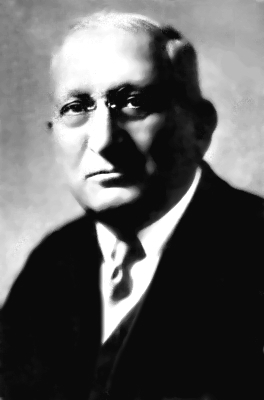
Cyrus Adler
Chaim Arlosoroff
Samuel Untermyer
Nahum Sokolow
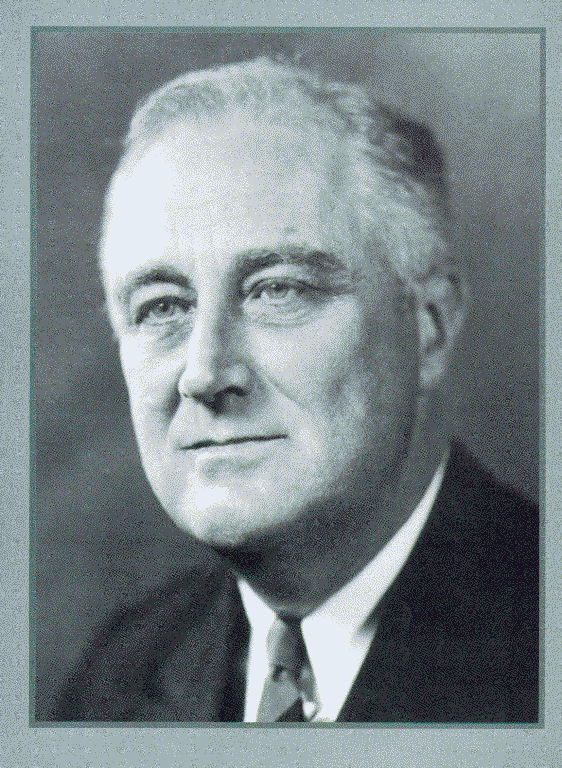
Franklin Delano
Roosevelt
September: Stephen Wise delivers the coup de grace to the
boycott
___________
The boycott could still be saved, and the man with
the power to save it was Reform Rabbi Stephen S. Wise. But, once again, Wise
would take it upon himself to sabotage everything.
As we saw, when it seemed that Untermyer
would wrest from him the leadership of the protest
movement, Wise had rushed to promise that, after the Zionist Congress
his own World Jewish Congress would launch in Geneva the infrastructure with
which, finally, to organize all over the world the boycott against the
Nazis. That moment had now arrived. Following the close of the Zionist
Congress, Stephen Wise gave the inaugural address at his World Jewish Contgress on 5 September in Geneva, and he announced that
he would organize the boycott.[225] It was impossible to say otherwise because those who assisted that
Congress had come to organize the boycott.
Naturally, the Zionist Organization was making
pressure against and in fact they had managed to secure the non-attendance of
the Board of Deputies of the British Jews, one of the most important
organizations.[226] But there was
pressure from the other side as well: on 6 September Untermyer
had gotten the Assembly of Hebrew Orthodox Rabbis of the United States and
Canada, with the support of Chief Rabbi of Jerusalem Abraham Kook, to place
an official curse of untouchability -- cherem -- on German goods, thus placing Orthodox
Judaism in dramatic confrontation with the Nazis and the Zionist
Organization.[227]
Despite everything, that same September 6 Nahum Goldmann and Stephen Wise were working already to steer
the whole business toward sabotage. Goldman defended what the Zionist
Organization had done -- the Transfer Agreement -- as compatible with what
the World Jewish Congress was planning to do. The confused participants in
Wise’s Congress couldn’t follow this: the Zionist Organization was doing
everything within its power to sabotage the boycott. Wasn’t the World
Jewish Congress supposed to organize, precisely, that same boycott?
This was, in fact, no longer clear.
In his speech of that same day, Wise did like Goldmann: he defended the Zionist Organization. He said,
“I do not believe the boycott has been ruthlessly trampled upon and violated
by our fellow Jews or their representatives in Palestine.” No? But the
Zionist Organization, as we earlier saw, had outlawed “all forms of anti-Nazi
protest, including campaigning against the [boycott-nullifying] Transfer
Agreement.” ‘War is peace,’ ‘freedom is slavery,’ and ‘nulifying
the boycott neither tramples upon nor violates the boycott.’ Wise could have
been a character in a George Orwell novel. Then Wise produced another of his
inimitable hot-air threats that were a menace to no one: “if it be proved to
me that any Jew in or out of Palestine, or any representative of any group of
Jews, has been so base as to attempt to do business with Germany for the sake
of profit and gain, I attest that life will not be bearable for any such
man...”[228] But the main
problem with the Transfer Agreement, which Wise had just excused, was not
with the motives that had inspired it (though these motives were that
base), but with its obvious effects: the Transfer Agreement would save
Hitler.
On September 7 things were getting a bit out of hand
for Goldmann and Wise, for the delegates to the
World Jewish Congress wanted to approve a resolution condemning the Zionist
Organization. Goldmann then gave a speech denying
that the Zionist Executive had negotiated the agreement, denying that it
broke with the boycott, and defending the agreement. When he saw that
he was convincing nobody, he desperately declared that it was “absurd”
(absurd!) to say that one could not negotiate with Germany. When he saw that
he still was not convincing them he announced, as organizer of the World
Jewish Congress, that
“...we will
not permit this forum to be used for anti-Zionist maneuvers and I am asking
you not to insist on resolutions which are directed against the Zionist
Organization. The conference is to decide about the boycott question. But
what has been done here [with the Transfer Agreement] was absolutely
necessary and not a crime.”[229]
His opponents immediately replied that the World
Jewish Congress certainly could deal with the question of the agreement of
the Zionist Organization with the Nazis because this was organically linked
with the success of the boycott. An agitated discussion ensued, and Goldmann continued defending the agreement as a Zionist
obligation.
On 8 September, the last day, Stephen Wise read the
‘boycott’ declaration. In his last sentence Wise would supposedly declare the
formation of a Central Jewish Committee to coordinate the boycott efforts
around the world, finally destroying the Nazis. But he didn’t. Wise’s
declaration simply encouraged the continuation of the spontaneous boycott
that was already taking place. There was not one word about the organization
of the boycott which was supposedly the very goal of the World Jewish
Congress. Once again, posing as a protest leader, Wise had sabotaged the
defense of the Jewish people. But few people realized on this moment what he
had done: everybody got the impression that Wise had declared the
organization of the boycott mostly because this was supposed to be the very
purpose of his World Jewish Congress. Immediately after this, Wise gave
control of boycott business to the Zionist Executive, for he placed
Leo Motzkin and Nahum Goldmann
at its head.
Naturally, the boycott was never organized.
In the United States Wise was received by the
leaders of the American Jewish Congress. They were not happy. They wanted to
know why Wise had sabotaged Untermyer’s efforts if
he was not going to organize the boycott himself. Some wanted to force Wise
to cooperate with Untermyer, but his followers
outnumbered them and there was no such revolution. Wise was the founder of
the American Jewish Congress, and his followers wanted to believe in him.
The boycott had been destroyed. Hitler had been
saved. The Jewish people had been betrayed. From here onwards the Western
governments would put in motion a policy that has been called ‘appeasement’
by historians -- because they apaprently consider
it out of bounds to call it ‘pro-Nazi’ -- and which resulted in Hitler taking
over all of Europe practically without having to draw his sword.
|
|
|
Is this article useful? Help us do
more with a donation . |
|
|
Stephen Wise
would go on to do worse things during the Holocaust. So would Chaim Weizmann, Moshe
Sharrett, and David Ben-Gurion.
Rabbi Stephen Wise
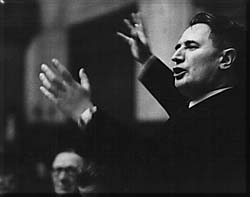
Nahum Goldmann

The next piece in
this series is:
“How the mainstream Jewish leadership failed the Jewish people in World War II”; from THE PROBLEM OF JEWISH SELF-DEFENSE; Historical and Investigative Research; 17 January 2006; by Francisco Gil-White.
http://www.hirhome.com/israel/leaders1.htm
Notify me of new HIR pieces!

________________________________________________________
Footnotes and Further Reading
________________________________________________________
[1] There is a
bewildering array of different spellings of the man’s name. I have used only
one, forcing other authors to agree with mine, for simplicity’s sake.
[2] Carroll, J.
2001. Constantine's Sword: The Church and the Jews. Boston: Houghton
Mifflin. (p.387-88)
[3] Hathaway, J.
1997. The Grand Vizier and the false Messiah: The Sabbatai
Sevi controversy and the Ottoman reform in Egypt. Journal
of the American Oriental Society 117:665-671. (p.665)
[3a] Davies, W. D.
1976. From Schweitzer to Scholem: Reflections on Sabbatai Svi. Journal of
biblical literature 95:529-558. (p.530)
[4] Hathaway
(1997:665)
[5] Davies(1976:530)
[6] Davies
(1976:537-38)
[7] “The religion
of peace?: What, exactly, is ‘moderate Islam’?”; from THE CULTURE OF ISLAM;
Historical and Investigative Research; 10 January 2007; by Francisco
Gil-White.
http://www.hirhome.com/islam/culture01.htm
[8] Bostom, A. G. 2005. The legacy of jihad: Islamic holy war
and the fates of non-Muslims. Amherst, NY: Prometheus Books. (pp.17-19)
http://www.hirhome.com/islam/art.htm
[9] To read about
the importance of Jewish ideology for the struggle to gain basic legal
protections of liberty and equality for ordinary workers throughout history,
read:
Gil-White, F. J. 2005. The Crux of World History. Volume 1. The Book of Genesis: The birth of the Jewish people: Historical and Investigative Research.
http://www.hirhome.com/israel/cruxcontents.htm
[10] Hathaway
(1997:667)
[11] Hathaway
(1997:667)
[12] Hathaway
(1997:667)
[13] Davies
(1976:542)
[14] Davies
(1976:542-43)
[15] Levin, K.
2005. The Oslo syndrome: Delusions of a people under siege. Hanover,
NH: Smith and Kraus. (p.3)
[16] The Talmud is
a record of rabbinic interpretations of the Torah that are considered
authoritative and which form the basis of Jewish law. It is divided into two
major parts, Mishna, which states concluded legal
opinions, and Gemara, which is a series of debates.
(Of course, the Talmud is infinitely more than this).
[17] Carroll
(2001:248)
[19] Levin
(2005:40)
[20] Dan, J. 1991. A
bow to Frumkinian Hasidism. Modern Judaism 11:175-193. (p.190)
[21] Levin
(2005:2)
[23] Dan (1991:180)
[24] Dan (1991:178-79)
[25] Dan (1991:178)
[26] Dan
(1991:175)
[26a] "Dhimmitude and slavery: The fates of non-Muslims (and
Muslims, too) in Islamic society"; from THE CULTURE OF ISLAM; Historical
and Investigative Research; 14 October 2007; by Francisco Gil-White.
http://www.hirhome.com/islam/culture02.htm
[27] Levin
(2005:44)
[28] Glenn, M. G. 1957.
Some historical background for the rise of Musarism.
The Jewish quarterly review 48:99-103. (p.99)
[29] Levin
(2005:44)
[30] Glenn
(1957:99)
[31] Carlebach (1992:199)
[32] Eisenstein-Barzilay, I. 1956. The ideology of the Berlin Haskalah. Proceedings of the American Academy for
Jewish Research 25:1-37. (p.1)
[33] “Towards the end of
the Middle Ages Jews lived in 85 towns in Poland and their total number
amounted to 18,000 in Poland and 6,000 in Lithuania, which represented merely
0.6 per cent of the total population of the two states. The 16th and the
first half of the 17th century saw increased settlement and a relatively fast
rate of natural population growth among both Polish and Lithuanian Jews. The
number of immigrants also grew, especially in the 16th century. Among the new
arrivals there were not only the Ashkenazim, banished from the countries
belonging to the Habsburg monarchy, that is Germany, Bohemia, Hungary and
Lower Silesia... but also the Sephardim who were driven away from Spain and
Portugal. Moreover many Sephardic Jews from Italy and Turkey came to Poland
of their own free will.”
SOURCE: "History of the Jews in Poland" by Ph. D. M. Rosenzweig
http://polishjews.org/history.htm
“Under Polish rule, the Jews had achieved a degree
of political and social autonomy unsurpassed in the European diaspora. More
than in any other country, the Jews of Poland were able to engage in the full
range of practices that made Judaism a distinct social order. Not only their
ritual observance but their rabbinic courts of law and system of taxation
were recognized and protected by the state. In each community, a governing
body known as the kahal gathered and
apportioned Jewish taxes, policed the local Jewish population, and controlled
residence and membership in the community. Moreover, a country-wide
institution known as the Council of the Four Lands (referring to the four
major regions of the Polish commonwealth) coordinated practices among the
hundreds of Jewish communities and represented them vis-à-vis the Polish
rulers.”
Nathans, B. 2002. Beyond the Pale: The Jewish encounter with late imperial Russia. Berkeley, CA: University of California Press. (p.25)
[34] Ofek, A. 1993. Cantonists:
Jewish Children as Soldiers in Tsar Nicholas's Army. Modern Judaism Vol.
13:277-308. (pp.277-78)
[34a] Levin
(2005:38)
[35] Levin
(2005:38)
[36] Black, E.
1984. The transfer agreement: The dramatic story of the pact between the
Third Reich and Jewish Palestine. New York: Carroll & Graf. (p.167)
[37] Black
(1984:167)
[38] Levin
(2005:40)
[39] Levin
(2005:41)
[40] Levin
(2005:40, 42)
[41] Carroll
(2001:406-13)
[42] Levin
(2005:46)
[43] Levin
(2005:26)
[44] Levin
(2005:6)
[45] Levin
(2005:7)
[46] Levin
(2005:7)
[47] For an
analysis of the political impact of Jewish Law in the fist
century Mediterranean, consult Chapter 1 of:
Gil-White, F. J. 2005. The Crux of World History.
Volume 1. The Book of Genesis: The birth of the Jewish people: Historical and
Investigative Research.
http://www.hirhome.com/israel/cruxcontents.htm
[48] Levin
(2005:192)
[49] Levin
(2005:10-11)
[50] Levin
(2005:189-90)
[51] Levin
(2005:189)
[51a] Levin
(2005:191)
[51b] The first
remark is in a letter from Weizmann to Steed, November 30, 1918. The second
remark, about the European Jews being "dust" not worth saving he
made in reply to a question, during his testimony before the Peel Commission
that was investigating the causes of Palestinian Arab terrorism against the
Jews in 1936. Weizmann had been asked whether the Zionist movement sought to
bring 6 million Jews to Palestine.
Wyman, D. S., and R. Medoff.
2002. A race against death: Peter Bergson, America, and the Holocaust.
New York: The New Press. (p.132).
[52] Brown, M.
1989. The New Zionism in the New World: Vladimir Jabotinsky's
relations with the United States in the pre-Holocaust years. Modern
Judaism 9:71-99. (p.75)
[53] Brown
(1989:75)
[54] Brenner, L.
1983. Zionist-Revisionism: The Years of Fascism and Terror. Journal of
Palestine Studies 13:66-92. (p.66)
[55] Hecht, B.
1991[1961]. Perfidy. Jerusalem: Gefen.
(p.234)
[56] Black
(1984:82).
[56a] Wyman, D. S.,
and R. Medoff. 2002. A race against death: Peter
Bergson, America, and the Holocaust. New York: The New Press. (p.15, fn.)
[57] Hecht
(1991[1961]:233-34)
[58] For British
policy in Palestine at the time of the Jewish people's greatest need, consult
the section entitled "The Arab terrorist and British puppet Hajj Amin al
Husseini becomes a British-Nazi puppet" in:
“How did the ‘Palestinian movement’ emerge? The British sponsored it. Then the German Nazis, and the US”; from UNDERSTANDING THE PALESTINIAN MOVEMENT; Historical and Investigative Research; 13 June 2006; by Francisco Gil-White.
http://www.hirhome.com/israel/pal_mov4.htm#nazis
[59] Black
(1984:83)
[60] “How did the
‘Palestinian movement’ emerge? The British sponsored it. Then the German
Nazis, and the US”; from UNDERSTANDING THE PALESTINIAN MOVEMENT; Historical
and Investigative Research; 13 June 2006; by Francisco Gil-White.
http://www.hirhome.com/israel/pal_mov4.htm
[61] For British
policy in Europe in the context of the Holocaust:
http://www.hirhome.com/israel/hirally.htm#1939
And for the role that the British played condemning
to death 800,000 Hungarian Jews, read:
“The responsibility of the mainstream (Labor Zionist) Israeli leaders during the Shoah (‘Holocaust’)”; from THE PROBLEM OF JEWISH SELF-DEFENSE; Historical and Investigative Research; 21 February 2007; by Francisco Gil-White.
http://www.hirhome.com/israel/leaders4.htm
[63] Brown
(1989:84)
[64] Tzahor, Z. 1988. The struggle between the Revisionist Party and the
Labor Movement: 1929-1933. Modern Judaism 8:15-25. (p.15)
[65] Tzahor (1988:18)
[66] Brenner
(1983:70)
[67] Tzahor (1988:19)
[68] Tzahor (1988:19-20)
[69] Tzahor (1988:20)
[70] Levin
(2005:44-45)
[71] Black
(1984:167).
[72] Cohon, S. S., and N. J. Vol. 2, 1922), pp. 27-43. 1922.
The Mission of Reform Judaism. The journal of religion 2:27-43. (p.27)
[73] Levin
(2005:49)
[74] Levin (2005:43)
[75] Freehof, S. B. 1955. Reform Judaism in America. The
Jewish quarterly review 45:350-362. (p.353)
[76] The
statistics, put together by the National Jewish Population Survey (“NJPS”) of
1990, were presented by Anthony Gordon and Richard Horowitz in: “Will your
grandchildren be Jews?”; Jewish Spectator; Fall, 1996; pp 36-38.
[77] Black
(1984:167)
[78] Levin (2005:56)
[79] Black
(1984:4)
[80] Black
(1984:5)
[81] Black
(1984:5-6)
[82] To read about
the rise of the eugenics movement in Britain and the United States, consult
Chapter 7 of:
Gil-White, F. J. 2004. Resurrecting racism: The
current attack on black people using phony science: Historical and
Investigative Research
http://www.hirhome.com/rr/rrchap7.htm
[82a] To read about
how the US ruling class sponsored the rise of German Nazism, read:
Black, E. 2003. War against the weak: Eugenics
and America's campaign to create a master race. New York: Four Walls
Eight Windows.
http://www.waragainsttheweak.com/
[83] “President
Woodrow Wilson counted [Wise] as a key supporter.” See: Black, E. 2003. War
against the weak: Eugenics and America's campaign to create a master race.
New York: Four Walls Eight Windows. (p.120)
To read about Woodrow Wilson’s ideology, consult the
section entitled “The institutionalization of eugenics in the US” in Chapter
7 of:
Gil-White, F. J. 2004. Resurrecting racism: The
current attack on black people using phony science: Historical and
Investigative Research
http://www.hirhome.com/rr/rrchap7.htm
[84] To learn
about the Supreme Court fraud that legalized eugenic sterilization in the US,
see:
Black, E. 2003. War against the weak: Eugenics and America's campaign to create a master race. New York: Four Walls Eight Windows. (pp.108-122).
For Brandeis’s role, same reference, p.120.
For a summary of all this, read Chapter 7
(especially the section entitled “Who Were the Feebleminded?”), in:
Gil-White, F. J. 2004. Resurrecting racism: The current attack on black people using phony science: Historical and Investigative Research.
http://www.hirhome.com/rr/rrchap7.htm
[85] “How the
mainstream Jewish leadership failed the Jewish people in World War II”;
Historical and Investigative Research; 17 January 2006; by Francisco
Gil-White; from THE PROBLEM OF JEWISH SELF-DEFENSE.
http://www.hirhome.com/israel/leaders1.htm
[85a] Rapoport, Louis. 1999. Shake heaven and earth: Peter
Bergson and the struggle to rescue the Jews of Europe, Gefen, Jerusalem and New York. (p.32).
[86] Black
(1984:8)
[87] Black
(1984:9)
[88] Black
(1984:10-11)
[91] “The
responsibility of the mainstream (Labor Zionist) Israeli leaders during the Shoah (‘Holocaust’)”; from THE PROBLEM OF JEWISH
SELF-DEFENSE; Historical and Investigative Research; 21 February 2007; by
Francisco Gil-White.
http://www.hirhome.com/israel/leaders4.htm
[92] Black
(1984:122)
[93] Black
(1984:39)
[94] Black
(1984:15)
[95] Black
(1984:18)
[96] Black
(1984:17)
[97] Black
(1984:17)
[98] Black
(1984:19, 39; emphasis mine)
[99] Black
(1984:39)
[100] Black
(1984:18-19)
[101] Black (1984:20)
[102] On the
international reaction to the accusations against Alfred Dreyfus: Mandell, R. D. 1967. The affair and the fair: Some
observations on the closing stages of the Dreyfus case. The journal of
modern history 39:253-265.
On Ford’s antisemitic
propaganda and the boycott that stopped it: Black (1984:25-30)
[103] Black
(1984:33)
[104] Black
(1984:35)
[105] Black
(1984:36)
[106] Black
(1984:40)
[107] Black
(1984:36)
[108] Black
(1984:79)
[109] Black
(1984:37)
[110] Black
(1984:38)
[111] Black
(1984:44-46; emphasis mine)
[112] Black
(1984:47-48)
[113] Black
(1984:52-53)
[114] Black
(1984:53)
[116] Black (1984:60)
[117] Black
(1984:54-55)
[118] Black
(1984:55)
[119] Black
(1984:60)
[120] Black
(1984:60-61)
[121] Black
(1984:72)
[122] Black (1984:98)
[123] Black
(1984:80)
[124] Black
(1984:96)
[125] Black
(1984:82, 86)
[126] Black
(1984:83)
[127] Black
(1984:134)
[129] Black
(1984:85-86)
[130] Black
(1984:86)
[131] Black
(1984:93)
[132] Black
(1984:142)
[133] Black
(1984:142)
[134] Black
(1984:142)
[135] Black
(1984:148)
[136] Black
(1984:122)
[137] Black
(1984:122)
[138] Black
(1984:122-23)
[139] Black
(1984:81)
[140] Black
(1984:62-63)
[141] “How did the
‘Palestinian movement’ emerge? The British sponsored it. Then the German
Nazis, and the US”; from UNDERSTANDING THE PALESTINIAN MOVEMENT; Historical
and Investigative Research; 13 June 2006; by Francisco Gil-White.
http://www.hirhome.com/israel/pal_mov4.htm
[142] Black
(1984:81, 122)
[143] Black
(1984:63-64)
[144] Black
(1984:64-65)
[145] Black
(1984:64-65)
[146] Black
(1984:71)
[147] Black
(1984:104-05)
[148] Black
(1984:111)
[149] Black
(1984:105)
[150] Black
(1984:129-30)
[151] Black
(1984:123)
[152] Black
(1984:110-11)
[153] Black
(1984:97)
[154] Black
(1984:112)
[155] Black
(1984:106)
[157] Black
(1984:108)
[158] Black
(1984:108)
[159] Black
(1984:173-74)
[159a] Naftali, T. 2005. "The CIA and Eichmann's
Associates," in US Intelligence and the Nazis. Edited by R. Breitman, N. J. W. Goda, T. Naftali, and R. Wolfe, pp. 337-374. Cambridge: Cambridge
University Press. (p.339)
[160] Black
(1984:174-75)
[160a] Simpson, C.
1988. Blowback: America's recruitment of Nazis and its effects on the Cold
War. New York: Weidenfeld & Nicholson.
(p.253)
[160b] Simpson
(1988:253-54)
[160c] Levin, K.
2005. The Oslo syndrome: Delusions of a people under siege. Hanover,
NH: Smith and Kraus. (p.195)
[160d] Shapira, A. 1992. Land and power: The Zionist resort to
force 1881-1948. New York & Oxford: Oxford University Press. (p.193)
[160d] Shapira (1992:164-66)
[160f] Black (1984:96)
[161] Black
(1984:95-96)
[162] Black
(1984:98-99)
[163] Black
(1984:96)
[164] “Was there,
in British Mandate Palestine, a ‘nationally conscious’ ‘Palestinian Arab
people’?”; from UNDERSTANDING THE PALESTINIAN MOVEMENT; Historical and
Investigative Research; 30 April 2006; by Francisco Gil-White
http://www.hirhome.com/israel/pal_mov2.htm
[165] Black
(1984:99-100)
[167] Black (1984:114-15,
119)
[168] Marks, F. W.
M. I. 1985. Six between Roosevelt and Hitler: America's Role in the
Appeasement of Nazi Germany. The Historical Journal 28:969-982.
(p.971)
[169] Black (1984:143-44)
[170] Black
(1984:180-184)
[171] Black
(1984:248)
[172] Black
(1984:160)
[173] Black
(1984:148-49)
[174] Black
(1984:149)
[175] To learn more
about the sicarii, read:
Horsley, R. A. 1979. The Sicarii: Ancient Jewish "Terrorists". The journal of religion 59:435-458.
To read about Roman oppression and the valiant
resistance of the ancient Jews, read:
Gil-White, F. J. 2005. The Crux of World History. Volume 1. The Book of Genesis: The birth of the Jewish people: Historical and Investigative Research.
http://www.hirhome.com/israel/cruxcontents.htm
[176] Black
(1984:149)
[177] Brenner
(1983:74)
[177a] Bradfield, A.
L., and G. L. Wells. 2000. The Perceived Validity of Eyewitness
Identification Testimony: A Test of the Five Biggers
Criteria. Law and Human Behavior 24:581-594. (p.581)
[178] Black
(1984:151-52)
[179] Black
(1984:157)
[181] Black
(1984:157)
[182] Black
(1984:142)
[184] The
quotations are from Irgunist Peter Bergson, in an
interview with David Wyman (Wyman & Medoff
2002:124).
[184a] Wyman & Medoff (2002:19)
[184b] Brown
(1989:73-74)
[184c] Black
(1984:62)
[184d] Brenner
(1983:79)
[184e] Wyman & Medoff (2002:19)
[184f] Black
(1984:288)
[185] Black
(1984:288-89)
[186] Black
(1984:199-89)
[187] Black
(1984:192)
[188] Black
(1984:192)
[189] Black
(1984:217-225)
[190] Black
(1984:193-94)
[191] Black
(1984:200)
[192] Black
(1984:209)
[193] Black
(1984:200)
[194] Black
(1984:203)
[195] Black
(1984:201)
[196] Black
(1984:201)
[197] Black
(1984:201)
[198] Black
(1984:202-05)
[199] Black
(1984:207-10, 272)
[200] Black
(1984:211-123)
[201] Black
(1984:224)
[202] Black
(1984:264-65)
[203] Black
(1984:224-25)
[204] Black
(1984:255-56)
[205] Black
(1984:276-78)
[206] Black
(1984:272-76)
[207] Black
(1984:248)
[208] Black
(1984:280-81)
[209] Black
(1984:301)
[210] Black
(1984:305)
[211] Black
(1984:296)
[212] Black (1984:305)
[214] Black
(1984:312-13)
[215] Black
(1984:313-14)
[216] Black
(1984:314-15)
[217] Black
(1984:315-21)
[218] Black
(1984:322-27)
[219] Black
(1984:325-30)
[220] Black
(1984:330)
[221] Black
(1984:332)
[222] Black
(1984:332)
[223] Black
(1984:334-35)
[224] Black (1984:335-43)
[225] Black
(1984:349)
[226] Black (1984:352)
[227] Black (1984:350-51)
[228] Black (1984:352-53)
[229] Black (1984:355)
Reform Rabbi Stephen Samuel Wise
Reform Rabbi Steven Samuel Wise