|
|
|||||||||||||||||||||||
|
Understanding the Palestinian Movement An HIR Series, in four parts Historical and Investigative Research
- 13 June 2006 Note: an earlier (and less complete) version of this
material
__________________________________________________________ █ Introduction █ Why did the
British encourage and aid the anti-Jewish terrorist violence of the Arabs in
British Mandate ‘Palestine’? -- John Patterson’s hypothesis. █ The British,
after encouraging the anti-Jewish violence of the early 1920s, rewarded the
Arab terrorists and took measures against the Jews. █ The British
encouraged the anti-Jewish violence of the late 1920s, took measures against the
Jews, and again rewarded the Arab terrorists. █ The Arab
terrorist and British puppet Hajj Amin al Husseini becomes a British-Nazi
puppet █ Hajj Amin al Husseini, leader of the ‘Palestinian movement,’ becomes
an architect of Adolf Hitler’s Final Solution, and then continues the
extermination effort beyond the World War, helping create Al Fatah, the
controlling core of the PLO. █ The next great
patron of Hajj Amin’s movement became...the United States. Introduction As you may recall from Part 1,
even anti-Zionist historian Nathan Weinstock recognizes that the ‘Palestinian
movement’ in British Mandate ‘Palestine’ was not exactly admirable. It was,
he says, “deformed by racism.” Racism against whom? The British? That should
be the first hypothesis for a movement that Weinstock calls “the Palestinian anti-colonialist
movement,” because the British were the occupying imperialist/colonialist
power in charge. But no, as Weinstock himself concedes, this movement was
racist against the Jews (Zionist or not, mind you). Weinstock’s
admission that the ‘Palestinian’ movement’s flag was anti-Jewish racism is
important because it comes from someone who would like to defend the justice
of this movement. Precisely in order to defend this movement, Nathan
Weinstock would like you to think that the violent racism of so-called
‘Palestinian’ Arabs was “understandable” because, he claims, the Zionist Jews
and the British were “clearly” allied with each other against the Arabs (see Part 1).
This representation is absurd. As Weinstock himself admits, 1) the British
imperialists were helping the Arabs kill Jews (see Part 1 for
Weinstock's admission; British support for anti-Jewish terrorist violence is
documented below); and as
Weinstock also admits, 2) the Arab
feudal lords in ‘Palestine’ incited racist violence against the Jews in order
to create a climate to intimidate fellow Arabs who might want to get
along with the mostly socialist Jews, the better to further exploit the
downtrodden Arab commoners (see Part
3) Therefore, it is amazing that Weinstock, who says he
is an anti-imperialist Marxist, should not defend the interpretation that the
British ruling class and the Arab ruling class were allied against ordinary
Arabs and Jews. After all, as I also show in Part
3, the Zionist Jews had no role in oppressing the
Arabs; on the contrary, the Zionist Jews were indirectly and directly helping
to end the oppression which the Arab (effendi) feudal lords
made the ordinary (fellahin) peasant Arabs to suffer. Nathan Weinstock would also like you to think that
this allegedly ‘Palestinian’ movement was an expression of a Palestinian Arab
“national consciousness.” But this is quite impossible. As I show in Part 1,
the ideology of this movement was just plain old anti-Jewish racism, of the
traditional sort in the Muslim world, and quite comparable -- notwithstanding
Weinstock’s loud protestations to the contrary -- to the traditional European
anti-Jewish racism that produced the Shoah (Holocaust). Moreover, as I show
in Part 2,
‘Palestine’ as such never existed, and neither was there ever any such thing
as an ‘Arab Palestinian’ population with a ‘Palestinian identity,’ much less
Weinstock’s alleged “national consciousness.” Most of the so-called
‘Palestinian Arabs,’ as I also show in Part
2, were immigrants from elsewhere attracted by the
economic boom that the Zionist Jews created when they transformed a desolate
land into an oasis (few people are even aware of this). So, although Nathan Weinstock may refer to the
racist movement that killed innocent Jews in British Mandate ‘Palestine’ as
the “Palestinian anti-colonialist movement,” the well-documented facts
suggest that this movement had absolutely nothing to do with fighting
colonialism. On the contrary, the aristocratic Arab leaders of repeated
terrorist violence against ordinary Arabs and Jews were directly sponsored
and assisted by the colonialist British Mandate government and the
colonialist British military, as I will document below in some detail. It was
this British sponsorship and assistance that initially set in motion the
so-called ‘Palestinian movement.’ Later, the Nazis would also sponsor it. And
after that, the United States. Anybody who chooses to defend the ‘Palestinian
movement’ should do so in full awareness of the facts documented below.
|
|||||||||||||||||||||||



|
|
|
Is this article useful? Help us do
more with a donation . |
|
|
It is important to point out that when the Turks
governed Jerusalem the local leaders had very little power: “Moslem affairs,
the administration of Moslem religious funds, the running of Moslem courts,
were handled by Constantinople [Istanbul].” The British transformed all this
and gave Husseini much power over the Muslim population. They created a
“Supreme Moslem Council, consisting of a president and four members, to take
complete charge of the Waqf-Moslem religious funds,
the Shariah (religious) courts, the Mosques, and
Moslem social services. Hajj Amin became President.” Hajj Amin also
controlled the funds for orphans and beyond this received a subsidy from the
British government. But it is not just a question of funds. There is also the
matter of the bureaucratic authority that Hajj Amin was given: “The [Supreme
Muslim] Council had in its hands the appointment of preachers and officials
of the Mosques; teachers at the religious seminaries; judges of the Shariah courts...; and all officials of Moslem institutions
throughout the country.”[23]
A Library of Congress study on the history of Israel
explains the consequences of Colonial Secretary Winston Churchill's reforms,
implemented by the High Commissioner Herbert Samuel:
“By heading
the SMC [Supreme Muslim Council], Hajj Amin controlled a vast patronage
network, giving him power over a large constituency. This new patronage
system competed with and threatened the traditional family-clan and Islamic
ties that existed under the Ottoman Empire. Traditional Arab elites hailing
from other locales, such as Hebron and Haifa, resented the monopoly of power
of the British-supported Jerusalem-based elite...
Tension
between members of Arab elites was exacerbated because Hajj Amin, who was not
an elected official, increasingly attempted to dictate Palestinian politics.
The competition between the major families and the increased use of the
Zionist threat as a political tool in inter-elite struggles placed a premium
on extremism. Hajj Amin frequently incited his followers against the Nashashibis [a competing clan] by referring to the latter
as Zionist collaborators.”[25]
I remind you that Hajj Amin, whom the British pardoned
after he organized mass murders of Jews, and whom they then made Mufti of
Jerusalem, before making him the head of the Supreme Muslim Council, was “not
[even] one of the three candidates for the office” of Mufti. Clearly, then,
the British were going quite out of their way, and flexing their every
muscle, to transform Arab politics in such a way that those extreme
anti-Jewish racists who also attacked fellow Arabs with terrorism ended at
the top, and were provided with the vast political, economic, and
bureaucratic power needed to mobilize anti-Jewish racism. The point? As we
see above, to prevent Arab leaders who wanted to get along with the Zionist
Jews from having any influence, thus derailing the Zionist project.
Anita Shapira explains
that “there is a debate among historians about Herbert Samuel’s policies”;
some wish to see Samuel as well meaning, whereas others see him as “fostering
the radical forces among [the Arabs] at the expense of the moderates. In the
eyes of Jewish contemporaries at the time, Samuel was viewed almost as a
national traitor...”[26] In my view
the latter assessment is correct, except that I don’t think Samuel was almost
a traitor.
Strong support for my view comes from Herbert
Samuel’s subsequent behavior on the eve of the Holocaust: acting as a
representative of the Jews before the British government, he kept important
information secret that could have saved thousands of European Jewish lives.[27] Samuel consistently cooperated with the antisemitic
feelings of the majority of British officials -- he was loyal to them,
not to the Jewish people.
Herbert Samuel is supposed to have been “a
proclaimed Zionist,”[28] and this naturally has something to do with the fact
that he was “one of the architects of the Balfour Declaration.”[29] But in the final analysis, taking his whole career into
account, if it is proper to call Herbert Samuel a ‘Zionist’ then we urgently need a more precise vocabulary.
The British encouraged the anti-Jewish violence of the late 1920s, took
measures against the Jews, and again rewarded the Arab terrorists
_________________
Kenneth Levin remarks on the great difference
between Herbert Samuel and his non-Jewish successor:
“Samuel was
replaced by Lord Herbert Plumer, who generally
resisted further backtracking from the Mandate even in the face of Arab
pressures, and Plumer’s three years in office saw a
marked decrease in violence. This reflected a pattern that has been noted by
a number of historians who have written on the Mandate: Appeasement tended to
result in increased Arab violence as violence was perceived as yielding
rewards, while a more steadfast course and rejection of concessions in the
face of violence typically yielded more peaceful interludes.”[24]
When Plumer left, the
British once again began allowing Arab violence against the Jews. Anita Shapira writes:
“Beginning in
1928, there was mounting tension between Jews and Arabs. After years [the
three Plumer years] in which the British had
imposed impeccable public order and Jews, men and women alike, had been able
to walk freely throughout Palestine in complete safety and without fear, the
situation now changed. There were more and more incidents of rape of young
Jewish women in Jerusalem by Arabs and an increasing number of robberies in
cities and towns everywhere in the country. ...the background to these
incidents was criminal, not nationalist.”[31]
In 1929, the next year, there was a Zionist Congress
in which Zionist leader Chaim Weizmann remained in control despite widespread
criticism of his acquiescence to any and all anti-Jewish measures decided by
the British government, measures that violated not only the spirit but the
letter of Britain’s treaty obligations to the Jews.[32] Feeling the climate change, and sensing an easy prey,
in the same year of 1929, Hajj Amin al Husseini once again mobilized Arab mob
violence against the Jews in British Mandate Palestine. Writes Kenneth Levin:
“...shortly
following the 1929 [Zionist] Congress, the de facto leader of the
Palestinian Arabs, Amin al Husseini, Grand Mufti of Jerusalem, orchestrated
large-scale assaults on the Jews of the Yishuv
[Jewish community], attacks that began in Jerusalem and soon spread
throughout the country. In Hebron, one of the hardest hit targets, more than
sixty Jews were killed and the rest of the community was forced to flee.”[33]
Anita Shapira tells it
like this:
“The [1929]
riots were accompanied by militant Arab slogans such as ‘The law of Muhammad
is being implemented by the sword,’ ‘Palestine is our land and the Jews our
dogs,’ ‘We are well armed and shall slaughter you by the sword.’ There were
also brutal acts by Arabs for the apparent sake of cruelty, such as the
killings in Hebron, where small children were tortured by their murderers
before being murdered. The dread that the Arabs were planning to annihilate
the entire Jewish community -- men, women, and children -- in one
concentrated burst of violence surfaced for the first time in the wake of the
August 1929 disturbances [which]...swept with a fury through Jewish
settlements and neighborhoods throughout the length and breadth of the
country. The danger now appeared to threaten the very survival of the entire
Jewish community.”[34]
What did the British do? As in 1920-21, the British
cooperated with the Arab anti-Jewish violence. Writes Kenneth Levin:
“For days,
British forces across the country did virtually nothing to stop the carnage.
The commission appointed by then Colonial Secretary Lord Passfield
to investigate the violence submitted a report that was in key respects a
reprise of earlier such exercises: It acknowledged that the Arabs were fully
responsible for the violence but then recommended restrictions on Jewish
immigration and land purchases to placate the Arabs.
The leaders of
the Yishuv and the Zionist leadership outside the
Mandate protested and were supported by sympathetic segments of the British
public. The League of Nations Permanent Mandates Commission also condemned
the report as offering recommendations that violated Britain’s Mandate
obligations. Still, the Labor government in London imposed a moratorium on
[Jewish] immigration in May, 1930, and the following fall the government
issued the so-called Passfield White Paper spelling
out further anti-Zionist steps. Protest against the halt to immigration and
the White Paper obliged the government to lift the former and to offer some
softening ‘clarifications’ of the latter, but the White Paper was not rescinded.”[35]
Anita Shapira relays the
opinion of the Jewish press at the time, which characterized the Arab leaders
as
“...agitators
and instigators, who by lying and deceit whipped up the masses into a
religious frenzy and stirred up uncontrollable urges. They were hypocrites
who tried to play both sides of the fence, enjoying the profits of land sales
to the Jews, while inciting the Arabs against them in order to strengthen
their hold over the masses.”[36]
I think this contemporaneous analysis, made by the
Zionist Jews at the time, gets it just right. The same Jews, however, failed
to recognize the depth of traditional anti-Jewish racism among ordinary
Arabs, which is precisely what the Arab leaders, chiefly Hajj Amin al
Husseini, were relying on to incite them against the Jews. In consequence,
many Jews naively increased their efforts to find common cause with the Arab
workers against the Arab feudal lords (effendis).
“...now more
than ever in the past, Jews sought to be active in the Arab sector and made
efforts to find ways to establish ties and advance cooperation. Socialists
found it natural to channel the desire for action among Arabs by trying to
organize Arab workers.”[37]
This naiveté can profitably be compared to how many
Jews today on the ‘left’ increase their efforts to accommodate their Arab enemies even as Arab violence against the Jews mounts.
History repeats itself, because the culture of both Jews and Arabs is
transmitted vertically from parents to children, so we see similar
self-destructive responses on the part of Jews mobilized in the face of
similarly intractable terrorist racism on the part of Arabs. We must not
forget, however, the role played by Jewish leaders without any real concern
for the lives of Jews, on the one hand, and the role played by thoroughly
cynical Arab leaders backed by the great powers, on the other, because these
aspects, too, have been reproduced from the past into the present.[38]
The Arab terrorist and British puppet Hajj Amin al Husseini becomes a
British-Nazi puppet
______________________________
In 1933 Adolf Hitler came to power in Germany.
In 1936, once again sensing a political opportunity,
and an easy prey, Hajj Amin did what he did best: mobilize terrorist violence
against the Jews. The first outburst of violence took place 19 April 1936:
the murder of Jews in Jaffa in retaliation against Arabs who had supposedly
been assaulted by Jews in Tel Aviv. But no Arabs had been assaulted in Tel
Aviv: this was just Arab terrorist incitement, once again.[40] At first the unrest was in the hands of upstart young
Arabs but very soon Hajj Amin decided that he wanted to direct any and all
violence against the Jews himself.
“...On April
25 [1936], the Mufti [Haj Amin] induced several of Palestine’s clan leaders
to establish an Arab Higher Committee, with himself as president. It was this
group that supported his call for the nonpayment of taxes after May 15, to be
followed by a nationwide strike of Arab workers and businesses.
...Haj Amin
loosed a series of grim warnings of the ‘revenge of God Almighty.’ The
initial outburst of Arab violence was then followed by a mass strike against
the government’s immigration policy... Enforced by the Mufti’s strong-arm
men, the work stoppage paralyzed government and public transportation
services, as well as Arab business and much of Arab agriculture...”[41] (my emphasis)
This strike, which Hajj Amin, as we see above,
enforced with violence against ordinary Arabs, “crippled the economy of the
entire Mandate,” and punished the Arabs especially.[42] Soon, “al Husseini unleashed another wave of Arab
massacres of Jews as well as attacks on Jewish farms that entailed wide
destruction of crops.”[43] The strike
and accompanying terrorist violence was called the ‘Arab Revolt.’
“...By
midsummer 1936 the intensity of the fighting mounted as Arab irregulars
poured into the hill country around Jerusalem, into Galilee and Samaria. A
majority of them at first were local Palestinians recruited by Haj Amin’s
agents. But soon ‘Committees for the Defense of Palestine’ were established
in neighboring Arab lands. Syrian and Iraqi volunteers began arriving in
Palestine at the rate of two or three hundred a month. Their leader, Fawzi al-Qawukji, played a
vital role in the ensuing civil war... He was a compact, sandy-haired man in
his early forties when the civil war began, gruff, vigorous, and endowed with
an unquestionable dynamism that he cultivated in open imitation of his
hero, Adolf Hitler. During the summer of 1936 it was Qawukji
who organized military training among the Arab nationalists, imposing a
single, unified command over the disparate rebel forces and helping
smuggle in Axis [i.e. Nazi German and fascist Italian] weapons. His
guerilla technique rarely varied. It took the form of night assaults on
Jewish farms, the destruction of cattle and crops, the
murder of civilians.”[44] (my
emphases)
As we see above, this terrorist ‘Arab Revolt’ was
supported by the fascists in Germany and Italy. Historian Howard Sachar
explains the context leading up to the ‘Arab Revolt’:
[Quote from
Howard Sachar begins here]
“With his
impressive African staging bases in Libya, Ethiopia, and Italian Somaliland,
[Italian fascist leader, and Hitler ally, Benito] Mussolini could indeed
begin to look westward toward French Tunisia, and eastward toward Egypt and
the Levant, the historic destinations of the merchant fleets of Venice,
Genoa, and Trieste. A high-powered Italian short-wave radio station in Bari
broadcast Arabic-language propaganda nightly to the Mahgreb
[Muslim North Africa] and the Middle East, striking systematically at
Britain’s and France’s tenure in their Arab lands of occupation. Posturing as
the ‘friend and protector of Islam,’ the Duce at the same time left no doubt
that he regarded the Mediterranean as mare nostrum -- our (Italy’s) sea.
The Italian
campaign for influence in the Moslem world was shrewdly reinforced by Nazi
Germany. Hitler may have evinced little enthusiasm for projecting German
territorial claims into the eastern Mediterranean; it was understood that the
Middle East was Italy’s sphere of expansion. But it was the Führer’s
intention to erode the Allied position in a region widely considered to be
the very pivot of Anglo-French imperial and defensive power. By 1935,
therefore, the Nazi propaganda bureau was subsidizing a wide variety of
Middle Eastern courses, institutes, and journals, and spending millions of
marks on the ‘educational’ activities of German cultural and press attachés
in the Islamic world. Beginning in 1938, the newly equipped German radio
station at Seesen transmitted propaganda to the
Middle East in all the languages of the area (except, of course, Hebrew).
Combined with the broadcasts of radio Bari and Spain’s Radio Sevilla [run by the Spanish fascist regime of Francisco
Franco], these programs won a large and appreciative reception in the Arab
world. So did the ‘goodwill’ visits to the Middle East of eminent Nazi
figures, among them Dr. Hjalmar Schacht and Baldur von Shirach.
One
particularly successful Axis technique of winning favor among the Arabs had
its basis in ideology. German journalists and diplomats constantly drew
parallels between Nazi Pan-Germanism and ‘the
youthful power of Pan-Arab nationalism [which] is the wave of the Arab
future.’ More significantly, the Arabs were reminded of the enemies they
shared in common with the Nazis. Even in the mid-1930s, when Berlin exercised
a certain restraint in ventilating its animosity against Britain and France,
Nazi German diplomats evinced no hesitation whatever in publicizing the Nazi
anti-Jewish campaign. Hardly a German Arabic-Language newspaper or magazine
appeared in the Middle East without a sharp thrust against the Jews. Reprints
of these strictures were widely distributed by the [Jerusalem] Mufti’s Arab
Higher Committee. Upon introducing the Nuremberg racial laws in 1935,
therefore, Hitler received telegrams of congratulation and praise from all
corners of the Arab world. The Palestine newspaper al-Liwa
eagerly borrowed the Nazi slogan ‘One Country, One People, One Leader.’ Ahmed
Hussein, leader of the ‘Young Egypt’ movement, confided to the Lavoro Fascista that ‘Italy and
Germany re today the only true democracies in Europe, and the others are only
parliamentary plutocracies.’ A delegation of Iraqi sporting associations,
returning from a trip to Germany in September 1937, expressed their profound
admiration for ‘National Socialist order and discipline.’ During a visit to
Transjordan in 1939, Carl Raswan, a noted
German-born journalist, was struck by the near-unanimity of Arab opinion that
only ‘Italy and Germany were strong, and England and the whole British Empire
existed only by the grace of Mussolini and Hitler.’ Throughout the Arab
Middle East, a spate of ultra-right-wing political groupings and parties
developed in conscious imitation of Nazism and Italian fascism.”[45]
[Quote from
Howard Sachar ends here]
In the wake of the ‘Arab Revolt’ the British yet
again appointed a Commission to ‘investigate’ and, naturally, proposed punishing
the Jews and rewarding the Arab terrorists with a partition plan that would
give the Jews just 4 percent of the original Mandate territory for a
Jewish state, giving all of Transjordan, and the rest of ‘Palestine’ for an
Arab state. The Zionist leader Ben Gurion decided
to accept this outrage (though the League of Nations was protesting that it
violated Britain’s Mandate obligations to the Jews). Hajj Amin, however, led
the Arabs in a total refusal, which reveals that the ‘Palestinian movement’
was never interested in a Palestinian Arab state, but merely in preventing
the Jews from having any state -- even if it was just 4% of the
original Mandate territory -- where the Jewish people could live free of
persecution.[46] Such views
agreed perfectly with the ideology of Hajj Amin’s Nazi sponsors, which was
also the ideology of Hajj Amin: death to all the Jews.
“Shortly
afterwards, the Arabs, under the Grand Mufti [Hajj Amin] and with Nazi
encouragement, initiated open rebellion in the Mandate. They targeted Jews,
British officials and troops, and Arabs considered too accommodating of the
Jews. Over the next two years, the Mufti’s forces killed more than four
hundred Jews and several thousand Arabs.”[47]
(my emphasis)
Hajj Amin and his thugs were killing many more Arabs
than Jews; the leaders of the ‘Palestinian movement’ have always been as bad
or worse for the Arabs they pretend to lead than they are for the Jews (and
this means that those who support the ‘Palestinian movement’ have never done
so out of compassion for these Arabs).
The British reaction to this violence, after they
put it down, was, once again, to punish the Jews, and in 1939, right before
the Holocaust was to begin, they sharply restricted Jewish immigration to
‘Palestine’ and committed themselves to creating an independent Arab state in
‘Palestine’ within ten years. This new policy has been called the Chamberlain
White Paper or the MacDonald White Paper (Malcolm MacDonald was at this time
the Colonial Secretary), and it constituted a “death warrant for much of
European Jewry.”[48]
It is hard to exaggerate the extremity of the
British position. After the outbreak of the World War, there were brutal
British searches for weapons in Jewish settlements, and they denied entry to
‘Palestine’ to three ships that came full of Jewish immigrants escaping Adolf
Hitler.
“The heads of
the [Jewish] community and the Jewish Agency beseeched the [British]
authorities to allow the Jews to stay in Palestine, even if in detention,
until the authorities were convinced that these people were, in truth,
genuine refugees and not dangerous spies, as the British alleged. Their pleas
were in vain. The high commissioner, Harold MacMichael,
was determined to send them to Mauritius [an island in the middle of nowhere,
in the Indian Ocean] in order to set an example for all to see: The intended
message was that there was no sense in continuing with illegal immigration.
The passengers onboard the Milos and the Pacific, and some of
those on the Atlantic, were transferred to the deportation ship Patria.
Hagana members decided to prevent the sailing of
the Patria by planting a bomb aboard that would cause damage to the ship
[Hagana = initially ineffective Jewish self-defense
militia created in response to Arab terrorist attacks, but which later formed
the backbone of what became the Israeli Defense Forces]. They hoped that this
delay would facilitate a change in decisions in London. The result was
disastrous: The blast was much larger than expected; and enormous hole was
blown in the ship, and nearly three hundred passengers perished.”[49]
The tragedy of the Patria, however, did cause
Winston Churchill to intervene and the survivors from this accident were
allowed to stay. But Winston Churchill’s compassion, if that’s what it was,
could not be moved with respect to the rest of the refugees:
“The rest of
the Atlantic refugees, who were interned in the meantime in Atlit, were brought by force aboard two deportation ships
and sent on a long journey to Mauritius. Their evacuation was accompanied by
a show of brutal force that made even many of the British police officers
flinch. General Nim, with whom Shertock
had discussed the matter, expressed shock that the Jews could dare damage a
much-needed ship like the Patria during time of war. Yet
significantly, he was not perturbed in the least by the allocation of ships
and other resources for sending refugees to Mauritius.
...[The
British] conducted searches for weapons in Jewish settlements...in the early
years of the war as if it was the principal military mission of the hour.
...The Jews did not use weapons against the British, and all victims killed
during the aggressive searches were Jewish.”[50]
Hajj Amin al Husseini, leader of the ‘Palestinian movement,’ becomes an
architect of Adolf Hitler’s Final Solution, and then continues the
extermination effort beyond the World War, helping create Al Fatah, the
controlling core of the PLO
____________________________________________________
Because the so-called ‘Arab Revolt’ had been
directed in part against the British and supported by the Nazis, the British
for once moved against Hajj Amin, and he became a fugitive. A furious 1948 New
York Post article against the ex-Mufti, by Immanuel Velikovsky,
states that
“...The
ex-Mufti escaped from Jerusalem and Palestine in the garb of a woman. In
Syria he was on Mussolini’s payroll. When, with the beginning of the war, his
position in Syria, a French mandate, became ‘insecure,’ he escaped to Iraq.
There he worked hard and succeeded in [organizing a coup,] bringing Iraq into
the war against the Allies, the declaration of war having been made on May 2,
1941. At that time the Nazis’ entered Greece and Egypt.”[51]
While in Iraq, Hajj Amin organized a pogrom like the
ones he had been organizing in 'Palestine' against the Iraqi Jewish
community, which ended some 2600 years of Jewish life in Iraq. This pogrom
was called the Farhud.[52] Velikovsky continues,
“When the
[Iraqi] revolt was crushed (mainly by the Jewish volunteers from Palestine),
the ex-Mufti escaped to Iran and hid himself in the Japanese Embassy there.
From Teheran he escaped to Italy, where his arrival was announced by the
Fascist radio as a ‘great and happy event’; in November, 1941, he arrived in
Berlin and was received by Hitler. In 1942 the ex-Mufti organized the Arab
Legion that fought the American invasion in Africa...”[53]
The substance of Hajj Amin’s 28 November 1941
interview with Adolf Hitler is preserved in a Nazi document that summarizes the
exchange between the two men:
“The Führer
then made the following statement to the Mufti, enjoining him to lock it in
the uttermost depths of his heart:
1. He (the
Führer) would carry on the battle to the total destruction of the
Judeo-Communist empire in Europe.
2. At some
moment which was impossible to set exactly today but which in any event was
not distant, the German armies would in the course of this struggle reach the
southern exit from Caucasia.
3. As soon as
this had happened, the Führer would on his own give the Arab world the
assurance that its hour of liberation had arrived. Germany’s objective
would then be solely the destruction of the Jewish element residing in the
Arab sphere under the protection of British power [my emphasis]. In that
hour the Mufti would be the most authoritative spokesman for the Arab world.
It would then be his task to set off the Arab operations which he had
secretly prepared. When that time had come, Germany could also be indifferent
to French reaction to such a declaration.”[54]
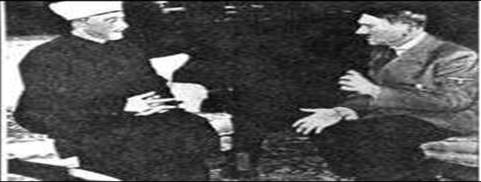
Hajj Amin al Husseini meets with
Hitler
(Berlin, 1941)
The same document states that the Mufti,
“was fully reassured and satisfied by the words which he had heard from the
Chief of the German State.” That is, he was “fully reassured and satisfied”
that Hitler would (1) help him carry out the destruction of all Jews living
in the Arab sphere and, (2) based on that Final Solution,
make him “the most authoritative spokesman in the Arab world.” Once again,
this shows that Hajj Amin al Husseini was not interested in defending any
Arabs, but rather interested in killing Jews. Hajj Amin would now demonstrate
his special predilection with a vengeance by leading Adolf Hitler’s
extermination program against the European Jews.
This has been well established.
Dieter Wisliceny was one
of the most important deputies of Adolf Eichmann, the same Eichmann who was
officially the chief architect of Adolf Hitler’s Final Solution (Wisliceny was eventually tried for war crimes in
Czechoslovakia and executed).[55] At Adolf
Eichmann’s own war-crimes trial in Israel, the earlier Nuremberg testimony of
Dieter Wisliceny was presented. This included Wisliceny’s remarks about Hajj Amin al Husseini. Strictly
speaking, these were Wisliceny’s reactions to
somebody else’s report of what Wisliceny had said
about Hajj Amin. The only thing that Wisliceny
corrected was the other person’s mistaken beliefs that 1) Wisliceny
had described Eichmann as a German born in Palestine, and that 2) Wisliceny had described Hajj Amin as a close personal
friend of Heinrich Himmler. So Wisliceny agreed
with all of the following:
“The Mufti
[Hajj Amin] is a sworn enemy of the Jews and has always fought for the idea
of annihilating the Jews. He sticks to this idea always, also in his talks
with [Adolf] Eichmann ... The Mufti is one of the originators of the
systematic destruction of European Jewry by the Germans, and he has
become a permanent colleague, partner and adviser to Eichmann...in the
implementation of this programme.”[56] (my emphasis)
In other words, Hajj Amin al Husseini, at the very
top of the Nazi leadership, planned with Adolf Eichmann from the very
beginning, and then supervised and directed as “permanent colleague, partner
and adviser to Eichmann,” the World War II extermination of the European
Jews. That Hajj Amin “always fought for the idea of annihilating the Jews” is
important, because it suggests that somebody needed convincing. In fact, as
historian Tobias Jersak explains,
“Since the
1995 publication of Michael Wildt's documentation
on the SS's Security Service (Sicherheitsdienst SD)
and the 'Jewish Question', it has been undisputed that from 1933 Nazi policy
concerning the 'Jewish Question' aimed at the emigration of all Jews,
preferably to Palestine. If their life were made miserable enough, Nazi
planners calculated, the Jews would emigrate
'voluntarily' and leave their property behind. Moreover,
the Ha'avara transfer agreement granted
'privileges' for those Jews willing to emigrate to
Palestine, allowing them to transfer at least part of their property.
Correspondingly, the Zionist movement was intentionally supported, whereas
assimilatory associations in Germany were 'hindered as much as possible, in
order to cause them to align themselves with the Zionist camp'.”[56a]
What caused the German Nazis to change their mind
from a policy of kicking the Jews out to one of killing them all? The
scholars Michael Marrus and Robert Paxton explain
that “until the autumn of 1941... no one defined the
final solution with precision, but all signs pointed toward some vast and as
yet unspecified project of mass emigration.”[56b] So what happened in the autumn of 1941? As mentioned earlier, “in November, 1941, [Hajj Amin al Husseini]
arrived in Berlin and was received by Hitler.”[53]
According to the documentation presented at the Eichmann trial, the decision
to exterminate the European Jews was taken at the Wannsee
Conference that took place January 20, 1942, which is less than two months
after Hitler met Hajj Amin.[56c]
Hajj Amin was a genocidal antisemite who didn’t have
anything to learn from Adolf Hitler and Adolf Eichmann. On the contrary, it
may have been Eichmann and Hitler who learned a thing or two from Hajj Amin.
After all, it was Hajj Amin who, when he arrived in Berlin in 1941, had some twenty
years years of direct experience organizing
terrorist violence against the Jews. So Hajj Amin's arrival in Berlin is
perfectly timed to support the view, expressed by Adolf Eichmann's lieutenant
Dieter Wisliceny, that it was Hajj Amin who
convinced the Nazis to opt for total slaughter as opposed to expulsion.
|
|
|
Is this article useful? Help us do
more with a donation . |
|
|
But Hajj Amin did not merely probably suggest, and
definitely organize and direct from start to finish the German Nazi Final
Solution as co-chief executive with Adolf Eichmann. He was also eager to soak
his own hands, literally, in Jewish blood, so he took personal and direct
responsibility for some of the major episodes of European anti-Jewish mass
killing.
As explained by the Encyclopedia of the Holocaust,
“[Hajj Amin
al] Husseini made his contribution to the Axis war effort in his capacity as
a Muslim, rather than as an Arab leader, by recruiting and organizing in record
time [my emphasis], during the spring of 1943, Bosnian Muslim battalions
in Croatia comprising some twenty thousand men. These Muslim
volunteer units, called Hanjar (sword),[57] were put in Waffen-SS units, fought [the mostly
Serbian] Yugoslav partisans in Bosnia, and carried out police and security
duties in Hungary. They participated in the massacre of [mostly Serbian,
Jewish, and Roma (Gypsy)] civilians in Bosnia and volunteered to join in the
hunt for Jews in Croatia... [my emphasis]. The
Germans made a point of publicizing the fact that Husseini had flown from
Berlin to Sarajevo for the sole purpose of giving his blessing to the Muslim
army and inspecting its arms and training exercises.”[58]
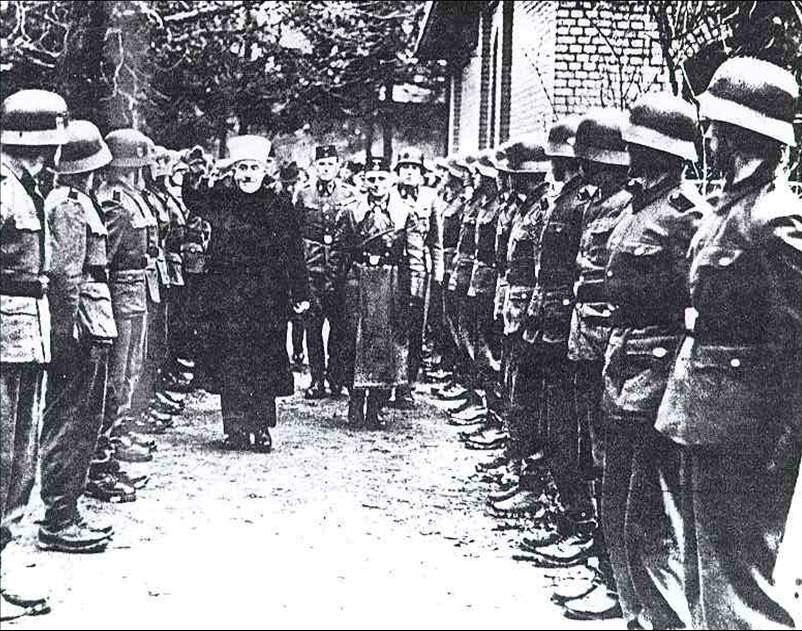
Hajj Amin (center, in black coat and
white hat) does the Nazi salute
as he inspects his Nazi SS Bosnian Muslim troops.
Hajj Amin's Bosnian Muslim SS troops killed hundreds
of thousands of people (mainly Serbs, Jews, and Roma) in their homes or else
sent them to die in the vast Croatian concentration camp system known as Jasenovac.[58a]
In addition to the SS Handzar
division, Hajj Amin also created in Bosnia the SS Freiwilligen-BH-Gebirgs-Division. The French newspaper Le Monde quotes
from a speech Hajj Amin gave to his assembled troops:
“‘You must be the example and beacon in the fight against the common enemies of National-Socialism [Nazism] and Islam.’ November 1943. In the heart of Bosnia, the Grand Mufti of Jerusalem, Hajj Amin al Husseini finishes his speech, and then slowly reviews the troops of the SS Freiwilligen-BH-Gebirgs-Division, the volunteers of the mountain division in Bosnia-Herzegovina.”[58b]
After the war, the Yugoslav government issued a
warrant for Hajj Amin’s arrest for war crimes. The Western Allies captured
him. They should have tried him for war crimes at Nuremberg or turned him
over to Yugoslavia. Instead, he mysteriously escaped. Immanuel Velikovsky's furious 1948 article in the New York Post
accuses,
“In August
1945, Yugoslavia asked that the ex-Mufti be placed on the official list of
war criminals. What is the reason for the failure to bring him to trial in
Germany, where he was captured when Germany collapsed?
...according
to the Charter of the International Tribunal at Nuremberg, the ex-Mufti is a
criminal on all three counts, for crimes against peace, war crimes, and
crimes against humanity.”[60]
The reason that Hajj Amin was not brought to trial,
is that the British and French governments did not want to. It was the French
who held him, and despite repeated insistence in the House of Commons that he
be extradited to Great Britain and tried as a war criminal for his crimes
against the Jews, the British government refused to do this, and in fact
declared our loud that Hajj Amin was not a war criminal (if not him, who?).[60a]
The French put him on house arrest. Question: When do you put the man
who is arguably history’s greatest war criminal on house arrest? Answer:
When you want him to escape. And in fact, surveillance had been relaxed so
much that Hajj Amin was allowed to make a trip to Paris, where he got a
passport from one of the Arab Legations, and made his escape.[60b] He
went to Cairo. Nathan Weinstock explains what happened next.
“The
reappearance of the Mufti [Hajj Amin] in Cairo in May 1946 considerably
reinforced the Husseinis’ prestige. As he was
banned from Palestine, his cousin Jamal Al Husseini asserted himself in the
country as the spiritual leader of Palestinian nationalism.
By falling
once more under the control of the Husseinis,
Palestinian nationalism was led into the most extreme chauvinism. The Arab
Higher Committee resorted to systematic terror to crush the last vestiges of
Jewish-Arab cooperation in every area of social life. It rejected not merely
the proposed partition of the country and all further immigration, but even
the proposal that the Palestinian Jews should be given national minority
status [in an Arab state].”[62]
So once again Hajj Amin was attacking his fellow
Arabs in order to advance his supreme goal: the extermination of the Jews.
Notes Weinstock:
“Even the
Communist organizations ended up following the orders of the Husseinis’ Arab Higher Committee. Moreover, the latter
used terror and political assassination to eliminate their opponents. Palestinian
nationalism sank once again into clannish faction fights and vendettas.”[61]
It is unclear why Nathan Weinstock would insist on
calling Arab terror against fellow Arabs “Palestinian nationalism,”
particularly when the point of this terror was to intimidate any pro-Jewish
Arabs so that the anti-Jewish extermination effort could be re-launched. But
if we remember that Nathan Weinstock is an anti-Zionist who defends the
justice of the ‘Palestinian movement,’ we have an obvious clue.
In 1947 the UN voted to create a Jewish and an Arab
state in ‘Palestine.’ In reaction, the Arabs in ‘Palestine,’ led by Hajj Amin
al Husseini, and the Arabs living in Arab states, considered that it was much
more important to kill the Jews in ‘Palestine’ than to get an Arab state, and
they launched a war of extermination. Azzam Pasha,
Secretary General of the Arab League (a British creation), promised: “This
will be a war of extermination and a momentous massacre, which will be spoken
of like the Mongolian massacres and the Crusades.”[64] In addressing the UN Security Council in April 1948,
Jamal Husseini, Hajj Amin's cousin and spokesperson for his Arab Higher
Committee, straightforwardly and proudly admitted that this was a war of
aggression: “The representative of the Jewish Agency told us yesterday that
they were not the attackers, that the Arabs had begun the fighting. We did
not deny this. We told the whole world that we were going to fight.”[65]
Hajj Amin himself issued a fatwa (legal Islamic pronouncement) to
murder all the Jews that had survived his Nazi Final Solution: “I declare a
holy war, my Moslem brothers! Murder the Jews! Murder them all!”[63]
One of Hajj Amin's soldiers, in this genocidal war,
was Yasser Arafat. According to David N. Bossie,
writing in the Washington Times,
“The mufti
[Hajj Amin] barely escaped trial for [war crimes] by fleeing to Egypt in
1946. There he made young Yasser Arafat, then living in Cairo, his protégé.
The mufti secretly imported a former Nazi commando officer into Egypt to
teach Mr. Arafat and other teenage recruits the fine points of guerrilla
warfare [NOTE: In fact, these Nazis
were sent to Egypt by the CIA]. Mr. Arafat
learned his lessons well; the mufti was so proud of him he even pretended the
two of them were blood relations.”[70a]
This agrees with Yassar
Arafat’s own statements. For example, in 2002, Arafat said the following to
an interviewer from the pro-PLO, London-based, Arabic-language newspaper al-Sharq al-Awsat (his comments were picked up by the
leading Palestinian daily Al-Quds):
“We are the
Mighty People. Were they able to replace our hero Hajj Amin
al-Husseini? ...There were a number of attempts to get rid of Hajj Amin, whom
they considered an ally of the Nazis. But even so, he lived in Cairo, and
participated in the 1948 war, and I was one of his troops.”[70]
This War of 1948 became Israel’s War of
Independence, and after the Jews miraculously won it, the Jewish state, the
state of Israel, was finally established.
There is a great deal of propaganda concerning
supposed war crimes committed by the Israeli Jews during this war. But it was
not the Israeli Jews who attacked, and it was not the Israeli Jews who
announced their goal to exterminate anybody. Neither was it the Israeli Jews
who were led by a man who was the world's most accomplished exterminator of
an entire people. So skepticism is in order when examining such accusations
against the Israelis. I have examined skeptically what is by far the single
most important such accusation -- the allegation that Israeli soldiers
committed a massacre of Arab civilians in the town of Deir
Yassin (or Dir Yassin). What I found is that this was a fabrication put
forward by representatives of Hajj Amin al Husseini’s Arab Higher Committee:
“WAS THERE A
MASSACRE AT DEIR YASSIN?; The pro-PLO camp says yes;
the historical documentation says otherwise”; Historical and Investigative
Research; 20 November 2005; by Francisco Gil-White.
http://www.hirhome.com/israel/deir-yassin.htm
By contrast, there is no shortage of evidence that
the Arabs took no prisoners: any Jews who fell alive into Arab hands were
routinely tortured to death -- so much so, in fact, that Jewish soldiers quickly
learned that if they were left wounded on the battlefield, beyond the reach
of their comrades, the thing to do was commit suicide by exploding a grenade.[66] In line with the announced genocidal purpose of the
war, Jewish civilians were targeted as a matter of Arab policy.
The British were not less opposed than the Arabs to
the creation of a Jewish state, and apparently equally keen on exterminating
the Israeli Jews. So the British not only assisted the publicly genocidal
Arab offensive of 1948 in various ways with the troops they had not yet
evacuated from ‘Palestine,’ but in addition sent captured Nazi officers to
lead and advise the Arab armies.[67] You read correctly (skeptics should consult the
footnote).
Hajj Amin’s Arab Higher Committee continued to be
the sole representative of the so-called ‘Palestinian’ Arabs after 1948,
until this role was taken over by Al Fatah, an organization created by. . .Hajj Amin’s Arab Higher Committee. Historian Howard
Sachar explains:
“...in
February 1967 the PLO [Palestine Liberation Organization] leader [Ahmed Shukeiry] was wounded in an assassination attempt. For
the while, as a result, the organization was at least partially immobilized
by factional intrigues.
Not so a rival, and even more radical Palestinian group in Syria,
the Fatah (Arab Liberation Movement), organized several years earlier by
veterans of the Mufti’s [Hajj Amin's] former Arab Higher Committee.
...From the
outset... the Fatah’s reputation depended largely upon the success of its Moslem
traditionalist approach of jihad against Israel, and upon conventional
infiltration methods.”[68] (my
emphases)
Al Fatah, from the start, was run by Mahmoud Abbas
(alias Abu Mazen), the current leader of the PLO,
and Yasser Arafat.[69] Soon, Al
Fatah swallowed the PLO, but kept its name, as explained by historian Howard
Sachar:
“By [1970]…the
splinterization of the guerilla ranks largely
dictated the altered nature of their offensive against Israel. Nominally,
most of them belonged to an umbrella coordinating federation, the Palestine
Liberation Organization. Yet this prewar, Egyptian-dominated group had been
seriously crippled by the June debacle, and its leader, Ahmed Shukeiry, had been forced into retirement. Since then,
the PLO had experienced less a revival than a total reincarnation of
membership and purpose under the leadership of Yasser Arafat.
Consisting ostensibly of representatives of all guerilla organizations, the
PLO in its resurrected form was almost entirely Fatah-dominated, and
Arafat himself served as president of its executive. In this capacity he
was invited to attend meetings of the Arab League, and won extensive
subsidies from the oil-rich governments of Saudi Arabia, Kuwait, and the
sheikhdoms of the Persian Gulf.”[71] (my emphases)
Because the PLO/Fatah became the sole representative
of the so-called 'Palestinian' Arabs, Hajj Amin's ideology and leadership
once again became synonymous with the 'Palestinian movement.' Hajj Amin
himself died in 1974, but his legacy has lived on, which is why the PLO's
Constitution proudly calls for the extermination of the Jewish people.[72]
After the German Nazis, the next great patron of Hajj Amin’s movement
became...the United States
_____________________________________
The secretive behavior of the US ruling elite makes it
difficult to establish precisely when US Intelligence became the boss of Hajj
Amin’s movement. But there is some evidence to suggest that the Allies were
secretly working with Hajj Amin immediately after the war:
1) The
British, as mentioned above, were in favor of the Arab destruction of the
fledgling state of Israel in the War of 1948, and backed the Arabs
materially, including the sending of captured Nazi officers to ‘advise’ the
genocidal Arab armies.[75] It was Hajj
Amin’s forces that they were assisting.
2) In
the same War of 1948, the US announced that it no longer recognized the state
of Israel and slapped an arms embargo on the Israeli Jews, making things
easier for Hajj Amin’s forces.[76]
The above establishes that, immediately after the
war, the Allies had a policy to further the aims of Hajj Amin’s movement.
This makes it relatively plausible that immediately after the war, the Allies were working directly with Hajj
Amin, given that they let him escape by placing him on house
arrest, and given that they said in public that Hajj Amin -- perhaps
history's greatest war criminal -- was, in their view, not a war
criminal.
This is like saying that evidence was lacking to
accuse Adolf Hitler of war crimes.
In addition, we must consider that US Intelligence
absorbed as its employees tens of thousands of Nazi war criminals,
immediately after the war,[78] and that
just-released US government documents show that the CIA protected the
fugitive Adolf Eichmann, Hajj Amin's “permanent colleague [and] partner...in
the implementation of th[e Final Solution]
programme.”[77]
In light of such facts, it is not exactly outlandish
to suggest that US Intelligence began making direct use of Hajj Amin
immediately after the war.
What is beyond question is that, at least by 1977,
the master-pet relationship between the CIA and Hajj Amin’s movement was firmly
in place. In 1977, the US was holding high-level secret talks with Hajj
Amin's PLO/Fatah that violated a 1975 agreement with Israel not to do that.[77a] In
public, US president Jimmy Carter worked very hard to give PLO/Fatah the
dignity of a government in exile. The explicit point of Jimmy Carter’s
diplomacy was to give international legitimacy to the demand for a PLO state
in the West Bank and Gaza, and it was in fact Jimmy Carter who first proposed
such a state, with the PLO obediently following about a week later, though up
to this point the PLO had loudly rejected the idea of a PLO state in the West
Bank and Gaza.[79]
In 1978, when Israel tried to defend itself from PLO
terrorist attacks coming from the PLO bases in southern Lebanon, vigorous US
pressure forced the Israelis to back down.[80]
In 1981, against Israeli objections, Ronald Reagan
pushed hard for a PLO state in the West Bank and Gaza.[81]
In 1982-1983 the Reagan administration rushed into
Lebanon to protect the PLO from being destroyed by the Israelis, after the
Israelis invaded Lebanon once again to protect themselves from PLO attacks
against Israeli civilians in the Galilee. The US exerted very strong pressure
on the Israelis to back down, and then provided a military safe passage for
the PLO so that they could make their new home in Tunis.[82]
In 1985, certain Israeli politicians, following US
wishes, tried hard to advance the political interests of the PLO. In the same
year, some Italian politicians who, it has now been established, were part of
a covert (pro-fascist) CIA effort in Europe, sacrificed their political
careers for the sake of advancing the political image of the PLO against
Israel. Meanwhile, Ronald Reagan denied the Holocaust. This was not Reagan’s
senility: the entire administration was behind the effort.[83]
In 1987-88, the PLO launched the First Intifada in
the West Bank and Gaza (though the media pretended it was a “spontaneous
uprising”). The US cooperated closely with the effort to blame the First
Intifada on supposed Israeli brutality, and to use the accusation as a reason
to advance the project to create a PLO state in the West Bank and Gaza.[84]
In 1989, with Dick Cheney leading the charge, the US
began supporting a PLO state in the West Bank as supposedly the “only
solution” to the Arab-Israeli conflict.[85]
In 1991, a critical year, George Bush Sr.’s
administration literally forced the Israelis -- with threats -- to
participate in what became the Oslo so-called ‘peace’ process, the purpose of
which was to bring the PLO out from Tunis and into the Jewish state,
where it would become the government over the Arab population living in the
West Bank and Gaza, from which position the PLO has been indoctrinating these
Arabs into Hajj Amin’s genocidal ideology, and murdering any Arabs who disagree,
as Hajj Amin also used to do.[86]
In 1994, the same year that Yasser Arafat was given
a Nobel Peace Prize (!!), and which saw the debut of the Oslo ‘peace’ process
by bringing the PLO into Israel, Bill Clinton's CIA was training the PLO.
This, despite the fact that Arafat’s henchmen were explaining to the Western
press, in English, in the same year of 1994, that they would
use their CIA training to kill Jews and any Arabs who didn't like that, in accordance
with Hajj Amin's ideology.[87]
When Yasser Arafat died, the US enthusiastically
endorsed his replacement Mahmoud Abbas (alias Abu Mazen),
who, like Yasser Arafat, has always shared Hajj Amin’s ideology and therefore
wishes to exterminate the Jewish people.[88]
|
|
|
Is this article useful? Help us do
more with a donation . |
|
|
Very soon, the Israeli government, under US pressure,
will finish cleansing the Jews out of the West Bank (it has already cleansed
them out of Gaza), giving this territory to the
antisemitic terrorists who are pledged to destroy the Jewish people. From
this position, and backed by Iran, by the Arab states, and by the US (and
Europe), it should not be too difficult to mount the next genocide of the
Jewish people, assuming that Israeli Jews and the Jews of the Diaspora
continue to offer only a weak resistance to the treasonous policies of their
own leaders.
Hajj Amin has almost won.

__________________________________________________________
Footnotes and Further Reading
__________________________________________________________
[0] Pearlman, M. 1947. Mufti of Jerusalem: The story of
Haj Amin el Husseini. London: V Gollancz. (p.51)
[1] Levin, K.
2005. The Oslo syndrome: Delusions of a people under siege. Hanover, NH:
Smith and Kraus. (p203)
[2] The Oslo
syndrome. (p.203)
[3] To see what
Patterson meant with his reference to Czarist Russia, consider the following
summary by historian Amos Elon of the pogrom in Kishiniev
[Kih-shee-nuh-yev], in 1903:
“On April 19
an outrage occurred in the small Bessarabian town
of Kishinev, which, in less than 48 hours, left 45 local Jews lying dead, and
nearly 600 wounded; 1,500 shops and homes were pillaged or destroyed. The
church bells were ringing on Easter Sunday, when a wild mob, undoubtedly
acting on a given signal, rushed through the narrow streets killing Jews and
setting fire to their homes and stores. In the past few decades Kishiniev's Christian population of some 60,000 had lived
peacefully alongside 50,000 Jewish artisans and small shopkeepers. The only
newspaper in the town was a sensational anti-Semitic journal, the Bessarabitz, subsidized by the czarist Ministry of
the Interior from a special slush fund. In recent months the Bessarabitz had waged a vicious campaign against
the Jews of Kishinev, accusing them of ritual murder of Christian babies and
of sponsoring, at the same time, both socialist revolution and the capitalist
exploitation of Christians.
The police
made no attempt to interfere in the widespread killing, looting, and arson.
For almost twenty-four hours, while the army was ordered by the provincial
governor to remain in its barracks, the mob ran amok. Nails were driven into
victim's skulls, eyes gouged out, and babies thrown from higher stories of
buildings to the pavement. Men were castrated, women were raped. The local
bishop drove in his carriage through the crowd, blessing it as he passed.
Only on the evening of the second day did the police appear on the scene to
disperse the mob. By then the devastation had been accomplished. It was
generally believed that Konstantin Pobedenostsev,
the Czar's close adviser and head of the Holy Synod, had inspired the outrage
in order to divert popular sentiments from the social revolutionists.
Pobedenostsev's
own solution of the Jewish problem was known to be three-pronged: a third
would convert, a third would emigrate, and a third would die. It was widely reported
that Wenzel von Plehve, the czarist Minister of the
Interior, had instructed the provincial governor of Kishinev not to be
overzealous in his protection of the Jews. At Kishinev the government was
testing a new technique to drown the revolutionary fervor in Jewish blood.
News of the pogrom was suppressed in the Russian newspapers, which merely
stated that there had been a sudden outbreak provoked by the Jews.”
SOURCE: Elon,
A. 1975. Herzl. New York: Holt, Reinhart, and Winston. (pp.373-374)
[4] The Oslo
syndrome. (p.203)
[5] Shapira, A. 1992. Land and power: The Zionist resort to force 1881-1948.
New York & Oxford: Oxford University Press. (pp.110-111).
[6] "In his memoirs, [World Zionist Organization
leader Chaim] Weizmann stated that several days before the tragic event he
had spoken with Allenby and Bols in Jerusalem,
warning them that there was strong potential for violence at the forthcoming
[al Nebi Musa] holiday..."
SOURCE: McTague, J. J.
1978. The British Military Administration in Palestine 1917-1920. Journal
of Palestine Studies 7:55-76. (p.68).
[6] Levin, K. 2005. The Oslo syndrome: Delusions of a
people under siege. Hanover, NH: Smith and Kraus. (pp.203-204)
[8] ““In June
1922 the League of Nations [the highest international authority, precursor to
the United Nations] passed the Palestine Mandate. The Palestine Mandate was
an explicit document regarding Britain’s responsibilities and powers of
administration in Palestine including ‘secur[ing] the establishment of the Jewish national home,’ and
‘safeguarding the civil and religious rights of all the inhabitants of
Palestine.’”
SOURCE: British Mandate of Palestine | From
Wikipedia, the free encyclopedia
http://en.wikipedia.org/wiki/British_Mandate_of_Palestine
[9] Levin, K.
2005. The Oslo syndrome: Delusions of a people under siege. Hanover,
NH: Smith and Kraus. (pp.203-204)
[10] The Oslo
Syndrome (p.202-03)
[11] Weinstock,
N. 1979. Zionism: False Messiah. London: Ink Links Ltd. (p.116)
[12] Zionism:
False Messiah. (p.115)
[13] Milstein , U. 1996. History of the War of Independence: A
Nation Girds for War. Vol. 1, New York: University Press of America.
(pp.155-156)
[14] Shapira, A. 1992. Land and power: The Zionist resort to force 1881-1948.
New York & Oxford: Oxford University Press (p.110).
[15] Land and
power (p.111).
[16] “...al-Husseini
had used his influence to quiet additional disturbances
in 1921. He assured Samuel that he would continue to maintain order,
and it was with this understanding that the high commissioner granted him the
position of mufti.”
SOURCE: Hajj Amin al Husseini | Jewish Virtual
Library
http://www.jewishvirtuallibrary.org/jsource/biography/mufti.html
[17] To see a
more thorough documentation of the remarkably stable phenomenon of attacks
against the Jewish people by Jewish leaders, consult the following series:
“THE PROBLEM OF JEWISH SELF-DEFENSE: An HIR series”; Historical and Investigative Research; 17 January 2006; by Francisco Gil-White
http://www.hirhome.com/israel/leaders0.htm
[18] Shapira, A. 1992. Land and power: The Zionist resort to force 1881-1948.
New York & Oxford: Oxford University Press (p.114).
[19] Shapira, A. 1992. Land and power: The Zionist resort to force 1881-1948.
New York & Oxford: Oxford University Press (p.114).
[20] Levin, K.
2005. The Oslo syndrome: Delusions of a people under siege. Hanover,
NH: Smith and Kraus. (p.205)
[21] In his
history of the eugenics movement, Edwin Black (2003:215) points out that
“Winston Churchill [was] an enthusiastic supporter of eugenics.” That's the
same eugenics movement out of which came the German
Nazi party, and readers are encouraged to visit the following link in order
to put Winston Churchill’s career (summarized in this footnote) in its
broadest historical context.
http://www.hirhome.com/israel/hirally.htm#1930
Winston Churchill was also a class warrior who was
irrevocably against giving women, and men without property, the right to vote
(‘universal suffrage’): “‘We already have enough ignorant voters,’ he
remarked, ‘and don’t want any more’” (Addison 2005:50). And he thought a good
way to solve labor problems was to shoot striking workers dead. Here’s an
example, as explained by Churchill’s biographer Paul Addison, from the period
when Winston Churchill was Home Secretary:
“During the summer of 1911, when strikes in the docks spread to the railways, [Winston Churchill]
was seized by a nightmare vision... Overriding the local authorities,
he dispatched troops to many parts of the country and gave army commanders
discretion to employ them. When rioters tried to prevent the movement of a
train at Llanelli, troops opened fire and shot two
men dead. Churchill’s blood was up and when [Prime Minister] Lloyd George
intervened to settle the strike Churchill telephoned him to say that it would
have been better to go on and give the strikers ‘a good thrashing.’” (Addison
2005:54)
Winston Churchill is also on record stating that
‘whites’ can exterminate ‘non-whites’ with impunity:
"I do not admit, for instance, that a great
wrong has been done to the Red Indians of America, or the black people of Australia.
I do not admit that a wrong has been done to these people by the fact that a
stronger race, a higher grade race, or at any rate, a more worldly-wise race,
to put it that way, has come in and taken their place." (quoted in Addison 2005:137).
With the above for context, one is not exactly
surprised to find that Churchill, “In February 1933,” which is the same year
that Adolf Hitler became German chancellor, “…praised [Italian fascist leader
Benito] Mussolini…as ‘the greatest lawgiver among living men’” (Addison
2005:140). Nor is one surprised to find Churchill’s biographer Paul Addison
admitting that “With fascism as such…he had no quarrel” (ibid.). But Addison
is understating matters here, and a quick glance at some of Churchill’s
behaviors is enough to make one wonder whether World War II will not perhaps
deserve a different interpretation from the one traditionally given.
As Addison explains, in 1927 Churchill led a cabinet
revolt and thereby derailed an agreement that the United States had been seeking
with Britain to allow expansion of the American navy (ibid. pp.126-127).
Churchill sprang this stunt, mind you, when the British representatives at
the conference had already agreed to sign. This was an obstacle to the
further spectacular enrichment of American steel magnate Charles M. Schwab,
because it was Schwab who would be providing the steel for an expanded
American navy. But he could not exactly be sore with Churchill, who in his
earlier capacity as WWI British Minister of Munitions had enriched Schwab
spectacularly by placing orders with him (ibid. p.128).
Two years later Schwab would have an opportunity to
demonstrate that, indeed, he was not sore at Churchill. You see, in 1929
Winston Churchill ended up ‘on the street,’ so to speak: “The Conservative
government was defeated in 1929, and Churchill, now out of office, was in
need of income. …[He] was now increasingly dependent on his writing and
public speaking to sustain his lifestyle,” as explained in a a Library of Congress exhibit on Churchill that may be
inspected here:
http://www.loc.gov/exhibits/churchill/wc-affairs.html
For Churchill this was a vexing problem indeed
because “his lifestyle” can only be described as royally extravagant, but as
chance would have it Charles M. Schwab just now invited the unemployed
British politician to promenade himself all around the American continent in
Schwab’s private railcar—at no expense (Addison 2005:128).
Like Churchill, Charles M. Schwab was a class
warrior who thought the right way to deal with a strike was to crush it by
calling in the state police and threatening sympathetic businesses.
"In 1910, he crushed a 108-day strike at
Bethlehem Steel. ‘I will not be in the position of having management dictated
to by labor,’ he said. It was not until 1941, two years after Schwab died,
that organized labor arrived at Bethlehem Steel."
http://www.bethlehempaonline.com/schwab_bio.html
The way Schwab crushed that strike was by calling in
the state police and threatening any businesses that sided with the striking
workers, as recorded in this Bethlehem Steel timeline called “Forging America:
the Story of Bethlehem Steel,” by McCall.com:
http://www.mcall.com/news/specials/bethsteel/
all-bstimeline-1910,0,1493803.htmlstory
Schwab got his start in the steel business
ingratiating himself to Andrew Carnegie, another class warrior who believed
the way to solve labor disputes was to shoot the strikers dead, and who was
the main financier of the American eugenics movement. (The fact that these
unimaginably wealthy men found it so easy to get the police organs of the
state to act repressively against their own workers is not surprising given
that the American government was enthusiastically pushing the anti-worker
eugenics movement, as documented extensively in Edwin Black's War Against the
Weak).
At Schwab's invitation, then, Churchill now took the
mother of all vacations on Schwab’s luxury-hotel-cum-railcar and traveled to
city after American city, giving lucrative talks. Matters were arranged so
that Winston Churchill would travel down to California to meet with William
Randolph Hearst, the man who essentially owned all of Hollywood and half of
the United States print media (Addison 2005:128). Hearst wined and dined
Churchill at his St. Simeon castle, and assembled for him an audience “dotted
with Hollywood figures and pretty much representing the whole film industry,”
to whom the British politician declaimed: “You are an educational institution
which spreads its influence all over the world…” (Leary 2001). After this
Hearst put Churchill on a stipend: “a lucrative contract for Churchill to
contribute regular articles to the Hearst Press” (Addison 2005:128-129).
Now Churchill could afford his lifestyle.
The conclusion to Winston Churchill’s remarkable tour
of the United States was a speech he gave to the Iron and Steel Institute,
where Charles M. Schwab was the CEO. Here there was a miraculous
metamorphosis, and Churchill, the erstwhile bitter enemy of American naval
expansion now became its most passionate advocate, because, what could be
better for everybody? (Addison 2005:126-127, 129). It doesn’t look good,
especially when you consider that prior to making for himself a hero’s
reputation during World War II, Churchill had been widely considered a shameless
and unprincipled opportunist who would do anything to get himself ahead
(Addison 2005:44).
But there’s more.
Winston Churchill’s employer, William Randolph
Hearst, the same one who in 1936 was being called “the most influential
American fascist…the keystone of American fascism” (Lundberg 1936:343), was
an intimate friend of the German millionaire Putzi Hanfstaengl, who was nothing less than Adolf Hitler’s
financial backer and press secretary (Pizzitola
2002:27-28). Consistent with all that, Hearst attended the famous Nuremberg
rallies with the hysterically adoring crowds that Leni Riefenstahl
immortalized in her famous Nazi propaganda films, staying in the same hotel
with all the top Nazis. Goebbels’ Nazi propaganda ministry went out of its
way to report the gushing reactions of Hearst’s son George (ibid.
pp.308-310). There were accusations at the time -- deserved ones, it appears
-- that Hearst had made an agreement with Hitler to give him good press in
the United States (ibid.).
Not long after two powerful American class warriors,
Hearst and Schwab, had turned Winston Churchill, another class warrior, into
the obedient advocate of American naval expansion, the future wartime British
prime minister, on the eve of Hitler’s coming to power, had a quite friendly
meeting with Putzi Hangstaengl.
I remind you that Hanfstaengl was Hearst’s good
friend and also Hitler’s spokesman and financier (Addison 2005:140). This was
soon followed by Churchill’s declaration, as Adolf Hitler was taking power in
Germany, that Italian fascist Benito Mussolini was God’s gift to the world
(see above). What are we to make of this, in combination with the fact that
Churchill’s own eugenic ideology included a rather strongly articulated
belief that a good way to rid the world of useless ‘riffraff’ was to get
countries to make war on each other?
“...[the]
social Darwinian views of war[,] which he had acquired as a subaltern in the
1890s..., were indeed to endure into the Second World War, according to a
memorandum in the FBI’s file on Churchill. In an off-the-record discussion
with American newspapermen in 1943 [that is to say, during WWII, while the
Jews of Europe were being exterminated], a source who had been 'intimately
associated' with Churchill reported that someone had asked him how it was
that God could make such a beautiful sunrise and then permit so much misery
in the world.
Churchill made
a lengthy statement that there was no peace on earth save in death; that all
life is war, a struggle for survival; that the best in men comes out in time
of war; that in times of war the real improvements are achieved, and that
under the stress of war tremendous progress is made for the good of living.
Churchill stated that when war ends, men settle down to taking things easy,
to complacency, and only war will compel more progress.” (Addison 2005:89)
SOURCES:
Addison, P. 2005. Churchill: The unexpected hero.
Oxford: Oxford University Press.
Black, E. 2003. War against the weak: Eugenics
and America's campaign to create a master race. New York: Four Walls
Eight Windows.
Leary, D. T. 2001. "Winston S. Churchill in
California." California History 70:167(17).
Lundberg, F. 1936. Imperial Hearst: A social
biography. New York: Equinox Cooperative Press.
Pizzitola,
L. 2002. Hearst over Hollywood. New York: Columbia University Press.
[22] Addison, P.
2005. Churchill: The unexpected hero. Oxford: Oxford University Press.
(p.140)
[23] Pearlman, M. 1947. Mufti of Jerusalem: The story of Haj
Amin el Husseini. London: V Gollancz. (pp.13-14)
[24] Levin, K.
2005. The Oslo syndrome: Delusions of a people under siege. Hanover,
NH: Smith and Kraus. (p.205)
[25] Library Of
Congress Country Study - Israel;
http://lcweb2.loc.gov/frd/cs/iltoc.html
(Click on the heading “The Arab Community During The
Mandate”)
[26] Land and
power (p.114).
[27] See
the subheading, “How similar to “mainstream American Jewish leaders” were
mainstream Jewish leaders elsewhere?” in,
“How the mainstream Jewish leadership failed the Jewish people in World War II”; Historical and Investigative Research; 17 January 2006; by Francisco Gil-White
http://www.hirhome.com/israel/leaders1.htm
[28] Shapira, A. 1992. Land and power: The Zionist resort to force 1881-1948.
New York & Oxford: Oxford University Press (p.111).
[29] Weinstock,
N. 1979. Zionism: False Messiah. London: Ink Links Ltd. (p.113)
[31] Shapira, A. 1992. Land and power: The Zionist resort to force 1881-1948.
New York & Oxford: Oxford University Press (p.170).
[32] Levin, K.
2005. The Oslo syndrome: Delusions of a people under siege. Hanover,
NH: Smith and Kraus. (pp.205-206)
[33] The Oslo
syndrome (pp.206-207)
[34] Shapira, A. 1992. Land and power. New York & Oxford: Oxford
University Press, (p.174)
[35] Levin, K.
2005. The Oslo syndrome: Delusions of a people under siege. Hanover,
NH: Smith and Kraus. (pp.205-207)
[36] Shapira, A. 1992. Land and power. New York & Oxford: Oxford
University Press, (p.182)
[37] Land and
power. (pp.182-183)
[38] See,
“How mainstream Diaspora Jewish leaders are failing
the Jewish people today”; Historical and Investigative Research - 22 March
2006; by Francisco Gil-White.
http://www.hirhome.com/israel/leaders2.htm
[39] Levin, K.
2005. The Oslo syndrome: Delusions of a people under siege. Hanover,
NH: Smith and Kraus. (p.217)
[40] “Following
false rumors about Arabs who had allegedly been assaulted in Tel Aviv, Arabs
in Jaffa rushed to attack Jewish passersby. On ‘Bloody Sunday,’ April 19,
nine Jews were murdered there, and another ten were injured. The unrest soon
spread to other mixed towns. At the same time, preparations were made to
organize an Arab general strike. After a few days of trouble in which the
initiative was in the hands of young Arab radicals, who enjoyed immediate,
spontaneous support among broad segments of the Arab population, the Arab
leadership responded to the popular rising tide and established the Arab
Higher Committee.”
SOURCE: Shapira, A. 1992. Land and power. New York &
Oxford: Oxford University Press, (pp.219-220)
[41] Sachar, H.
1982. A history of Israel: From the rise of Zionism to our time. New
York: Knopf. (p.200-201)
[42] Levin, K.
2005. The Oslo syndrome: Delusions of a people under siege. Hanover,
NH: Smith and Kraus. (p.217)
[43] The Oslo
syndrome (p.218)
[44] Sachar, H.
1982. A history of Israel: From the rise of Zionism to our time. New
York: Knopf. (p.201-202)
[45] Sachar, H. 1982.
A history of Israel: From the rise of Zionism to our time. New York:
Knopf. (excerpt beings on p.195)
[46] “The British
yet again appointed a commission to investigate the unrest and formulate
recommendations, and the Peel Commission in 1937 -- informally early in the
year and officially and publicly in July -- proposed partition of the Mandate
into independent Jewish and Arab states. The Jewish state would consist of
about 4 percent of the original Palestine Mandate. The League of Nations
objected to the proposal, insisting that it violated Britain’s obligations to
the Jews under the Mandate. [Zionist leader] Ben-Gurion, however, agreed to
the recommendation, focused as he was on the looming catastrophe in Europe
and his recognition that even this mini-state would offer the Jews a refuge.
He argued: ‘Through which [option] can we get in the shortest possible time
the most Jews in Palestine?’ ...How much greater will be the absorptive
capacity without an alien, unconcerned...hostile [British] administration,
but with a Zionist government...holding the key to immigration in its hand?’”
SOURCE: Levin,
K. 2005. The Oslo syndrome: Delusions of a people under siege.
Hanover, NH: Smith and Kraus. (p.218)
“...the report’s proposal was for Palestine and
Transjordan to be divided into three regions: a Jewish state comprising,
essentially, the coastal plain and Galilee; a much larger Arab state
embracing the rest of Palestine and Transjordan; and a permanently mandated
British enclave including the Jerusalem-Bethlehem promontory...
...there was no ambiguity whatever in the views of
the Mufti and his followers. They rejected the plan with contempt and ensured
that he entire Arab Higher Committee formally turned it down. In their stand,
they now mobilized the support of Arab and Moslem leaders far beyond the
boundaries of Palestine itself.”
SOURCE:
Sachar, H. 1982. A history of Israel: From the rise of Zionism to our time.
New York: Knopf. (excerpt beings on p.195)
[47] Levin, K.
2005. The Oslo syndrome: Delusions of a people under siege. Hanover,
NH: Smith and Kraus. (p.219)
[48] The Oslo
syndrome (p.219)
[49] Land and
power (p.289)
[50] Land and
power (p.289-290)
[51] “Ex-Mufti,
Criminal Ally” by ‘Observer’ (Immanuel Velikovsky),
New York Post, Monday, February 23, 1948.
http://www.varchive.org/obs/480223.htm
[52] To learn
about the Farhud, and Hajj Amin’s role in it,
visit:
http://judeoscope.ca/article.php3?id_article=0390
[53] “Ex-Mufti,
Criminal Ally” by ‘Observer’ (Immanuel Velikovsky),
New York Post, Monday, February 23, 1948.
http://www.varchive.org/obs/480223.htm
[54] Author:
Germany. Auswärtiges Amt
[Foreign Ministry]. Title: Documents on German foreign policy, 1918-1945,
from the archives of the German Foreign Ministry. Akten
zur deutschen auswärtigen Politik.
English Publisher: Washington, U.S. Govt. Print. Off., 1949- Description:
Book v. fold. maps. 24 cm.;
Series D, Vol. XIII no. 515. NOTE: You may read the entire document at:
http://www.hirhome.com/israel/muftihitler.htm
[55] Dieter Wisliceny | From Wikipedia, the free encyclopedia
http://en.wikipedia.org/wiki/Dieter_Wisliceny
[56] Transcription
of the Adolf Eichmann trial in Jerusalem; Session 50; 9 Sivan 5721 (24 May
1961); p.915; Published online by The Nizkor
Project.
http://www.nizkor.org/hweb/people/e/eichmann-adolf/
transcripts/Sessions/Session-050-07.html
[56a] Jersak, T. 2000. Blitzkrieg revisited: A new look at nazi war and extermination planning. The historical
journal 43:565-582. (p.571).
[56b] Marrus, M. R., and R. O. Paxton. 1982. The Nazis and the
Jews in occupied Western Europe, 1940-1944. Journal of modern history
54:687-714. (p.687)
[56c] Lasok, D. 1962. The
Eichmann trial. The international and comparative law quarterly 11:355-374.
(p.358).
[57] To see
documentation on the terrorist Handzar Division
created by Hajj Amin in WWII Bosnia, including photographs of the Bosnian
Muslim Nazi soldiers being inspected by Hajj Amin, visit:
“HIMMLER WAS THEIR DEFENDER!; The SS Handzar Division Lives on in Bosnia; Emperor’s Clothes; 9 January 2003; by Dan Chukurov, Petar Makara and Jared Israel.
http://emperors-clothes.com/bosnia/svijet.htm
To read about how the Handzar
division was resuscitated in the 1990s by Bosnian Muslim leader Alija Izetbegovic, visit:
Painting fascists as victims, and their victims as fascists: The mainstream media turned Bosnia upside down; from “WHAT REALLY HAPPENED IN BOSNIA?”; Historical and Investigative Research, 19 Aug 2005; by Francisco Gil-White.
http://www.hirhome.com/yugo/ihralija2.htm
[58] Encyclopedia
of the Holocaust, Edition
1990, Volume 2, Pages 706 and 707, entry Husseini, Hajj Amin Al-
[58a] Jasenovac concentration camp | From Wikipedia, the free
encyclopedia
http://en.wikipedia.org/wiki/Jasenovac_concentration_camp
[58b] "VOUS devez servir d'exemple et de
fanal dans la lutte contre les ennemis communs du national-socialisme
et de l'islam. " Novembre
1943. Au coeur de la Bosnie, le grand mufti de Jerusalem, Hajj Amin Al Husseini termine
son allocution, puis passe lentement en revue les hommes de la SS Freiwilligen-BH-Gebirgs-Division, les volontaires de la
division de montagne de Bosnie-Herzegovine."
SOURCE: Le Monde, November 15, 1993, Idees, 1880 words, DATE Il y a cinquante ans Une division SS islamiste en Bosnie, YVES-MARC AJCHENBAUM, FRENCH; FRANCAISE [translation, Francisco Gil-White]
[59] “Mufti of
Jerusalem Hajj Amin's Role as an Instigator of
the Shoah (Holocaust)”; Emperor’s Clothes; 2 December 2003; by Jared Israel.
http://emperors-clothes.com/docs/bakera.htm
[60] “Ex-Mufti,
Criminal Ally” by ‘Observer’ (Immanuel Velikovsky),
New York Post, Monday, February 23, 1948.
http://www.varchive.org/obs/480223.htm
[60a] Pearlman, M. 1947. Mufti of Jerusalem: The story of
Haj Amin el Husseini. London: V Gollancz. (78-82)
[60b] “On 8th June,
1946, Mr. Duff Cooper held a Victory Day Garden Party at the British Embassy
in Paris. M. Bidault, French Foreign Minister at
the time, was one of the guests. He arrived late, bringing with him the
interesting news that Hajj Amin al Husseini, former Mufti of Jerusalem, had
fled from his villa in the fashionable Paris subub
of Rambouillet, where he had been under
surveillance since the end of the war.
...He had been in France since May, 1945, having
been captured by French forces near the Swiss border after his unsuccessful
attempt to find refuge in Switzerland with Germany's collapse. He had been
brought to Rambouillet and kept under surveillance.
M. Bidault revealed that,
some months before his flightm, the French
Government had received the Mufti's assurance that he would not seek to
escape. Since November, 1945, surveillance had been relaxed, and Hajj Amin
had been permitted to visit Paris. He had taken the opportunity of visiting
the Legations of the Arab States at will, and had secured a passport from one
of these Legations.
Now he had fled.”
SOURCE: Pearlman, M. 1947. Mufti of Jerusalem:
The story of Haj Amin el Husseini. London: V Gollancz. (p.7)
[61] Weinstock,
N. 1979. Zionism: False Messiah. London: Ink Links Ltd. (pp.260-261)
[62] Weinstock,
N. 1979. Zionism: False Messiah. London: Ink Links Ltd. (p.261)
[63] Leonard J.
Davis and M. Decter (eds.). Myths and Facts
1982; a Concise Record of the Arab-Israeli Conflict (Washington DC: near
east report, 1982), p. 199
[64] Sachar, H.
1982. A history of Israel: From the rise of Zionism to our time. New
York: Knopf. (p.333)
[65] Security
Council Official Records, S/Agenda/58, (April 16, 1948), p. 19
[66] Historian
Uri Milstein, who has produced the definitive history of the 1948 war,
recounts many battles with great detail in his work “The Rabin File.” It
becomes clear from these descriptions just how routine the suicide of wounded
Jewish soldiers on the battlefield was, who feared the atrocities they knew
only too well would follow at the hands of the enemy Arabs. See:
Milstein U. 1999. The Rabin file: An unauthorized exposé. New York:
Gefen
[67] “THE BRITISH
RECORD ON PARTITION”; Reprinted from The Nation, May 8, 1948; Comments by
Jared Israel, Emperor's Clothes.
Original in pdf: http://emperor.vwh.net/history/br-role.pdf
Easy to read text version: http://emperors-clothes.com/history/br.htm
To place this behavior of the British in a broader
context, visit:
In 1947-48, forced by external circumstances, the US government gave lukewarm support to the creation of the State of Israel. But then it reversed itself and implemented policies designed to destroy Israel; from “IS THE US AN ALLY OF ISRAEL: A chronological look at the evidence”; Historical and Investigative Research; by Francisco Gil-White
http://www.hirhome.com/israel/hirally.htm#1947
[68] Sachar, H.
1982. A history of Israel: From the rise of Zionism to our time. New
York: Knopf. (pp.619, 698)
[69] “Abu Mazen is...one of the founders of Fatah, one of the
original Arafat band of brothers.”
SOURCE: THUS
FAR AND NO FATAH FOR MR PALESTINE; Resistance is growing within the PLO over
Yasser Arafat and the Israeli peace process, The Guardian (London), November
12, 1993, THE GUARDIAN FEATURES PAGE; Pg. 24, 1204 words, DAVID HIRST
[70] Al-Quds (Palestinian daily newspaper) Aug, 2, 2002
(This is according to a translation made by Palestinian Media Watch:
http://www.pmw.org.il/bulletins-050802.html )
[70a] Washington Times; August 9, 2002; "Yasser Arafat:
Nazi trained", by David N. Bossie.
[71] Sachar, H.
1982. A history of Israel: From the rise of Zionism to our time. New
York: Knopf. (p.698)
[72] The 1968 PLO
Charter states the objectives of the PLO as follows. Article 9 says that
“armed struggle is the only way to liberate Palestine.” That’s worth chewing
on for a second, because the PLO could have written the same thing like this:
“it is required that Palestine be liberated in the act of killing people.”
Killing which people? This is relatively obvious. Article 15 of the PLO
Charter states that it is “a national duty to repulse the Zionist imperialist
invasion from the great Arab homeland and to purge the Zionist presence from
Palestine,” and article 22 declares that “the liberation of Palestine will
liquidate the Zionist and imperialist presence.” In other words, the PLO,
which organization asserts that ‘Palestine’ may be ‘liberated’ only in the
act of killing people, explains that its goal is purging and liquidating --
that is to say, exterminating -- “Zionists.” Doesn’t this agree perfectly
with how the PLO, behaviorally, chooses to define ‘Palestine’ as ‘the
territory that Jews live on’?
SOURCE: The
PLO Charter articles were translated by: The Associated Press, December 15,
1998, Tuesday, AM cycle, International News, 1070 words, Clinton meets with
Netanyahu, Arafat, appeals for progress, By TERENCE HUNT, AP White House
Correspondent, EREZ CROSSING, Gaza Strip.
[74] Amin al-Husayni | From Wikipedia, the free encyclopedia
http://en.wikipedia.org/wiki/Amin_al-Husayni
[75] “THE BRITISH
RECORD ON PARTITION”; Reprinted from The Nation, May 8, 1948; Comments by
Jared Israel, Emperor's Clothes.
Original in pdf: http://emperor.vwh.net/history/br-role.pdf
Easy to read text version: http://emperors-clothes.com/history/br.htm
To place this behavior of the British in a broader
context, visit:
In 1947-48, Forced by external circumstances, the US government gave lukewarm support to the creation of the State of Israel. But then it reversed itself and implemented policies designed to destroy Israel; from “IS THE US AN ALLY OF ISRAEL: A chronological look at the evidence”; Historical and Investigative Research; by Francisco Gil-White
http://www.hirhome.com/israel/hirally.htm#1947
[76] In 1947-48,
forced by external circumstances, the US government gave lukewarm support to
the creation of the State of Israel. But then it reversed itself and
implemented policies designed to destroy Israel; from “IS THE US AN ALLY OF
ISRAEL?: A chronological look at the evidence”; Historical and Investigative
Research; by Francisco Gil-White
http://www.hirhome.com/israel/hirally.htm#1947
[77] “THE CIA PROTECTED
ADOLF EICHMANN, ARCHITECT OF THE HOLOCAUST: Has the US ruling elite been
pushing a pro-Nazi policy?”; Historical and Investigative Research; 8 June
2006; by Francisco Gil-White
http://www.hirhome.com/israel/eichmann.htm
[77a] In 1981, the New York Times commented that the United
States had a 1975 agreement with Israel not to establish any contact with the
PLO. It is interesting that the Israelis felt such an agreement was needed.
But it was not honored. Writes the New York Times:
"In fact, however, the Central Intelligence Agency has for several years maintained and occasionally used a little publicized, so-called 'back-channel' line of communications with P.L.O. headquarters in Beirut."
SOURCE: Source: The New York Times, May 17, 1981, Sunday, Late City Final Edition, Section 6; Page 77, Column 3; Magazine Desk, 11464 words, "Putting The Hostages' Lives First"
The word 'several' corresponds very well to the
number of years that had gone by since the agreement: six. It appears,
therefore, that the US violated its agreement with Israel immediately after
signing it. What appears beyond doubt is that the CIA had violated the
agreement by 1977, because in that year it was reported that the Carter
administration and the PLO were "involved in secret high-level
contacts":
"Beirut newspaper Al Anwar repts Carter Adm and Palestinian guerrilla leaders are involved in secret high-level contacts. Cites June 24 meeting between William W Scranton, reptdly representing Carter, and PLO repr Basil Akl, London. Says exch began in May with note from PLO head Yasir Arafat delivered to Carter by Saudi Prince Fahd. Note reptdly outlined Arafat's views on PLO role in Arab-Israeli Geneva peace talks and on Palestinian state and peace treaties with Israel (S)."
SOURCE: New York Times; July 20, 1977, Wednesday; Section: Page 8, Column 3; Length: 81 Words; Journal-Code: Nyt; Abstract:
[78] After 1945,
the US created US Intelligence by recruiting tens of thousands of Nazi war
criminals; from “IS THE US AN ALLY OF ISRAEL?: A chronological look at the
evidence”; Historical and Investigative Research; by Francisco Gil-White.
http://www.hirhome.com/israel/hirally.htm#1945
[79] In
1977 Jimmy Carter worked hard to give the terrorist PLO the dignity of a
'government in exile'; from “IS THE US AN ALLY OF ISRAEL?:
A chronological look at the evidence”; Historical and Investigative Research;
by Francisco Gil-White.
http://www.hirhome.com/israel/hirally.htm#1977
[80] When Israel
tried to defend itself from the PLO terrorists in 1978, the US forced Israel
to stand back; from “IS THE US AN ALLY OF ISRAEL?: A
chronological look at the evidence”; Historical and Investigative Research;
by Francisco Gil-White.
http://www.hirhome.com/israel/hirally.htm#1978
[81] In
1981 the US pushed for a PLO state in the West Bank, against Israeli
objections; from “IS THE US AN ALLY OF ISRAEL?: A
chronological look at the evidence”; Historical and Investigative Research;
by Francisco Gil-White.
http://www.hirhome.com/israel/hirally2.htm#1981
[82] In 1982-1983
the US military rushed into Lebanon to protect the PLO from the Israelis;
from “IS THE US AN ALLY OF ISRAEL?: A chronological
look at the evidence”; Historical and Investigative Research; by Francisco
Gil-White.
http://www.hirhome.com/israel/hirally2.htm#1982
[83] The
following is the hyperlinked table of contents for the 1985 entry in: “IS THE US AN ALLY OF ISRAEL?: A chronological look at the evidence”; Historical and
Investigative Research; by Francisco Gil-White.
1985 includes
more material than other years, so we have divided it into subsections.
1. Shimon Peres acted as a US agent, against Israeli interests.
2. Bettino Craxi and Giulio Andreotti (respectively, the Italian prime minister and foreign minister) committed political suicide for the sake of pushing the PLO. The US was behind them.
3. Ronald Reagan denied the Holocaust
4. Who was in charge of US covert operations in 1985?
[84] The ‘First Intifada’
of 1987-88 was a US-PLO strategy used to represent the Arabs in West Bank and
Gaza as supposedly oppressed ‘underdogs’; from “IS THE US AN ALLY OF ISRAEL?:
A chronological look at the evidence”; Historical and Investigative Research;
by Francisco Gil-White.
http://www.hirhome.com/israel/hirally2.htm#1987
[85] In 1989, with Dick Cheney, the US began supporting a
PLO state in the open as the 'only solution' to the Arab-Israeli conflict;
from “IS THE US AN ALLY OF ISRAEL?: A chronological look at the evidence”;
Historical and Investigative Research; by Francisco Gil-White.
http://www.hirhome.com/israel/hirally2.htm#1989
[86] In 1991,
Bush Sr.'s administration forced Israel to participate in the Oslo process,
which brought the PLO into the West Bank and Gaza; from “IS THE US AN ALLY OF
ISRAEL?: A chronological look at the evidence”;
Historical and Investigative Research; by Francisco Gil-White.
http://www.hirhome.com/israel/hirally2.htm#1991
[87] In
1994 Yasser Arafat was given a Nobel Peace Prize, and the CIA trained the
PLO, even though Arafat's henchmen were saying in public, this very year,
that they would use their training to oppress Arabs and kill Jews; from “IS
THE US AN ALLY OF ISRAEL?: A chronological look at the evidence”; Historical
and Investigative Research; by Francisco Gil-White.
http://www.hirhome.com/israel/hirally2.htm#1994
[88] Mahmoud
Abbas, who in 2005 will be given total control over Gaza, is the one who
invented the strategy of talking ‘peace’ the better to slaughter Israelis.
The US ruling elite loves Mahmoud Abbas; from “IS THE US AN ALLY OF ISRAEL?: A chronological look at the evidence”; Historical and
Investigative Research; by Francisco Gil-White.
http://www.hirhome.com/israel/hirally2.htm#2005
Hajj Amin al Husseini, leader “Arabs, rise as one man and fight for your sacred rights. Kill the
Jews wherever you find them. This pleases God, history, and religion. This
saves your honor. God is with you. Note to the reader: Nathan Weinstock, whom we encounter repeatedly in
this series, claims to have made an 'about face' and to have seen the error
of his earlier ways. HIR has published an article that demonstrates how
Nathan Weinstock has merely found a new, more clever
way to attack the Jewish people.
Notify me of new HIR pieces!
Notify me of new HIR pieces!
|