
Notify me of new HIR pieces!

What is
Seeds of Peace?
Does this US
Intelligence operation groom young Arab leaders who want peace with
Israel, or who wish to destroy Israel?
Historical and Investigative Research,
21 Sep 2005
by Francisco Gil-White
http://www.hirhome.com/israel/seeds.htm
_________________________________________________________
Seeds of Peace bills
itself as an organization seeking to produce the next
generation of leaders on both the Arab and Israeli sides. It
is funded by the US government and loudly extolled in the US
House of Representatives. But if the young Arab leaders it
grooms turn out to be violent antisemites who
support the murder of innocent Jews, then what are we to
make of US foreign policy? Can we say it is pro-Israel?
In order to answer these questions I will focus on a
young man whom the US House of Representatives calls a
"most illustrious graduate" of the Seeds of Peace
program:
Fadi El-Salameen.
_________________________________________________________
Table of Contents
( hyperlinked
< )
< Introduction
< The power behind Seeds of Peace
< Fadi El-Salameen and his political importance
< Fadi El-Salameen’s support for Mahmoud Abbas, and what that means
< Is Mahmoud Abbas a moderate?
< Fadi El-Salameen, in his own words
< Were El-Salameen's friends killing Jews?
< What did Fadi El-Salameen say about the 25 February Al Aqsa Martyrs Brigades suicide attack?
< What is Fadi El-Salameen's position on how Abbas’s Fatah oppresses the West Bank and Gaza Arabs?
< How the PLO oppresses West Bank and Gaza Arabs
< Does Fadi El-Salameen complain about PLO violence against West Bank and Gaza Arabs?
< What were the politics of John Wallach, the founder of Seeds of Peace?
< So does the US government want peace in the Middle East?
<
AFTERWORD: How
come the founder and current president of Seeds of Peace both say they
are Jewish?
_________________________________________________________
Introduction
Does the US government want peace in the Middle East?
Of course, it says it does. But one cannot rely on what a government says publicly in order to know what that government really wants. There are all kinds of reasons why official statements may contradict actual policy, and governments publicly misrepresent their true intentions all the time (they call it ‘diplomacy’). Therefore, the only way to test any hypothesis about what the US government wants is to look at the effects of its policies. If it turns out that the policies which the US government says are meant to produce peace in the Middle East are in fact designed to produce the opposite, there can be little question about which outcome the US ruling elite truly prefers.
Actions speak louder than words.
In a different piece, to leave no doubt that US foreign policy has been consistently anti-Jewish and anti-Israel, I have taken the trouble to trace the history of US foreign policy toward the Jewish people and state since the 1930s until the present.[1] In this piece I will do something different, which is to take a relatively in-depth look at just one tool of US foreign policy: the Seeds of Peace program.
This program was jump-started in 1993 with 46 Israeli, Palestinian, and Egyptian teenagers. This is not a coincidence: 1993 is also the year that the so-called Oslo ‘Peace’ Process got started. According to the Seeds of Peace website,
“Founded in 1993, Seeds of Peace is dedicated to empowering young leaders from regions of conflict with the leadership skills required to advance reconciliation and coexistence. . . Seeds of Peace has focused primarily on bringing Arab and Israeli teenagers together before fear, mistrust and prejudice blind them from seeing the human face of their enemy.”[2]
In other words, the claim is that Seeds of Peace will work to groom the next generation of leaders on both the Arab and Israeli sides, so that these leaders can then make peace between their respective peoples. There is no question that Seeds of Peace is well equipped when it comes to “empowering young leaders,” because it is strongly backed by the government of the world’s only superpower (see below). But as for its politics, the Zionist Organization of America claims that Seeds of Peace is really a “pro-PLO, anti-Israel organization.”[3] If so, then Seeds of Peace must be camouflaging under its deadly ‘peace’ flag young Arab leaders who wish to destroy Israel, and whom Seeds of Peace empowers.
Who’s right?
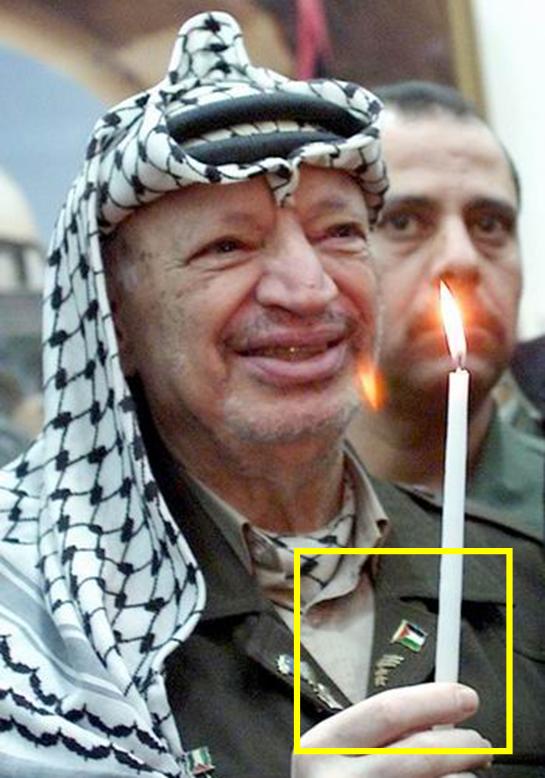
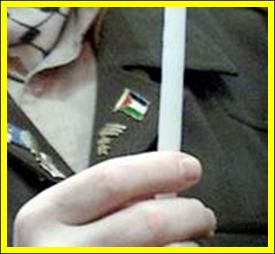
Well, the PLO certainly seems to have nothing against Seeds of Peace, which would be consistent with Seeds of Peace being pro-PLO. Yasser Arafat proudly wore the Seeds of Peace pin on his lapel, giving it pride of place right underneath the Palestinian flag.
 |
 |
 |
I will argue that the ZOA is right, and that Seeds of Peace is indeed “pro-PLO and anti-Israel.” Supposing I convince you, what will we conclude about the foreign policy of the US government, which strongly backs the Seeds of Peace program? That it is pro-Israel?
_________________________________________________________
The power behind Seeds of
Peace
_________________________________________________________
Let me first make clear what kind of clout is behind Seeds of Peace. Although this may seem hard to believe, yet it is true: the US House of Representatives, on the taxpayer’s dime, introduced a special resolution -- H. Con. Res. 288 -- just to praise Seeds of Peace. This resolution says that Congress
“(1) honors the accomplishments of Seeds of Peace for promoting understanding, reconciliation, acceptance, coexistence, and peace among youth from the Middle East and other regions of conflict around the world; and
(2) offers Seeds of Peace as a model of hope that living together in peace and security is possible.”[4]
In addition to extolling the alleged virtues of this organization, the same Congressional resolution explains that:
“. . .previous Federal funding for Seeds of Peace demonstrates its recognized importance in promoting United States foreign policy goals.”
If the US House of Representatives goes out of its way to praise Seeds of Peace, and if the Federal government is funding Seeds of Peace because this program is “promoting United States foreign policy goals,” then perhaps Seeds of Peace is an important tool of US foreign policy.
What else?
To get a sense for the exposure Seeds of Peace gets, consider that:
“Seeds of Peace has been featured in The New York Times, USA Today, The Washington Post, Time Magazine, The Wall Street Journal, People Magazine, on ABC, CBS and NBC network programs including ‘Nightline’ with Ted Koppel, ‘60 Minutes’ with Morley Safer, ‘Sunday Morning,’ ‘The Today Show,’ and ‘Good Morning America,’ as well as on CNN, PBS and NPR.”[4a]
In order to raise funds, Seeds of Peace holds celebrity auctions. To get an idea for what these are like, consider that the fifth such auction, held in 14 January 2003, was hosted by Janeane Garofalo “with special guest, The Honorable William J. Clinton, 42nd President of the United States,” no less.[4b] In fact, as mentioned in a UCLA write-up of a Seeds of Peace event there, “Former U.S. presidents George Bush, Senior, and Bill Clinton serve on its advisory board.”[5] The sixth celebrity auction, held 10 February 2004, was hosted by Al Franken and featured “former US Secretary of State, Madeleine K. Albright.”[5a] And the press release for the latest such auction (February 16 2005) informs me that “This year’s event honored Christiane Amanpour of CNN; Former Assistant Secretary of State James Rubin; and former US Ambassador to the UN Richard C. Holbrooke.”[6]
This is not just any organization.
But the true measure of that lies in the fact that “Aaron David Miller became President of Seeds of Peace in January 2003.”[7] Who is he?
“For the last two decades, [Miller] served at the Department of State as an adviser to six Secretaries of State, where he helped formulate U.S. policy on the Middle East and the Arab-Israel peace process, most recently as the Senior Adviser for Arab-Israeli Negotiations. He also served as the Deputy Special Middle East Coordinator for Arab-Israeli negotiations, Senior Member of the State Department’s Policy Planning Staff, in the Bureau of Intelligence and Research. . .”[8]
Aaron Miller is a major power who has been making US policy towards Israel and the PLO all these years. In fact, as the Oslo process was taking its first steps, in 1994, the Jerusalem Post described Miller like this:
“. . .the trio that implements Middle East policy at the State Department [are] State Department planning director Dennis Ross, …and his two chief assistants, Dr. Daniel Kurtzer and Aaron Miller…”[9]
Seeds of Peace, also taking its first steps in 1994, is the organization that Aaron Miller now presides. This increases the probability that Seeds of Peace is an important tool of US foreign policy in the Arab-Israeli conflict. But any remaining doubts on that score are dispelled the minute you take a closer look.
As we’ve seen above, Aaron Miller worked in the State Department’s Bureau of Intelligence and Research. What is that? According to the Department of State's website,
“The Bureau of Intelligence and Research (INR). . .drawing on all-source intelligence, provides value-added independent analysis of events to Department policymakers, ensures that intelligence activities support foreign policy and national security purposes [emphasis mine]; and serves as the focal point in the Department for ensuring policy review of sensitive counterintelligence and law enforcement activities. INR’s primary mission is to harness intelligence to serve U.S. diplomacy [emphasis mine]. The bureau also analyzes geographical and international boundary issues. INR is a member of the U.S. intelligence community.”[10]
Now, let’s see if we can put it together.
First, if the Bureau of Intelligence and Research (INR) deals with “all-source intelligence” in order to ensure that “[US] intelligence activities support [US] foreign policy,” the better to “harness intelligence to serve US diplomacy,” then INR is not merely “a member of the US Intelligence community” but an important brain of US Intelligence.
Second, Aaron Miller’s title at the Bureau of Intelligence and Research is interesting. He was “Deputy Special Middle East Coordinator for Arab-Israeli negotiations, Senior Member of the State Department’s Policy Planning Staff, in the Bureau of Intelligence and Research.” This would mean that Aaron Miller was one of the most important US government officials working to harness intelligence activities to support US foreign policy goals in the Arab-Israeli conflict.
Third, the obvious: “US intelligence activities” are often the sort of thing that nobody notices -- such things are therefore called ‘covert’ work. This is what you would be doing, certainly, if you were involved in counterintelligence and ‘law enforcement’ intelligence work, which is what the Bureau of Intelligence and Research specializes in (see above).
What have we learned?
That a master at doing things in secret which in public appear very differently, the better to advance the foreign policy goals of the US ruling elite in the Middle East, is who runs Seeds of Peace.
This has certain consequences. For example, it raises the probability that Seeds of Peace is in fact a US Intelligence operation. It also makes it quite likely that Seeds of Peace will indeed implement US foreign policy goals to the letter, just as the US House of Representatives obviously thinks it does, since it loudly extols Seeds of Peace for “its recognized importance in promoting United States foreign policy goals.”
Now, it is beyond question that this organization has all the necessary clout to give power to any teenagers it designates as future leaders. Below I will show that, indeed, Seeds of Peace makes certain young leaders of its choosing prominent and powerful. I will focus on the most famous graduate of Seeds of Peace: the young West Bank Arab Fadi El-Salameen (his name is also spelled Fadi Elsalameen). Once I have established how prominent El-Salameen has become, and how much support he gets from the US ruling elite, I will turn to the question of what Seeds of Peace has equipped him with. Is El-Salameen really acquiring those “leadership skills required to advance reconciliation and coexistence”? And if not, then why not?
_________________________________________________________
Fadi El-Salameen and his
political importance
_________________________________________________________
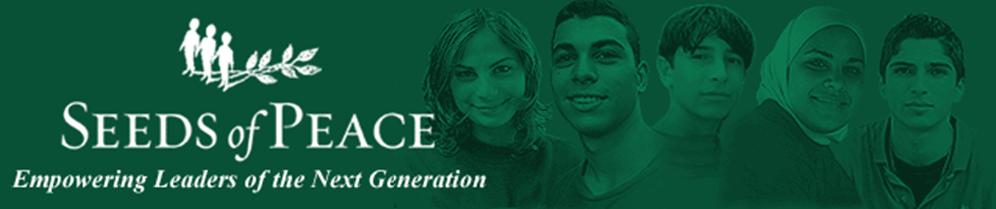
Evidence of how important El-Salameen is may be seen right away in that his face is part of the green publicity banner for Seeds of Peace, which appears at the top of their website (he appears on the far right, no pun intended):
But that’s nothing. At the same congressional session that introduced a resolution just to praise Seeds of Peace, Congresswoman Lois Capps, the representative from California, asked for some time so that she could extol Fadi El-Salameen himself.
“Mrs. CAPPS: Mr. Speaker, I thank the gentleman for yielding me this time.
Mr. Speaker, I rise in strong support of this important resolution honoring Seeds of Peace. I thank the gentleman from Maine (Mr. Allen) for authoring this resolution.
In describing the Day of Redemption, the Prophet Isaiah tells us ‘a little child shall lead them.’ During the past 3 years of violence and bloodshed, it is clear that the leaders of Israel and the Palestinian Authority have failed their people. The beauty and wisdom of the Seeds of Peace program is to instill within Israeli and Arab children a sense of understanding, reconciliation, and acceptance so that some day these future leaders can bring peace to their embattled peoples.
Mr. Speaker, my office is well acquainted with Seeds of Peace through its relationship with one of its most illustrious graduates, a young man named Fadi El Salameen. The oldest of nine children from a Palestinian family in Hebron, Fadi has overcome incredible hardships in his life and is currently studying at Earlham College in Indiana. He tells us that he owes his success, self-confidence, and his optimism for peace in the Middle East to his experiences in the woods of Maine with Seeds of Peace.”[12]
Remarkable.
Mrs. Capps says that “the leaders of Israel and the Palestinian Authority have failed their people,” and so it will be the “future leaders” trained by Seeds of Peace who will make peace. And she singles out for special praise “one of [Seeds of Peace's] most illustrious graduates, a young man named Fadi El Salameen,” who according to one source (below), in the year 2005, is just 21-years-old. Such extraordinary praise for El-Salameen, almost a teenager, comes on the heels of Capps’ quotation from the prophet Isaiah foretelling that “a little child shall lead them.” The Book of Isaiah is the Jewish book where the Messianic tradition originated, and Mrs. Capps is quoting a Messianic prophecy, so one could interpret her words as an implication that Fadi El-Salameen -- a West Bank Arab -- is ‘the Jewish Messiah’!
How many people -- let alone how many non-Jewish foreign 21-year olds -- get obliquely called ‘the Messiah’ in the US House of Representatives? I would wager, not too many. So the above is evidence that the US Establishment goes out of its way to push El-Salameen and give him power.
Fadi El-Salameen now has his own organization, Voice of Arab Youth, which he founded and directs. And he is very close to the top leadership of the PLO (Yasser Arafat handpicked him for Seeds of Peace).[12a] He is indeed an emerging leader. To us, he will be a great teacher. Why? Because he is “one of [the] most illustrious graduates” of the Seeds of Peace program, so an analysis of El-Salameen’s politics will teach us what the Seeds of Peace program is trying to produce. And since Seeds of Peace, according to the US House of Representatives, is “promoting United States foreign policy goals,” Fadi El-Salameen’s politics will also teach us what those goals are.
_________________________________________________________
Fadi El-Salameen’s support
for Mahmoud Abbas, and what that means
_________________________________________________________
Writing for the Israeli Insider, M.J. Rosenberg reports what Fadi El-Salameen shared with him in an email, following the death of Yasser Arafat and the rise of Abu Mazen. Rosenberg writes:
“Young Palestinians, traditionally the most militant, also seem ready for a new chapter in Palestinian life. That is what I heard the other day in an e-mail I received yesterday from Fadi Elsalameen, a 20-year old Palestinian who is from the Hebron area.
[Fadi] wrote me about the mixed feelings he experienced at Yasir Arafat’s funeral. He had met Arafat and, like all Palestinians his age, had known no other leader. He believes Arafat put his people on the map but that the past is past. . . ‘people are ready to move on.’ And, for him, that means moving toward pragmatism and supporting Abu Mazen [Mahmoud Abbas]. . .”[13]
Yasser Arafat was a career antisemitic terrorist and a disciple of Hajj Amin al Husseini, one of the leaders of Adolf Hitler’s Final Solution in World War II, which is why Yasser Arafat dedicated his entire professional life to the killing of innocent Jews.[13a] Can this be what Fadi El-Salameen means when he says that “Arafat put his people on the map”?
What I see above is that, in his email to Rosenberg, Fadi El-Salameen missed a great opportunity to denounce Arafat, and to denounce the constitutions of both Al-Fatah and the PLO, which call for the extermination of the Jews.[14] That sort of thing would have been consistent with Fadi El-Salameen sincerely wanting peace with the Israeli Jews.
But notice that Rosenberg accepts El-Salameen’s support for Mahmoud Abbas, expressed in the same email to Rosenberg, as a positive sign. The implication here is that Abbas is not like Arafat: Abbas really wants peace. And if we accept this premise then, yes, El-Salameen’s support for Abbas (which really is quite strong[15]) can be interpreted as a positive sign, as Rosenberg does. But if Abbas is an antisemitic terrorist just like Arafat, then Rosenberg will be interpreting things precisely upside down. So this question matters: Is it likely that the replacement for Yasser Arafat, a career antisemitic terrorist who kept himself in power by fanning antisemitism, will be someone who wants to make peace with Jews?
That seems unlikely. But since the question of whether Fadi El-Salameen endorses antisemitic terrorism or not hinges on the nature of Mahmoud Abbas, I will take a few words to convince you that Mahmoud Abbas, indeed, is an antisemitic terrorist. However, I am aware that there is an effort to convince everybody that he is a moderate, so I will begin by giving you a picture of how just how passionately this interpretation of Mahmoud Abbas is pushed in the mass media, the better to mobilize a healthy skepticism towards the well-endowed news services.
Is Mahmoud Abbas a moderate?
_______________________________
I ran a little test on September 20, 2005, that anybody with access to the Lexis-Nexis Academic database can easily repeat.
First, limiting myself to “major papers,” I asked the database to give me any newspaper articles that mentioned the word ‘antisemite’ or ‘anti-Semite’ within ten words of ‘Abu Mazen,’ which is Mahmoud Abbas’s nickname. I got nothing. Zip. Then I tried the word ‘terrorist’ within ten words of ‘Abu Mazen.’ This gave lots of results but when I started reading the articles I noticed that the word ‘terrorist’ and the nickname ‘Abu Mazen’ usually did not even appear in the same sentence.[16] These articles were not saying that Abu Mazen was a terrorist in the least. I was looking for something like, ‘the terrorist Abu Mazen,’ ‘Abu Mazen, the terrorist,’ ‘Abu Mazen, who is a terrorist’ -- anything like that. So I shortened the search to ‘Abu Mazen’ within 5 words of ‘terrorist.’ This time I got only 62 results, and as I started reading the articles I found the same phenomenon: the word ‘terrorist’ would end one sentence and the name ‘Abu Mazen’ would begin the next, as in “...and ceasing the targeted killings of suspected terrorist leaders. Abu Mazen may represent Israel’s best chance...”[17] Or else these were sentences that explicitly alleged that Abu Mazen was not a terrorist, as in “Sharon spokesman Raanan Gissin said: ‘Contrary to Arafat, Abu Mazen is against terrorist activity...’” (which claim, by the way, is precisely what M.J. Rosenberg implies, above).[18]
So, according to my test, nobody much seems to accuse Abu Mazen (Mahmoud Abbas) of being a terrorist. That’s interesting because Fatah is one of the world’s worst terrorist organizations, and “Abu Mazen is...one of the founders of Fatah, one of the original Arafat band of brothers.”[19] Moreover, Fatah is the controlling organ in the PLO, and as early as 1992 the PLO made clear that Mahmoud Abbas would be Yasser Arafat’s replacement.[20]
I tried one more search. This time I asked the database for appearances of ‘Abu Mazen’ within ten words of ‘moderate.’ Now I got a grand total of 121 results. Below I reproduce not a cherry-picked selection of these but simply the first five in the chronologically ordered list. You will notice an obvious -- and lightning quick -- progression.
1) 1992 (Financial Times). “Mr [Mahmoud] Abbas, whose nom de guerre is Abu Mazen and who is regarded as a moderate...”[21]
Notice the words “who is regarded as.” They seem innocent, but they are not. If some people regard Abbas as a moderate, it should matter to the reader who these people are. Are these people sane or insane? Knowledgeable or ignorant? Impartial or biased? All of these things can potentially be ascertained by the reader if only the identities of those who supposedly consider Abbas a moderate are not withheld. Why is the Financial Times leaving out this vital information? Well, the first hypothesis for the goal of any behavior ought to be that its actual effects were intended: so it appears that the Financial Times wants the reader to infer that it is a scientific and/or widespread opinion that Abbas is a moderate.
And yet the representation here is still somewhat careful, because the Financial Times does not stick its neck out to say that Abbas is a moderate in the newspaper’s opinion. It merely ‘reports’ that others (supposedly) think this. Brilliant, on the hypothesis that this is anti-Israeli propaganda; or else remarkably bad and coincidentally anti-Israel journalism, under the hypothesis that this is an innocent mistake.
Which hypothesis would subsequent Financial Times behavior support?
2) 1993 (Financial Times). “Mr Mahmoud Abbas (Abu Mazen), the PLO moderate. . .”[22]
And again:
3) 1993 (Financial Times). “Mr Mahmoud Abbas (Abu Mazen)...a key moderate...”[23]
The views at the Financial Times matured quickly in a consistent direction: Abbas began as “a moderate” according to implied but unidentified multitudes, and a year later became “the PLO moderate” (said in passing because it is so obvious), and also “a key moderate.”
Could Abbas become any more moderate? Yes he could.
4) 1994 (The Observer). “Abu Mazen, the leading moderate in the PLO. . .”[24]
But with a little effort, who’s to say that Abbas could not become an arch-moderate?
5) 1995 (The Guardian). “...the arch-moderate Abu Mazen...”[25]
This is now the ceiling; by 1995, the propaganda had reached its final destination.
Now, here is what ought to be terribly surprising to anybody who was taught by the mainstream media, the US government, and the Israeli government, to think of Mahmoud Abbas (Abu Mazen) as a moderate: After Yasser Arafat died, the Fatah terrorists who publicly cried against ‘peace’ and promised to go on killing innocent Israelis were precisely those most eager to see Mahmoud Abbas succeed Yasser Arafat as Fatah chief.
An Associated Press wire dated 27 November 2004 reports that:
“. . .in the Balata refugee camp near the West Bank city of Nablus, about 1,000 Palestinians -- including scores of armed, masked militants affiliated with Fatah -- demonstrated for the continuation of the uprising.
The demonstrators also declared their support for Mahmoud Abbas, the new head of the Palestinian Liberation Organization and Fatah’s candidate in Jan. 9 presidential elections.”[26]
The Al-Aqsa Martyrs Brigade branch of Fatah was passionate, taking Abbas’s side vociferously when it seemed like Marwan Barghouti, another Fatah leader, might seek the post:
“Abbas already has been nominated as Fatah’s presidential candidate, so Barghouti must run as an independent. But as a leading Fatah member, he would likely undermine Abbas’ prospects. . . Zakaria Zubeidi, the 29-year-old West Bank leader of the Al Aqsa Martyrs’ Brigades, a violent group linked to Fatah, said he would back Abbas. ‘Barghouti. . .should resign from Fatah,’ he told The Associated Press.”[27]
The Al Aqsa Martyrs’ Brigades, as Newsday once explained, is “the deadliest Palestinian militia,”[28] so what we see above is that the most extreme Arab terrorists in the West Bank and Gaza are also the most enthusiastic supporters of Mahmoud Abbas.
Why? Because Mahmoud Abbas is an arch-moderate?
By the way, it is precisely the Al-Aqsa Martyrs Brigade that quickly claimed responsibility for the 25 February 2005 suicide bombing that broke the cease-fire between Israel and Mahmoud Abbas’s Palestinian Authority.[29] And they did indeed carry out the attack, as was subsequently shown.[30] As I have argued elsewhere, this requires that Mahmoud Abbas himself gave the order for this terrorist attack of 25 February, 2005.[31] Why? Because Mahmoud Abbas is the leader of Fatah, the PLO, and the Palestinian Authority, and the structure of Fatah, the PLO, and the Palestinian Authority is utterly authoritarian, so it is inconceivable that Al-Aqsa Martyrs Brigade -- part of Fatah -- carried out a suicide bombing on 25 February without Mahmoud Abbas -- the Fatah chief -- giving the order.[32] If it had, and if Mahmoud Abbas disagreed with such actions, then he would naturally have castigated the Brigades publicly. Instead, Abbas’s Palestinian Authority pretended that the Lebanese Hezbollah -- a terrorist group that was denying responsibility -- was responsible.[33]
So what we have is that Mahmoud Abbas gave an order to murder innocent Israelis and break the cease-fire.
This will be surprising if you still believe -- understandably, given the barrage of repetitions in the media -- that Mahmoud Abbas is really a moderate. You will be less surprised if you have heard that Abbas’s PhD thesis is an exercise in Holocaust denial.[34] And even less surprised if you knew that Mahmoud Abbas, far from ever opposing Arafat’s terrorism, appears to have been the power behind the scenes when Arafat lived. Consider only that the Oslo ‘peace’ process resulted from “secret talks conducted [by]. . .Shimon Peres, the Israeli Foreign Minister, and Abu Mazen [Mahmoud Abbas],”[36] which is why it is not Arafat’s signature on the Oslo agreement, but Mahmoud Abbas’s, who not coincidentally is called the “architect” of Oslo.[37] And if you’ve heard that Mahmoud Abbas invented the so-called PLO ‘peace’ strategy in order to use it as a shrewd ploy to destroy Israel in stages,[35] then you simply cannot be surprised to find that he ordered the 25 February suicide bombing.
This has consequences. For example, given that Mahmoud Abbas is the man whom the West Bank Arab Fadi El-Salameen strongly endorses, it raises the probability that Fadi El-Salameen supports antisemitic terrorism. And this is troubling, because Fadi El-Salameen is “one of [the] most illustrious graduates” of Seeds of Peace, which organization appears to be a US Intelligence foreign policy tool in the Middle East.
(More troubling: M.J. Rosenberg, who, as we saw, considers Fadi El-Salameen’s support for Mahmoud Abbas a hopeful sign for peace, turns out to be “former editor of AIPAC’s Near East Report,” and AIPAC is supposed to be the pro-Israeli lobby.[37a] Rosenberg’s position is inconsistent with the idea that AIPAC tries to produce pro-Israel US foreign policy, but it agrees nicely with the fact that AIPAC can easily be found applauding pro-PLO US foreign policy.[38])
Now, but if Fadi El-Salameen indeed supports antisemitic terrorist violence, it shouldn’t be too hard to document an ideology consistent with this by taking a look at the things El-Salameen says. Happily, conducting this test is easy because the young Fadi El-Salameen is quite loquacious.
_________________________________________________________
Fadi El-Salameen, in his own
words
_________________________________________________________
In the article quoted earlier by M.J. Rosenberg, the author reports that “Fadi’s hope is for ‘peace and reform.’” And yet Rosenberg’s next sentence is that “Not surprisingly Fadi does not love the Israelis.”
Wait. Not surprisingly?
I find it natural that someone who wishes to kill Israelis hates Israelis, but it seems to me that one is entitled to some surprise when Fadi from Seeds of Peace says he wants “peace and reform” and then turns out to hate the Israelis. So Rosenberg’s reasoning is at least strange, because he reports that this is not surprising.
Rosenberg continues:
“[Fadi El-Salameen] told me on several occasions that in Hebron ‘you don’t meet the good Israelis from Tel Aviv or Haifa or wherever but the very worst of Israeli society: the Hebron settlers from Brooklyn. They live to torment us, to humiliate us. But I don’t even consider them Israelis, just settlers. I have met enough real Israelis to know we can have peace with them. I don’t have to love them and they don’t have to love us. Respect is all that is required and the understanding that both peoples have the right to live in security on their own land.’
But he has no illusions about the Palestinians being able to accomplish that goal alone. The Palestinian future ‘will have to be shaped by the combined efforts of Palestinian, Israeli, and American leaderships. We Palestinians must rise to the occasion. Israelis must act to ease Palestinian conditions so that a new legitimate leadership can be elected. And Americans on the other hand, must seize the opportunity and invest serious efforts with heavy backing from President Bush himself to bring a fair and honest solution to the table.’ He also wants the Arab states to play a role.”
Let's see. El-Salameen says that “[the] Israelis must act to ease Palestinian conditions” and that “[the] Americans…must seize the opportunity and invest serious efforts.” What he neglects to say is that the West Bank and Gaza Arabs must stop killing innocent Jewish civilians. What he says instead is that “We Palestinians must rise to the occasion,” which can be interpreted to mean anything at all. Certainly, a terrorist who temporarily adopted a ‘peace’ stance in order thereby to dupe his well-meaning future Jewish victims could describe this sort of thing as “rising to the occasion,” so long as this was the occasion that the terrorist leadership would like him to rise towards.
If this were the case, then Fadi El-Salameen might easily let it slip that he hates the Jewish settlers. And he does. Look at how he describes Jewish settlers in the West Bank town of Hebron: “the very worst of Israeli society [are] the Hebron settlers from Brooklyn. . .I don’t even consider them Israelis, just settlers.”
This sort of thing makes me worry, because the Seeds of Peace program is supposed to be “bringing Arab and Israeli teenagers together before fear, mistrust and prejudice blind them from seeing the human face of their enemy.” And yet El-Salameen goes out of his way to say that he does not love even the “good Israelis” or “real Israelis” who support a PLO state: “I have met enough real Israelis to know we can have peace with them. I don’t have to love them. . .”
If this is “one of [the] most illustrious graduates” of Seeds of Peace, can we expect the mediocre graduates to be less racist?
And El-Salameen’s description of the settlers deserves a comment. He says, “They live to torment us, to humiliate us.” They do? But it is not the Israeli settlers who are strapping bombs around the waists of their children and sending them to die killing Arab children. It is the Arab terrorists who do that to Jewish children. The Israeli settlers are guilty of having settled: it is their mere presence that offends Fadi El-Salameen. One does not wish to exaggerate, but it is not impossible to read into El-Salameen's words that Jews offend him if they live. In such a case El-Salameen’s solution would be for these Jews to die, which would make him not just an obvious antisemite, but something far worse: a violent one.
What is beyond any doubt is that El-Salameen is more comfortable talking about his hatred of Jews than about ‘peace.’ The following is reported, amazingly, in the Seeds of Peace own website:
“Even after attending the [Seeds of Peace] camp, El-Salameen found himself infuriated when the Israeli army shut down the main road from his town into Hebron -- and then slashed the tires of a taxi driver he knew when he tried to use it. ‘When you see something like that, it’s just sowing seeds of hate,’ he says, eerily and unconsciously inverting the group’s name.”[40]
It is eerie -- at least.
Assuming El-Salameen is reporting a true event, why did the Israeli army shut down the main road to Hebron? The IDF does things like these, as well as institute checkpoints where West Bank Arabs are searched, for the same reason that Israel is building a wall to separate Israelis from West Bank Arabs: because innocent Jewish civilians are routinely blasted to shreds in all directions by Arab suicide terrorists. It is these perfectly sensible -- and, I might add, compassionate -- reactions to Arab terrorism that El-Salameen considers to be “sowing seeds of hate.” Not the terrorism, note. El-Salameen would not hate the Jews, it appears, if they would just die quietly.
Were El-Salameen's friends killing Jews?
________________________________________
When he spoke to Paradise Valley eighth-grade students about “conflict resolution,” as a representative of Seeds of Peace, Fadi El-Salameen ‘explained’ that:
“‘A number of my friends were killed by Israeli soldiers; some of them from very close range for absolutely no reason,’ Mr. Elsalameen said when asked about the Israeli-Palestinian conflict’s effect on his life. ‘You’re always in constant fear living on the West Bank.’”[41]
Were friends of El-Salameen killed by Israeli soldiers? Who knows. But from other things El-Salameen says, if his friends really were killed by Israeli soldiers, it does not appear that they were innocent victims:
“The parents of my friends who were shot by the IDF one or two years ago are still mourning. They wipe tears from their eyes, and at their homes, pictures from the funerals and posters showing their dead sons as heroes are still hanging on the walls.”[42]
If these friends of El-Salameen were shot “from very close range for absolutely no reason” then they were arbitrarily executed, in which case they are simply victims. Why does El-Salameen call them “heroes”? Here is a hypothesis: it just slipped out. You see, ‘hero’ would be the fatal mistranslation of the Arab Muslim concept of shahid, often also mistranslated as ‘martyr.’ A shahid is honored and rewarded by Allah for killing infidels.[43] If this is what El-Salameen’s friends were, shahids, then it would make sense for him to call them ‘heroes’ in English, assuming that El-Salameen is a violent antisemite. But then, if his friends were shahids, like the members of the Al Aqsa Martyrs Brigade, the deadliest Arab terrorist group in the West Bank and Gaza, it is impossible that they were killed “for absolutely no reason.” They were killed for a reason: because they murder innocent civilians, which is to say ordinary men, women, and -- yes -- children.
Perhaps the most important point here is that El-Salameen is spreading his slanders against the Israelis to American high-schoolers as a representative of Seeds of Peace. This is how the American taxpayer's dollars go to work: to spread antisemitic lies.
And they are lies. It should be obvious that the IDF does not have a policy to go around killing innocent Arab civilians for no reason: it is extremely careful to protect civilians in the enemy population -- more so than any army in the world. In fact, the distaste for any kind of unnecessary violence in the Israeli army is so strong, that even the already superior ethical behavior of the Israeli army is not good enough for many soldiers, who in consequence now refuse to serve. So the accusation that El-Salameen makes -- namely, "A number of my friends were killed by Israeli soldiers; some of them from very close range for absolutely no reason" -- is hard to believe, and things that are hard to believe require extra careful evidence. And yet, accusations without evidence against the Israeli army, with precisely this structure, happen to be very common.
For example, in 2002 the media blared incessantly that the IDF had supposedly gunned down unarmed civilians in the UN refugee camp of Jenin (they claimed 500 Palestinian casualties). Yasser Arafat compared the IDF operation to the WWII Nazi attack on Stalingrad, where 600,000 people were killed.[44] As was subsequently shown, the IDF was in fact extremely careful to protect civilians in its operations in Jenin, sustaining heavy casualties precisely because they fought door-to-door in order to protect civilians, rather than simply bomb the place. As had been shown already by a BBC investigation, the UN refugee camp at Jenin contained a secret bomb-making factory and a secret weapons-making factory run by “the Al-Aqsa brigade, the military wing of Yasser Arafat’s Fatah organisation.”[45] Moreover, as the BBC also explained, “Jenin, just a few miles from the Israeli town of Afula, has become one of the most important bases from which suicide attacks are launched.” This is why the IDF, naturally, had to do something about the terrorism coming out of Jenin. It has now been established that 23 IDF soldiers were killed versus 56 Palestinian terrorists, figures that Arab news sources such as Al Jazeera, and even the PLO, in fact, no longer dispute.[46] And what is now accepted by everybody is precisely what the IDF, from the beginning, claimed had happened. That makes sense: the ratio 23/56 is not the ratio of a massacre by IDF soldiers of unarmed Palestinian Arab civilians; it is the ratio of a combat operation against terrorists who fired back, and in which the IDF, though victorious, nevertheless put its soldiers at considerable risk, and sustained heavy losses, in order to protect Palestinian Arab civilian life. This has been dramatically documented in the film “The Road to Jenin,” by Pierre Rehov.[47]
By contrast, in order to accuse the Arab leadership in the West Bank and Gaza of serious human rights violations, there is zero need to create a media hoax: these are proud terrorists, who boast about it every time they tear into pieces the flesh of another innocent man, woman, or child.
Which may suggest the a propos question:
What did Fadi El-Salameen say about the 25 February Al
Aqsa Martyrs Brigades suicide attack?
_____________________________________
This would be the suicide bombing that broke the Sharm El-Sheikh ceasefire, and which Mahmoud Abbas, whom El-Salameen supports, ordered.
About this, El-Salameen said:
“With the continuous cycle of violence in the Middle East, people have lost hope or even interest in any kind of a peace agreement. Human beings are blown up, because of the contagious hatred that is being spread among them. Palestinians and Israelis have forgotten the meaning of life; they rather die than live in this nightmare. Why? Because politicians are not willing to give up to each other. They are too busy teaching each other lessons.”[48]
You might think from reading this that the incident in question was a shootout between Arabs and Jews. But Fadi El-Salameen is writing the above as a commentary on the murder of innocent Israeli civilians by Arab terrorists. El-Salameen says “Human beings are blown up” as an abstraction, but it is in fact innocent human beings of the Israeli variety that are getting blown up, and those doing the blowing up, the ones who “have forgotten the meaning of life,” are Arabs who strap explosives around the waists of their children and send them to die killing other people’s children. I haven’t seen any reports of Israeli suicide bombers.
El-Salameen says this violence happened “Because politicians are not willing to give up to each other.” Given that Arab terrorists had just murdered innocent Jewish civilians, which politicians do you suppose had to “give up” to which, in his view?
El-Salameen continues:
“Instead of being busy solving the long suffering of two nations, they are intimidating each other. Until when? Until one nation wipes out the other? So the other one can live quietly? It will never happen. The Israelis will never leave Israel, and the Palestinians will never give up the hope of having a state of their own. This is the reality that the politicians have to deal with, and if they don’t, this is the price that will be paid. More and more people will be victimized on both sides.
This will reward a close reading.
“[T]his is the price that will be paid.”
It is? The incident in question is the murder in cold blood of innocent Jews. El-Salameen is promising more of that.
“More and more people will be victimized on both sides?”
Why “both sides”? There was supposed to be a cease-fire. The Israelis didn’t break it. Again: the event in question is a mass murder of innocent Jewish civilians by Arab terrorists.
“[The] two nations. . .are intimidating each other.”
They are? Why is it fair to say that the two sides are intimidating each other when the Arabs break a ceasefire by mass murdering innocent Jewish civilians?
Now, consider El-Salameen’s question. He wants to know whether this will continue “until one nation wipes out the other?” Which ‘nation’ would be wiping out which? No Israeli law calls for the extermination of the Arabs, and the Arab citizens of Israel are the best treated Arabs in the Middle East. They certainly have their human rights respected above and beyond the treatment Arabs get anywhere in the Arab states, and even the Arab women can vote in Israel (practically the only Arab women who vote anywhere). So the government of Israel should logically be the last government suspected of wishing gratuitously to mistreat Arabs in the Middle East.
By contrast to Israeli law, the PLO Charter, the Fatah Charter, and the Hamas Charter do call for the extermination of the Israeli Jews.[14] Meanwhile, any Jew who wanders into the West Bank risks being torn limb from limb. This is not, by the way, a metaphor:
“Palestinian antagonism is such that when two uniformed Israeli reservists stray into Ramallah -- not two undercover commandos, as the Palestinian media claims -- they get torn limb from limb. . .”[49]
Which means that their arms and legs were pulled out of their sockets by a deranged mob. So the only sensible translation of El-Salameen's phrase, “until one nation wipes out the other,” is “until the Arabs wipe out the Jews.”
Consider, finally, what El-Salameen says, in the same article, when he makes direct reference to the 25 February attack:
“The discotheque bombing in Tel Aviv was uncalled for, totally irresponsible, and fully supports the idea of dehumanizing the other side just like the use of F-16’s against innocent people.”[50]
Figure that: the murder of innocent Jewish civilians in the prime of their lives, out for a little dancing fun, is “irresponsible,” and even “uncalled for.” Would you call it that if your children had been in that discotheque? And notice that El-Salameen reserves the label “innocent people” for Arab civilians supposed to have been deliberately murdered in IDF attacks. It’s almost as if he doesn’t realize that what happened here is that Fatah broke the ceasefire by murdering innocent Jewish civilians. And yet he just mentioned it himself.
El-Salameen’s representation of the IDF is of course entirely gratuitous. Israeli F-16s obviously do not target civilians; the IDF is careful to target terrorists. Sometimes civilians do become casualties of IDF operations, but not because they were specifically targeted. The difficult problem the IDF has is that its terrorist enemies hide in the middle of civilian populations. Those responsible for Arab civilian deaths, then, are the terrorists who -- without any regard for these people’s lives -- use them as shields when they are not using them as bombs.
I looked hard for a statement where the most famous of all Seeds of Peace graduates, Fadi El-Salameen, actually denounced Arab terrorism. This is the only one I could find:
“As long as Palestinians feel as if they are in the biggest prison in the world, there will be no peace. And as long as Israel’s security is threatened by suicide missions, there will be no peace.”[51]
But even this expresses an absurdity, because it suggests an equivalence between Arab and Israeli suffering. The measures that the Israeli government has taken, and which have made some “Palestinians feel as if they are in the biggest prison in the world,” are not gratuitous measures; they were taken because West Bank and Gaza Arabs murder Israeli civilians. If these Arabs did not murder Israeli civilians, they would not be living in the biggest prison in the world.
The demonstration is in how these Arabs were treated when the government over them were not the PLO gangsters, but the Israeli government. Here is a description of what the Israeli ‘occupation’ was like, before the Oslo ‘peace’ process brought so much violence to Israel. It is from Newsweek, writing in 1977:
“Arab living standards [in the West Bank] have jumped more than 50 per cent in the past ten years, and employment has nearly doubled, largely because of the $250 million annual trade that has grown up between the West Bank and Israel. The Israelis have also kept the Jordan River bridges open, allowing 1 million Arabs a year to cross and to keep their markets in Jordan for such products as olive oil, soap and farm produce. The Israelis also allow the Arabs to elect their own officials, even though the winners are often radical activists. Still, the Arabs say they have never been more unhappy. . .”[52]
During this time, suicide bombers were not emerging from the West Bank to murder innocent Israeli children, and life in the West Bank had never been better. And yet Newsweek reported that “Still, the Arabs say they have never been more unhappy.” Arab unhappiness therefore appears entirely unrelated to whether they are living in a prison or not. What really bothers so many of them, it seems, is that there are still Jews living and breathing. The prison that is choking them is a prison of the mind: antisemitism.
This is the prison that has also made an inmate of Fadi El-Salameen. And it is the prison that keeps other West Bank and Gaza Arab graduates of Seeds of Peace -- El-Salameen is not an exception.[52a]
_________________________________________________________
What is Fadi El-Salameen's position on how Abbas’s
Fatah oppresses the West Bank and Gaza Arabs?
_________________________________________________________
Those who live in the West Bank do live in “constant fear,” as El-Salameen says in one of the quotes above, but not because they are in danger of arbitrary violence against them by Israeli soldiers. The ones arbitrarily killing Palestinian civilians are the gangsters who call themselves ‘policemen’ in the areas controlled by the Palestinian Authority.
This is not a secret. It is well known to everybody who spends five minutes looking at how the PLO runs the Palestinian Authority that this ‘government’ specializes in oppressing the West Bank and Gaza Arabs. A demonstration here is nevertheless useful given that the media hardly does its job when it comes to making the public aware of what the PLO is like. And it is useful for another reason: it will teach us something important about Fadi El-Salameen. Once I have convinced you that the PLO engages in a great deal of anti-Arab violence, we can turn to this question: Does El-Salameen complain about it? If he does, then we can say that at least El-Salameen expresses concern for West Bank and Gaza Arabs; but if he does not, then the only thing El-Salameen cares about is the PLO, an antisemitic terrorist organization.
Establishing this has a larger significance, I remind you, because Seeds of Peace is a taxpayer-funded program led by an expert in how to use covert work to pursue US foreign policy goals in the Middle East. El-Salameen is “one of [Seeds of Peace's] most illustrious graduates,” and therefore it is fair to judge the intentions of the US ruling elite -- which went out of its way to praise El-Salameen in the US House of Representatives -- by this young Arab's performance.
How the PLO oppresses West Bank and Gaza Arabs
__________________________________________________
Here is what an Associated Press wire reported on November 27, 2004:
“The Palestinian Authority said Saturday it will disband a small security unit tainted by accusations of abuse, an initial step toward reforming its bloated network of overlapping and competing security forces.”[53]
Why does the Palestinian Authority have a “bloated network of overlapping and competing security forces”? And why should the PLO policemen be “tainted by accusations of abuse”? The wire continues:
“Palestinian reformers, as well as Israeli and U.S. officials, have long demanded a major overhaul of the Palestinian security services but faced stiff resistance from Yasser Arafat, who used the bloated security network to maintain his hold on power.”
We have our answer. If “Yasser Arafat used the bloated security network to maintain his hold on power,” then he was using his thugs to quash dissent among West Bank and Gaza Arabs: he was not protecting anybody. This is why the PLO policemen are accused of being gangsters: they are.
After explaining the above, the Associated Press makes an amazing claim:
“The stalled U.S.-backed ‘road map’ peace plan also called for a restructuring of the forces but coupled that with a call for a crackdown on militant groups, a demand the Palestinians have opposed, saying it could spark a civil war.”
The Palestinians have opposed this?
Not at all. Ordinary Arabs are not asked their opinion given that the Palestinian Authority is one of the most undemocratic and repressive governments in the world. So when the Associated Press says that “the Palestinians have opposed [a crackdown on the militant groups], saying it could spark a civil war,” it is the Palestinians in power who said this. In other words, the gangsters. After all, we were already told above that “Palestinian reformers. . .have long demanded a major overhaul of the Palestinian security services but faced stiff resistance from Yasser Arafat, who used the bloated security network to maintain his hold on power.”
The wire explains further that,
“Since Arafat’s death Nov. 11, his successors have taken steps to restore confidence in a Palestinian leadership long accused of corruption, calling for elections to choose a new leader and promising to be more open and accountable.
As part of that effort, Palestinian Preventive Security chief Brig. Gen. Rashid Abu Shbak said Saturday he would abolish the Gaza Security and Protections unit -- nicknamed the ‘death squad’ by Palestinians -- in the wake of accusations that some members abused their powers and used intimidation to rule the streets of Gaza.”
Doesn’t this say it all? The “Gaza Security and Protections unit” is called, by ordinary Arabs, the “death squad.” Who is it providing security and protection for, then? Not for ordinary Arabs -- that’s for sure.
“‘We are facing a new phase and we must say farewell to chaos and to all those who cause it in the Palestinian street,’ Shbak said in Gaza City. ‘We must clear the air of past mistakes of the previous era.’
The 70-person unit was formed more than a year ago to crack down on militant groups, including Hamas and Islamic Jihad, and to track and arrest high-profile criminals in Gaza.
Instead, some members of the unit were accused of turning into criminals themselves, confiscating land, smuggling weapons and intimidating the general public with threats of violence.”
These people, supposed to protect Palestinian Arabs, were instead “confiscating land, smuggling weapons and intimidating the general public [Gaza Arabs] with threats of violence.” Since they were called the “death squad” by ordinary Arabs, they were obviously making good on their threats. By contrast, when the Israeli government was the government in the West Bank and Gaza, these Arabs were holding local elections (even though they kept electing rabid antisemites), had freedom of the press, freedom to cross the border into Jordan and see their families and sell their produce, etc., as we saw earlier. They prospered tremendously (“Arab living standards…jumped more than 50 per cent in [a period of] ten years”), especially because they could get jobs in Israel. Violence was not a special problem because, unlike the Palestinian Authority, the Israeli government did not prey on them.
The Associated Press tells us that the PLO leaders supposedly are going to fix the continuing catastrophe where the PLO 'police' are the main criminals preying on Gaza Arabs. How will the PLO do this?
“The unit’s members will be dispersed to other units in the security system, Shbak said.”
But if the criminals who rob and kill ordinary Arabs are dispersed into other units of the PLO's so-called “security system,” which also rob and kill ordinary Arabs, how is this a solution? And notice that the above is not the only proposed reform:
“Shbak also announced plans to merge the ruling Fatah party’s fragmented and decentralized armed militias, including the Al Aqsa Martyrs’ Brigades, a militant group responsible for suicide bombings and other attacks on Israelis. The move was needed to make the militants more accountable and to end the gun chaos on Palestinian streets, he said.”
Once again we see that the Al Aqsa Martyrs Brigades, which Newsday called “the deadliest Palestinian militia,”[54] and which is responsible for suicide bombings and other outrages against innocent Israeli men, women, and children, is part of “the ruling Fatah party.” What is Fatah? It is essentially the PLO (in 1970 Fatah swallowed up the PLO but kept the name to preserve the appearance that the PLO was a coalition of groups).[55] And the PLO is the same thing as the Palestinian Authority, because it was the PLO that formed the PA. So Fatah is the government in the West Bank and Gaza. And Al-Aqsa Martyrs Brigade is part of Fatah. If "the ruling Fatah party’s fragmented and decentralized armed militias" are causing "gun chaos on Palestinian streets" then we have that the PLO police is not the only gangster organization preying on West Bank and Gaza Arabs: the PLO's antisemitic terrorist 'militias' do that too.
But at least Shbak says he is going to centralize them to make them "more accountable," you may say, with some hope. I hate to disappoint you, but the problem here is what Shbak means by "more accountable."
“‘These groups must be brought under control and there must be a central leadership that can be held responsible for their actions,’ Shbak said.
He said the committee would pursue ways to bring these armed groups under control without interfering with their ‘principles of resistance,’ indicating Fatah had no intention of pushing them to end the 4-year-old armed uprising against Israel.”
What Shbak wants is a leaner, meaner, antisemitic terrorist force. The point of the improved and streamlined command structure is to better attack Israel, because “Fatah had no intention of pushing them to end the 4-year-old armed uprising against Israel.” Which shows...what? That Mahmoud Abbas, Shbak’s boss, is in no way different from Arafat. He hardly wants peace.
Does Fadi El-Salameen complain about PLO violence
against West Bank and Gaza Arabs?
___________________________________
No. Just as I have found zero real denunciations by Fadi El-Salameen of Fatah’s plans -- i.e. Mahmoud Abbas’s plans -- to continue the violence against innocent Israeli civilians, I have found zero denunciations of any kind by Fadi El-Salameen of the violence daily perpetrated by Fatah on West Bank and Gaza Arabs.
What Fadi El-Salameen denounces is the presence of Israeli settlers in the West Bank, who are guilty of the 'crime' of raising a Jewish family nearby, which to El-Salameen is obviously far worse than PLO theft, extortion, and murder of Arabs. Since Fadi El-Salameen loudly supports Mahmoud Abbas, the leader of Fatah, and therefore the chief oppressor of West Bank and Gaza Arabs, one is forced to conclude that “one of [the] most illustrious graduates” of the Seeds of Peace program favors antisemitic terrorist violence even when killing Jews requires the widespread oppression of fellow Arabs who, unlike himself, are not plugged into the PLO power structure. This means that Fadi El-Salameen is about as extreme an antisemite as one can get.
And yet Fadi El-Salameen is a product of an organization calling itself Seeds of Peace! It would appear, then, that El-Salameen is another cog in the PLO strategy to talk ‘peace’ the better to dupe well meaning Israelis and kill them. To El-Salameen ‘peace’ is an Orwellian term that stands for ‘the extermination of the Jewish people,’ which is precisely what people such as Yasser Arafat and Mahmoud Abbas have always meant by ‘peace.’
Can it be coincidence, then, that someone else who used the word ‘peace’ in this manner was John Wallach, the founder of Seeds of Peace?
_________________________________________________________
What were the politics of
John Wallach, the founder of Seeds of Peace?
_________________________________________________________
To get a sense for John Wallach, consider that in a Washington Post editorial he wrote entitled “A Palestinian Israel Needs,” he defended Faisal Husseini -- until his death, Arafat’s right-hand man -- as a supposed moderate, telling his audience that “[Husseini] is reconciled to Israel's existence within its 1967 borders and has proved his willingness to help negotiate a two-state solution.”
Wallach acknowledged that many Israelis disagreed, and without a hint of irony explained that
“What angers the Israelis is that [Faisal] Husseini’s well-endowed Arab Studies Society published literature that glorified [my emphasis] some of Israel’s most brutal enemies, including Nazi sympathizers, and circulated ‘historical’ maps that show no place for Israel in the Middle East.”[56]
I suppose Wallach considered the Israelis to be overly sensitive?
Faisal Husseini's “well-endowed Arab Studies Society,” which publishes Nazi sympathizers who wish to destroy Israel, is, not coincidentally, funded by the Ford Foundation.[57] I say “not coincidentally” because the Ford Foundation was created by a man, Henry Ford, who was such a big Nazi that Adolf Hitler not only decorated him, but he kept a life-sized portrait of the American automaker in his office and told everybody that Ford was his inspiration.[58]
And where did Faisal Husseini’s Nazi sympathies come from? Just possibly, they could have something to do with the fact that he was the great nephew of the Grand Mufti Hajj Amin al-Husseini,[59] the same who mentored Yasser Arafat, and before that led Adolf Hitler’s Final Solution in Europe.[60]
It is interesting that Faisal Husseini’s deathbed statements agree very closely with Mahmoud Abbas’s entire approach to the so-called ‘peace’ process. In an interview he gave to the Arab-language weekly Al Arabi shortly before he died, Husseini compared the Oslo Process to a Trojan Horse, invented to make Israelis and Westerners believe in the PLO’s conversion to moderation, thus duping all sorts of people into supporting terrorists whose objective was the extermination of the Jewish people.
“. . .Faisal Husseini, the top PLO official in Jerusalem…[was] quoted as likening the Oslo accords to a ‘Trojan horse.’. . .[T]he weekly Al-Arabi,[61] quotes Husseini as calling the Oslo accords ‘just a temporary procedure, or just a step towards something bigger. . .the liberation of all historical Palestine from the (Jordan) river to the (Mediterranean) sea, even if this means that the conflict will last for another thousand years or for many generations.’”[62]
To the Mediterranean sea.
Doesn't leave much land on which to have the other state -- you know, the Jewish state. And yet John Wallach defended this man as someone who "has proved his willingness to help negotiate a two-state solution." A Trojan Horse? Yes, Faisal Husseini chose his metaphor carefully.
Since John Wallach was a big fan of Faisal Husseini and the one representing him as a supposed moderate, one has to wonder if Wallach wasn't a cog in the effort to dupe the Israelis with all the talk of ‘peace,’ the better to destroy them. That hypothesis gets further support from the fact that John Wallach wrote an entire biography lionizing Yasser Arafat.[63] Because, you see, Arafat sounded exactly like Faisal Husseini when he talked to Arab audiences in Arabic about the Oslo Process. This is what the Evening Standard reported in 1994, right as the Oslo ‘Peace’ Process got started:
“A tape-recording has surfaced of PLO leader Yasser Arafat speaking to Moslem followers in a Johannesburg mosque. . .Mr Arafat was exhorting his followers to prosecute a ‘jihad. . .to liberate Jerusalem.’ Mr Arafat does not deny the tape’s authenticity, but now says he meant ‘jihad’ in a metaphorical sense. A verbal jihad. A jihad of ideas. Nothing to do with violence. Mr Arafat’s effrontery adds insult to injury. In 1980, King Fahd of Saudi Arabia gave a clear definition: ‘What is meant by jihad is a united, comprehensive, integrated Arab-Islamic confrontation in which we place all our resources and our spiritual, cultural, political, material and military potential in a long and untiring ‘Holy War’ against Israel, of course, who else?’ So even if Mr Arafat really did mean ‘jihad’ in this novel, non-violent sense, his legions of followers would not have picked up the sophisticated nuance. They would have taken it to mean that the peace process was just a stratagem: a Trojan Horse which should now be exploited with maximum violence. At best, Mr Arafat was irresponsible. At worst, deeply dishonest.”[64]
So, given that John Wallach, an apologist for both Faisal Husseini and Yasser Arafat, is the founder of Seeds of Peace, one is entitled to suspect that Seeds of Peace is yet another effort to dupe well-meaning Jews, the better to set them up for slaughter. Of course, John Wallach did not represent his organization like that. What he said was that “the Seeds of Peace experience was a ‘detox’ program for getting rid of hatred before it poisoned the minds of emerging young leaders.”[65] But as we have seen, there is no evidence to suggest that his organization had any such effect on Fadi El-Salameen, who happens literally to be the poster boy for Seeds of Peace (his face is on the banner), and unquestionably an “emerging young leader” who owes much of his clout to his Seeds of Peace experience.
_________________________________________________________
So does the US
government want peace in the Middle East?
_________________________________________________________
This was our original question. I have tried to answer it by pointing out that the US government created Seeds of Peace as a tool of its foreign policy in the Middle East, and by documenting that this organization empowers and camouflages violent antisemites under its alleged ‘peace’ flag. The effect of this sort of thing is to dupe well-meaning Jews and prepare them for slaughter -- yet again. And the first hypothesis about any policy ought to be that its actual effects are intended.
So, although the US says it wants peace, and although it says it supports the State of Israel, actions (naturally) speak louder than words.

_________________________________________________________
Afterword...
How come the
founder and current president of Seeds of Peace both
say they are Jewish?
_________________________________________________________
In this afterword I will deal with an incongruity that really cries out for an explanation: the people implementing the anti-Israeli policies of the US government say they are Jewish. And it is not difficult to find Jewish publications celebrating them. . .
For example, Hadassah Magazine, which is published by the Women’s Zionist Organization of America, explains John Wallach’s founding of Seeds of Peace as follows:
“. . .John Wallach, former foreign editor for Hearst Newspapers and son of Holocaust survivors, felt compelled to wage peace.”[65a]
I have also seen John’s son Michael Wallach make the claim that his grandparents were supposedly Holocaust survivors.[65b]
You can see the problem right away: I have documented for you already that John Wallach was an extreme apologist for Faisal Husseini, in fact pretending that Husseini was a moderate even though Wallach himself explained that
“What angers the Israelis is that [Faisal] Husseini’s well-endowed Arab Studies Society published literature that glorified some of Israel’s most brutal enemies, including Nazi sympathizers. . .”
Is it likely that “the son of Holocaust survivors” will defend people who glorify those who tried to kill his own parents, as part of an extermination program against his own people?
Hold that thought.
We’ve also seen that John Wallach was an extreme apologist for Yasser Arafat, who was mentored by Hajj Amin al Husseini, one of the architects of Adolf Hitler’s Final Solution.[13] The founding charter of Arafat’s organization calls for the extermination of the Israeli Jews.[14] Is it likely that “the son of Holocaust survivors” will defend people who were mentored by those who tried to kill his own parents and who wish to produce another Holocaust?
Hold that thought.
We also learn that John Wallach used to be “foreign editor for Hearst Newspapers.” William Randolph Hearst, the founder of this publishing empire,
1) was called by his contemporaries “the most influential American fascist. . .the keystone of American fascism”[65c];
2) was an intimate friend of Putzi Hanfstaengl, who was nothing less than Adolf Hitler’s financial backer and press secretary[65d];
3) was an attendee of honor at the famous Nazi Nuremberg rallies held in 1934, staying in the same hotel that all the top Nazis had reserved for themselves[65e];
4) was accused at the time -- with justice -- of having reached a secret agreement with Hitler to give him good press in the United States.[65f]
Is it likely that “the son of Holocaust survivors” became the “foreign editor for Hearst Newspapers”?
Absurdities are best avoided. A good hypothesis of the world is one where the facts that one gathers from that world make sense. If they are absurd or puzzling, then a reasonable person will conclude that he or she does not yet have the right hypothesis. What hypothesis could make our data on Wallach less puzzling? Well, since there is simply no question about what Wallach has done, one might posit that Wallach was not really the son of Holocaust survivors. He just said he was so that people would think that if Wallach defended someone this person couldn’t be so bad. Under this hypothesis, it makes perfect sense that Wallach worked for Hearst newspapers where he represented the Arab-Israeli conflict with an anti-Israel bias, it makes sense that he apologized for Nazis, and it makes sense that he founded an organization that promotes violent antisemites such as Fadi El-Salameen.
We should prefer hypotheses that make sense over those that don’t.
When John Wallach died, his replacement as president of Seeds of Peace became Aaron David Miller, who also claims to be Jewish. Here we may broaden the scope to see just how widespread the emerging pattern is. As we saw before, in 1994, it was said that
“. . .the trio that implements Middle East policy at the State Department [are] State Department planning director Dennis Ross, …and his two chief assistants, Dr. Daniel Kurtzer and Aaron Miller… 'They managed to make themselves the most important bureaucrats regardless of the fact that they are Jewish,' [former State Department official Howard] Teicher says . 'They did not go out on any limbs. They didn't take any controversial positions on any issues. They play ball with the Foreign Service. They don't try to push the bureaucracy to change. They don't rock the boat.'”[66]
This is interesting: there seem to be quite a few Jews in high places making and implementing US foreign policy towards Israel. But Howard Teicher explains that the only Jews who achieve high office in US foreign policy are the ones who behave like obedient servants of the US ruling elite (which is made up overwhelmingly of gentiles). He continues:
"For years, [Teicher] says, he and other Jews in government fought a mind-set that determined that Jews can't be trusted about Israel. It was a position shared by the so-called experts in the Trilateral Commission, Brookings Institute and certain leading universities.
'Foreign policy experts believe that Jews cannot be objective about the Middle East,' says Teicher during a recent visit here. 'On an academic level, there are people who might discourage Jews from working in the Middle East and direct them instead to European affairs. You will find many Jews working for Russian affairs. They were discouraged from working on Middle East affairs. You go around embassies in the Arab world and you find so few Jews.
'This has been an insidious form of antisemitism,' he adds. 'They say it has nothing to do with antisemitism. It has to do with Israel.'"
If the US had a pro-Israel foreign policy, as many believe without examining the evidence, there would hardly be a special reason to keep those perceived to be pro-Israeli Jewish Americans out of the top US foreign policy positions, so Teicher's accusation is consistent with the view that the US government has an anti-Israel foreign policy, something that I have documented in excruciating detail.[66a]
But if there is strong discrimination against pro-Israeli Jews, then it is remarkable that there should be so many Jews in the top echelons of US foreign policy. This appears to suggest that there is a special interest to pepper these high foreign-policy positions with people who will push anti-Israel policies while saying they are Jewish. One of the obvious effects of this is to give the impression to those who do not investigate -- most people -- that if US foreign policy is run by ‘the Jews,’ then it must be run for ‘the Jews’ and hence must be pro-Israel.
Enemies of Israel can easily be found making this argument in print, as is the case, for example, of Alfred M. Lilienthal.
To get a sense for how rabidly anti-Israel Lilienthal is, it will suffice to see that, according to him "the incessant use of the pejorative [word] 'terrorist'" when referring to, say, "the Palestinian suicide bombing that...shattered a crowded Jerusalem market, killing or fatally injuring 16 people and wounding a score more," is the sort of thing that will "stultify reasoning."[67] That's strange; I thought this use of the word 'terrorist' followed straightforwardly from the dictionary definition. In any case, in that same article, published in the Washington Report on Middle East Affairs (December 1997), a pro-Arab publication, Lilienthal also said the following:
“It was reported. . .that U.S. representative Dennis Ross would shortly be sent back to the region [Middle East] to continue 'U.S. mediating efforts.' It is axiomatic that mediation requires objectivity and impartiality. Yet, Ross, his deputy, Aaron David Miller, U.S. Ambassador to Israel Martin Indyk (who is soon to be assistant secretary of state for Near East affairs), and State Department spokesman James Rubin all just happen to be Jewish, as are the head of the National Security Council, Samuel Berger, and his deputy, James Steinberg, the top two foreign policymakers in the White House.
Whatever the individual predilections of these policymakers, it is simply ridiculous that all American officials involved with U.S. mediation in Middle East peace are Jewish. . .”[67]
The implied argument is that US foreign policy must be pro-Jewish if everybody in charge of US policy in the Middle East is Jewish. But US foreign policy is whatever it is; one does not describe much less evaluate this policy by stating the ethnicity or religious affiliation of the people in charge of it. The fact is that the Oslo ‘Peace’ Process brought a defeated PLO back from exile in Tunis and made it the government over the Arabs in the West Bank and Gaza, from which position the PLO was able to indoctrinate these Arabs into the most violent antisemitism, resuming the killing of innocent Jews. Since the Oslo process happened only because of US pressure,[68] and since it was a radically anti-Israeli policy, what does it matter if those in charge of this policy say they are Jewish? The policy is what it is, and it is designed to kill innocent Jews.
Now, it is interesting that Alfred Lilienthal used to be “in the U.S. military...stationed in Egypt during World War II...[and] later served with the Department of State,”[71] because this means he knows US foreign policy in the Middle East has always been biased against the Jewish people and the State of Israel. When he pretends that US foreign policy is supposedly pro-Israel because the people in charge of it say they are Jewish, he is not merely defending a specious argument; he is consciously lying.
But what is Lilienthal’s incentive to lie? Well, Alfred Lilienthal says he is "an American of Jewish faith," and yet "in 1949, his article, Israel's Flag Is Not Mine, published in the Reader's Digest, caused great controversy because of its anti-Zionist position."[71] This was a strange year in which to take an anti-Zionist position, because an anti-Zionist in 1949 could only mean a person who was opposed to the Jews being able to defend themselves from an attempted extermination. You see, 1949 comes immediately after 1948, when the Arab armies of the surrounding states, led by German Nazi officers, and in alliance with the Arab population of British Mandate 'Palestine,' had attempted to finish the Final Solution -- interrupted only three years earlier -- by exterminating the Israeli Jews.[72] So it appears that Lilienthal is a violent antisemite. I am not going to give him a pass just because he says he is Jewish.
Could this all be deliberate?
What I mean is this. Since US foreign policy is anti-Israel, it is only because those carrying it out say they are Jewish that obvious enemies of Israel can get away with the specious argument that US foreign policy must therefore be pro-Israel. So I wonder if making such slanders possible is not the very reason that a ‘Jewish’ stamp is deliberately impressed on US foreign policy, thereby convincing people of the absurdity that ‘the Jews’ run the world superpower for their own ends. I worry about this because it was precisely this kind of propaganda that was mobilized prior to World War II, and which produced such a savage anti-Jewish hysteria that more than 5 million innocent Jews were murdered in cold blood.
In those days the anti-Jewish propaganda centered around a bestselling book (later made required reading by Adolf Hitler in German schools) titled The Protocols of Zion. This was a Tsarist hoax concocted at the turn of the twentieth century, and exposed by a London Times investigation in 1921, though the exposure had zero effect on the growing anti-Jewish hysteria. A long string of remarkable absurdities, The Protocols claimed that ‘the Jews’ supposedly ran everything in secret, including the governments of all the Western powers. And to what end? According to The Protocols ‘the Jews’ meant to use their secret power to destroy what this document called ‘gentile civilization,’ because ‘the Jews’ supposedly can think of nothing better to do than find ways to hurt ‘the gentiles.’[69] The nonsense of this was tragically demonstrated when the European masses began persecuting and then massacring the Jewish people, whom they absurdly feared. For you see, it was extremely easy to exterminate the vulnerable European Jewish population; this marginalized minority did not have great secret political power.
But today, amazingly, the Western mass media is once again promoting the Protocols of Zion propaganda, setting the stage for another great slaughter of Jews.[70] This propaganda that ‘the Jews’ supposedly control everything is greatly assisted by the fact that the top echelons of the US foreign policy elite are peppered with people who proclaim a Jewish identity (or else conveniently ‘discover’ it, as in the case of Madeleine Albright). So is this deliberate? Are these people playing their roles so that spectators will think that ‘the Jews’ are in control?
One has to wonder because the pattern is quite general. It is not only in the US that prominent Jews make sure that anti-Israel US foreign policy is implemented; those who run the Israeli government do that too. In fact, they will not even allow the US to be criticized.
“‘Israel has no substitute for the United States,’ Foreign Minister David Levy cautioned the Knesset yesterday. ‘That doesn’t mean we have to fold up in the face of an ultimatum and accept policies contrary to our interests. But neither do we have to portray the US as an enemy out to subvert us and weaken our position.’”[74]
This was in reply to a Knesset (Israeli parliament) member who was complaining about the obvious: that US foreign policy is anti-Israeli. David Levy's reply is shocking. Notice that he conceded the point: he said himself that the US was making ultimatums, trying to force Israel to "accept policies contrary to our interests," which means, naturally, that the US was behaving as an enemy trying to subvert the Jewish state. And yet, according to David Levy, Israelis may not complain about it -- in fact, they may not even portray reality accurately: "neither do we have to portray the US as an enemy out to subvert us and weaken [the Israeli] position." This is the Israeli foreign minister speaking.
It would appear that the Israeli people do not have a government, and that the Jewish state is a vassal state on its way to destruction at the hands of its owners.
It is true that, while explaining that Israel may not criticize US attacks against Israel, Levy nevertheless tried to stick his chest out by saying that Israel has no obligation to accept anti-Israel policies which the US tries to force on the Jewish state. But is it likely that a state which does not allow itself to identify its enemy out loud can resist this enemy? Levy was speaking in 1992, but the year before, Israel had already “fold[ed] up in the face of an ultimatum and accept[ed] policies contrary to [its] interests”: after 8 months of US threats, Israel agreed in 1991 to participate in what became the Oslo ‘peace’ process, which brought the PLO -- a defeated organization -- into the heart of the Jewish state, giving the PLO the strength and opportunity to murder scores of innocent Israelis.[75]
The pattern is quite widespread: everywhere you look, the anti-Israel policies of the US government are defended by, apologized for, or attributed to, 'Jewish leaders,' whether in the US or in Israel. What are the effects? One effect is that enemies of Israel get to misinform the public by making the specious argument that US foreign policy must be pro-Israel if those making it in the US are Jews, and if those accepting it in Israel are also Jews. Another is that antisemites everywhere get to say that they are not antisemitic, because just look at all the important Jews who agree with them, they will say. And yet another effect is to make it difficult for many Israelis to reach the conclusion that they need to protect themselves from US foreign policy goals.
The combined effect is to make the defense of the Jewish people and state very difficult.
If you agree that the first hypothesis for any behavior ought to be that its effects are intended, especially when the same behavior is repeated many times, always with the same effects, then we have reason to worry for the future of the Jewish people and state, whose defense is being made deliberately difficult. But does it really make sense to say that there is a high-level intention to make the defense of the Jewish people difficult? Well, haven't the Jews been the object of widespread massacres in the West practically every century for 2000 years? And hasn't the Israeli government, under US pressure, just ceded total control over strategic territory in the Jewish state to a genocidal, antisemitic organization, created by a leader of Adolf Hitler's Final Solution with the mandate to continue the Holocaust?
The answers are: Yes,
the Jews have been the object of great massacres
practically every century for 2000 years. And yes, an
organization descended from the Final Solution -- backed
by the Arab states and the US ruling elite -- is
getting into position for the next assault. So if there
appears to be a great effort in high places to make the
defense of the Jewish people difficult, why should we
consider this a coincidence?
________________________________________________________
Footnotes and
further reading
________________________________________________________
[1]
“Is the US an Ally of
Israel?”; Historical and Investigative Research;
by Francisco Gil-White
http://www.hirhome.com/israel/hirally.htm
[3]
“Seeds of Peace Award?”;
By Jerome S. Kaufman, National Secretary of the
ZOA; Printed in The Detroit Jewish; News
October, 2002.
http://www.zoa.org/oped/oped20021022a.htm
[4]
Congressional Record;
House of Representatives; November 19, 2003;
Page H11528; HONORING SEEDS OF PEACE FOR ITS
PROMOTION OF UNDERSTANDING AMONG YOUTH FROM
REGIONS OF CONFLICT.
http://thomas.loc.gov/cgi-bin/query/R?r108:FLD001:H11528
http://frwebgate.access.gpo.gov/cgi-bin/getpage.cgi?
dbname=2003_record&page=H11527&position=all
[4a] http://www.seedsofpeace.org/site/News2?page=NewsArticle&id=5441
[4b] http://www.seedsofpeace.org/site/News2?page=NewsArticle&id=5389
[5] http://www.international.ucla.edu/bcir/article.asp?parentid=9221
[5a] http://www.seedsofpeace.org/site/News2?page=NewsArticle&id=5430
[9] GETTING EVEN, The Jerusalem Post, January 14, 1994, Friday, FEATURES; Pg. 18, 4545 words, Steve Rodan
[12]
Congressional Record;
House of Representatives; November 19, 2003;
Page H11528; HONORING SEEDS OF PEACE FOR ITS
PROMOTION OF UNDERSTANDING AMONG YOUTH FROM
REGIONS OF CONFLICT.
html:
http://thomas.loc.gov/cgi-bin/query/R?r108:FLD001:H11528
pdf:
http://frwebgate.access.gpo.gov/cgi-bin/getpage.cgi?
dbname=2003_record&page=H11527&position=all
[12a] The founder of Seeds of Peace, John Wallach, explained how he got this organization off the ground as follows:
"I went to leaders I'd come to know while covering the Middle East," Wallach explains. "I asked them to trust me with their children, to help me give the next generation a chance to escape the poison." The late Prime Minister Yitzhak Rabin, PLO chairman Yasser Arafat and Egyptian President Hosni Mubarak all responded. Forty-five English-speaking Arab and Israeli teenagers attended Seeds of Peace that year."
SOURCE: “Seeds of Peace”; Hadassah Magazine; March 2000; Vol. 81, No. 7; By Leslie Chess Feller.
http://www.hadassah.com/news/content/per_hadassah
/archive/2000/March/seeds.htm
[13] http://web.israelinsider.com/Views/4556.htm
[13a]
If you
would like to read more about Hajj Amin, and his
mentorship of Yasser Arafat, consult:
“HOW DID THE ‘PALESTINIAN MOVEMENT’
EMERGE? The British sponsored it. Then the German Nazis, and the
US.”; Historical and Investigative Research; 13 June 2006; by
Francisco Gil-White.
Some of this
material was originally published here:
“Anti-Semitism,
Misinformation, And The Whitewashing Of The Palestinian
Leadership”; Israel National News; May 26, '03 / 24 Iyar 5763;
by Francisco J. Gil-White
http://www.hirhome.com/israel/pal_mov4.htm
http://www.israelnationalnews.com/article.php3?id=2405
[14] Translation: The Associated Press, December 15, 1998, Tuesday, AM cycle, International News, 1070 words, Clinton meets with Netanyahu, Arafat, appeals for progress, By TERENCE HUNT, AP White House Correspondent, EREZ CROSSING, Gaza Strip. [Emphasis added]
Article 9 [of the PLO Charter]. . .says that “armed struggle is the only way to liberate Palestine.”
Article 15 says it is “a national duty to repulse the Zionist imperialist invasion from the great Arab homeland and to purge the Zionist presence from Palestine.”
Article 22 declares that “the liberation of Palestine will liquidate the Zionist and imperialist presence and bring about the stabilization of peace in the Middle East.”
If armed struggle is the only way to "liberate Palestine," then this supposed liberation can only take place in the process of killing Jews. How many Jews? Well, the Charter wants "to purge the Zionist presence" and to "liquidate the Zionist...presence." This language is very clear, and identical to how the German Nazis also spoke.
If you would like to read
more about the real history of the PLO, consult:
“HOW DID THE ‘PALESTINIAN MOVEMENT’
EMERGE? The British sponsored it. Then the German Nazis, and the
US.”; Historical and Investigative Research; 13 June 2006; by
Francisco Gil-White.
Some of this
material was originally published here:
“Anti-Semitism,
Misinformation, And The Whitewashing Of The Palestinian
Leadership”; Israel National News; May 26, '03 / 24 Iyar 5763;
by Francisco J. Gil-White
http://www.hirhome.com/israel/pal_mov4.htm
http://www.israelnationalnews.com/article.php3?id=2405
[15]
EL-SALAMEEN: “SUPPORTING
ABU MAZIN - ‘There is a clear chance for hope;
we must pay attention to it. It is Abu Mazen.
The United States, as well as Israel must give
Abu Mazen the chance to deliver. . . Abu Mazen
has been working on the Palestinian grounds
relentlessly to set up the stage for the next
period. The Americans, and the Israelis,
guaranteeing Abu Mazen the required support to
continue his work is just as essential for the
next stage.’”
http://www.israelipalestinianprocon.org/comments.html
[16] Here are three examples of the common pattern:
“It is clear, however, that Arafat only acts on his own commitment to crack down on Palestinian terrorism when it is too late -- after a massive terrorist attack. Palestinian leader Mahmoud Abbas (Abu Mazen) admitted as much to the New Yorker, stating ‘until March (after the suicide bombings) we weren’t serious.’”
SOURCE: Get serious, The Jerusalem Post, December 13, 1996, Friday, OPINION; Pg. 4, 824 words
“Until now, Sharon, the architect of Israel's 1982 war against the PLO in Lebanon, has not softened his rejection of the PLO, calling it a terrorist organization and Arafat himself a ‘war criminal.’ The Sharon-Abu Mazen meeting was indeed a watershed event, in that it symbolizes the recognition of the PLO by the right-wing of the Likud.”
SOURCE: The Sharon watershed, The Jerusalem Post, June 30, 1997, Monday, OPINION; Pg. 6, 850 words.
“(b) Abu Mazen, longtime deputy to Yasir Arafat; (c) Marwan Barghouti, head of the terrorist Tanzim faction.”
SOURCE: Office Pool, 2002 , The New York Times, December 27, 2001 Thursday, Late Edition - Final , Section A; Column 1; Editorial Desk; Pg. 19, 705 words, By WILLIAM SAFIRE; E-mail: safire@nytimes.com, WASHINGTON
[17] AN ALTERNATIVE TO ARAFAT, The Boston Globe, March 23, 2003, Sunday, ,THIRD EDITION, Pg. H10, 472 words
[18] Israel in warning on Arafat deadlock, The Australian, April 23, 2003 Wednesday All-round Metro Edition, WORLD; Pg. 7, 500 words, Robert Tait
[19] THUS FAR AND NO FATAH FOR MR PALESTINE; Resistance is growing within the PLO over Yasser Arafat and the Israeli peace process, The Guardian (London), November 12, 1993, THE GUARDIAN FEATURES PAGE; Pg. 24, 1204 words, DAVID HIRST
[20] “The PLO leadership has agreed that Mahmoud Abbas, known as Abu Mazen, will be Yasser Arafat's successor, Palestinian sources in East Jerusalem said yesterday. However other Palestinians were skeptical of the report.
According to the sources, Abu Mazen, a PLO executive committee member, and two other leaders will serve as a senior committee to take some of the pressure off Arafat in light of his current health problems.
The Israeli Arab newspaper, published in Jerusalem, reported that the other two committee members will be Farouk Kaddoumi and Khaled al-Hassan.
According to the paper, Abu Mazen, 59, was born near Safed and was one of the PLO's founders. He was responsible for making contacts with Israeli leftists and supporting the Palestinian delegation to the peace talks. He studied in Moscow and has a degree in Zionist history. Abu Mazen is known to support the creation of a Palestinian state alongside Israel, believing that such a state would eventually absorb Israel.”
SOURCE: Abu Mazen is Arafat's heir, sources say, The Jerusalem Post, June 11, 1992, Thursday, News, 464 words, Jon Immanuel and Itim
[21] PLO crisis talks as Arafat is reported missing, Financial Times (London,England), April 8, 1992, Wednesday, Pg. 20, 437 words, By TONY WALKER
[22] Peres joins direct talks with PLO, Financial Times (London,England), September 4, 1993, Saturday, Pg. 3, 448 words, By JULIAN OZANNE and MARK NICHOLSON, JERUSALEM, CAIRO.
[23] How the secret deal was hatched: Only Peres' private coterie knew of talks with PLO, Financial Times (London,England), September 4, 1993, Saturday, Pg. 3, 485 words, By JULIAN OZANNE.
[24] THE PEACE BROKERS, The Observer, January 16, 1994, Sunday, THE OBSERVER MAGAZINE PAGE; Pg. 20, 3200 words
[25] THE AXE IS SHARPENED FOR ARAFAT; He once carried the hopes of his people. Now Yasser Arafat faces their bitterness as the peace process stalls and allegations of corruption, incompetence and even collaboration dog him. In the first of three articles, DAVID HIRST looks atthe slow collapse of the latest Palestinian dream of freedom., The Guardian (London), April 15, 1995, THE GUARDIAN FEATURES PAGE; Pg. 21, 3747 words, David Hirst
[26] Associated Press Online, November 27, 2004 Saturday, INTERNATIONAL NEWS, 991 words, Palestinian Security Unit to Be Disbanded, IBRAHIM BARZAK; Associated Press Writer, GAZA CITY, Gaza Strip.
[27] Barghouti Seeking Palestinian Presidency, Associated Press Online, December 1, 2004 Wednesday, INTERNATIONAL NEWS, 836 words, MOHAMMED DARAGHMEH; Associated Press Writer, RAMALLAH, West Bank
[28] Newsday (New York, NY), September 8, 2002 Sunday, NASSAU AND SUFFOLK EDITION, Pg. A05, 1333 words, WEST BANK; Inside the Crucible; An occasional series on te Israel-Palestine conflict; Militia Goes More Quietly; Al-Aqsa changes tactics after losses, By Matthew McAllester. MIDDLE EAST CORRESPONDENT
[29] “The Al-Aqsa Martyrs' Brigades…claimed responsibility for the attack in a telephone call to AFP.” Source: Palestinians denounce Tel Aviv suicide attack, Agence France Presse -- English, February 25, 2005 Friday, 11:03 PM GMT, 123 words, GAZA Feb 25
[30] “The Israeli army. . .identified the Tel Aviv suicide bomber as a young Palestinian university student. . .[by name] Abdullah Badran, 21. . . Badran was a member of the al-Aqsa Martyrs Brigade, an armed wing of the Palestinian mainstream Fatah Movement. . .”
SOURCE: Tel Aviv suicide bomber identified, Xinhua General News Service, February 26, 2005 Saturday, 5:00 AM EST, WORLD NEWS; Political, 196 words, RAMALLAH
[31]
“Can Israel survive if it
does not defend itself?”; Historical and
Investigative Research; 27 Feb, 2005; last
revised 13 Sep 2005; by Francisco Gil-White
http://www.hirhome.com/israel/defense.htm
[32] This article contains a demonstration that Yasser Arafat’s rule was authoritarian.
“Can Israel survive if it does not defend itself?: The Jewish people must come to grips with their radical opposition to self-defense”; Historical and Investigative Research; 13 Sep 2005; by Francisco Gil-White
http://www.hirhome.com/israel/defense.htm
[33] “A Palestinian official speaking on condition of anonymity said preliminary inquiries pointed to the involvement of Hezbollah in the attack, although the radical Lebanese Shiite group denied any involvement.”
SOURCE: Palestinian bomber told mother: 'I won't be home for dinner', Agence France Presse -- English, February 26, 2005 Saturday, 2:25 PM GMT, 487 words, DEIR AL-GHUSSUN, West Bank Feb 26
[34] The
following are excerpts from the following
article: “A Holocaust-Denier as Prime Minister
of “Palestine?”; by Dr. Rafael Medoff; March
2003
http://www.wymaninstitute.org/articles/2003-03-denier.php
[Excerpt begins here]
While European Union officials praised Yasir Arafat’s decision to appoint his first-ever prime minister, historians of the Holocaust winced at the news that a leading candidate for the job is the author of a book denying that the
Nazis murdered six million Jews.
The candidate is Mahmoud Abbas (also known as Abu Mazen), Arafat’s second in command, and his book, published (in Arabic) in 1983, is titled ‘The Other Side: The Secret Relations Between Nazism and the Leadership of the Zionist Movement.’ It was originally his doctoral dissertation, completed at Moscow Oriental College, in the Soviet Union.
According to a translation of the text provided by the Simon Wiesenthal Center, Abbas’s book repeatedly attempts to cast doubt on the fact that the Nazis slaughtered six million Jews. He writes: “Following the war, word was spread that six million Jews were amongst the victims and that a war of extermination was aimed primarily at the Jews ... The truth is that no one can either confirm or deny this figure. In other words, it is possible that the number of Jewish victims reached six million, but at the same time it is possible that the figure is much smaller--below one million.” Abbas denies that the gas chambers were used to murder Jews, quoting a “scientific study” to that effect by French
Holocaust-denier Robert Faurisson.
Abbas then asserts: “The historian and author, Raoul Hilberg, thinks that the figure does not exceed 890,000.” This is, of course, utterly false. Professor Hilberg, a distinguished historian and author of the classic study ‘The Destruction of the European Jews’, has never said or written any such thing.
Abbas believes the number six million is the product of a Zionist conspiracy: “It seems that the interest of the Zionist movement, however, is to inflate this figure so that their gains will be greater,” he writes. “This led them to emphasize this figure [six million] in order to gain the solidarity of international public opinion with Zionism. Many scholars have debated the figure of six million and reached stunning conclusions--fixing the number of Jewish victims at only a few hundred thousand.” Another falsehood. In fact, no serious scholar proposes such a figure.
After reducing the magnitude of the Nazi slaughter so that it no longer seems to have been a full-scale Holocaust, Abbas seeks to absolve the Nazis by blaming the Zionist leadership for whatever killings did take place. According to
Abbas, “a partnership was established between Hitler’s Nazis and the leadership of the Zionist movement ... [the Zionists gave] permission to every racist in the world, led by Hitler and the Nazis, to treat Jews as they wish, so long
as it guarantees immigration to Palestine.” In addition to encouraging the persecution of Jews so they would emigrate to the Holy Land, the Zionist leaders actually *wanted* Jews to be murdered, because --in Abbas’s words--”having
more victims meant greater rights and stronger privilege to join the negotiation table for dividing the spoils of war once it was over. However, since Zionism was not a fighting partner--suffering victims in a battle--it had no escape
but to offer up human beings, under any name, to raise the number of victims, which they could then boast of at the moment of accounting.”
(…)
Yet some in the media have treated Abbas with kid gloves, to say the least. The official BCC News Profile of Abbas reports: “A highly intellectual man, Abbas studied law in Egypt before doing a Ph.D. in Moscow. He is the author of several books.” The New York Times recently characterized Abbas as “a lawyer and historian ... He holds a doctorate in history from the Moscow Oriental College; his topic was Zionism.” Neither the BBC nor the Times have offered any further explanation as to the contents of Abbas’s writings.
Bestowing the title “historian” upon Mahmoud Abbas awards his writings a stature they do not deserve, and deals a grievous insult to every genuine historian.
(…)
[Excerpt ends here]
[35]
“In 2005 Mahmoud Abbas is
being given total control over Gaza. He is the
one who invented the strategy of talking ‘peace’
the better to slaughter Israelis. The US ruling
elite loves Mahmoud Abbas.” From “Is the US an
Ally of Israel?”; Historical and Investigative
Research; by Francisco Gil-White.
http://www.hirhome.com/israel/hirally2.htm#2005
[36] THE PEACE BROKERS, The Observer, January 16, 1994, Sunday, THE OBSERVER MAGAZINE PAGE; Pg. 20, 3200 words
[37] “Mr Mahmoud Abbas (Abu Mazen), the PLO moderate who initialed last week’s draft Israeli-Palestinian peace agreement in Norway”
SOURCE: Peres joins direct talks with PLO, Financial Times (London,England), September 4, 1993, Saturday, Pg. 3, 448 words, By JULIAN OZANNE and MARK NICHOLSON, JERUSALEM, CAIRO.
“Oslo could, perhaps, have worked. But its architect, the arch-moderate Abu Mazen, warned from the outset that it would lead ‘either to a Palestine state or the liquidation of the Palestine cause.’”
SOURCE: THE AXE IS SHARPENED FOR ARAFAT; He once carried the hopes of his people. Now Yasser Arafat faces their bitterness as the peace process stalls and allegations of corruption, incompetence and even collaboration dog him. In the first of three articles, DAVID HIRST looks atthe slow collapse of the latest Palestinian dream of freedom., The Guardian (London), April 15, 1995, THE GUARDIAN FEATURES PAGE; Pg. 21, 3747 words, David Hirst
[37a] Playing a non-zero sum game, The Jerusalem Post, April 12, 2005, Tuesday, OPINION; Pg. 16, 939 words, M. J. Rosenberg
[38]
“What is AIPAC for? Does
the so-called ‘Jewish Lobby’ produce pro-Israeli
US foreign policy, or the opposite?”; Historical
and Investigative Research; 5 May 2005; by
Francisco Gil-White.
http://www.hirhome.com/israel/aipac.htm
[43] “Muslims who die in a legitimate jihad bis saif (struggle with the sword, or Islamic holy war) are typically considered shahid.”
SOURCE: Wikipedia. Martyr.
http://en.wikipedia.org/wiki/Martyr
“Summoned to [Hamas leader] Yassin’s defence by blaring loudspeakers, hundreds of Palestinians, many armed and masked, flocked to the squalid neighbourhood where - in telling contrast to the luxury beachfront apartments of Arafat's cronies - he lives in conspicuous modesty. Among them was a young engineering student, Ibrahim Addes, [who said]:
‘. . .We are the new generation of Islam, ready to become shahid [holy martyrs] by bombing Jerusalem, Tel Aviv, Haifa, at his command.’”
SOURCE: These are the true rulers of the West Bank The main threat to Yasser Arafat comes not from Israel, but from the radicals of Hamas, report PHILIP JACOBSON in Bethlehem and INIGO GILMORE in Gaza, SUNDAY TELEGRAPH(LONDON), December 09, 2001, Sunday, Pg. 22, 1402 words, By PHILIP JACOBSON AND INIGO GILMORE
[44] This is Arafat comparing Jenin to Stalingrad:
“Palestinian leader Yasser Arafat on Thursday compared fighting in the Jenin refugee camp to the devastating World War II battle of Stalingrad that destroyed the former Soviet city and killed more than 600,000 people.
‘Jenin has turned into Jeningrad, instead of Stalingrad. Remember something like that, Stalingrad? Now, Jeningrad,’ Arafat told CNN shortly after Israeli troops lifted their month-long siege of his Ramallah office.
Palestinian officials accuse Israeli troops of staging a massacre in Jenin while Prime Minister Ariel Sharon’s government dismisses the claims as propaganda.
The Israelis insist they killed 52 people, mostly Palestinian fighters, in pitched battles that also left 23 of their soldiers dead.”
Agence France Presse, May 2, 2002 Thursday, International News, 257 words, Arafat compares Jenin battle to Stalingrad, JERUSALEM, May 2
[45]
Friday, 22 February, 2002,
18:00 GMT The ugly war: Children of vengeance;
Correspondent, BBC; Producer/Director: Stuart
Tanner Executive Producer: Tom Roberts Editor:
Fiona Murch
http://news.bbc.co.uk/1/hi/programmes/correspondent/1834452.stm
[46] “Dozens of Palestinian men armed with light weapons kept the world’s toughest army at bay for 11 days and killed 23 Israeli soldiers... 56 Palestinians died in defence of Jenin...”
SOURCE: “Disappointed Palestinians mourn the fall of Baghdad”; by Dalia Hatuqa; Al Jazeera, Tuesday 15, April, 2003 / Last Updated: 9:55PM Doha time, 1:55AM GMT
http://english.aljazeera.net/topics/article.asp?cu_no=1&
item_no=2475&version=1&template_id=279&parent_id=258
As for the PLO, “Kadoura Mousa Kadoura, director of Yasser Arafat’s Fatah movement for the northern West Bank, told The Washington Times on Tuesday that after receiving a report from four Palestinian-appointed investigators, he no longer believed there had been a massacre at the camp. He produced a list of 56 persons known to have died in Jenin.”
Source: “Annan
calls off Jenin Probe”; by Ben Barber;
Washington Times; May 2, 2002
http://www.washtimes.com/world/20020502-349403.htm
[49] THE ISRAELI VIEW: HOW TWO TRUTHS MAKE ONE TRAGEDY; IN FEW CONFLICTS ARE THE STANDPOINTS OF THE PROTAGONISTS SO POLARISED AS IN THE MIDDLE EAST. WE ASKED WRITERS FROM EITHER SIDE FOR THEIR EXPERIENCES, The Independent (London), October 22, 2000, Sunday, COMMENT; Pg. 18, 794 words, David Horovitz
[52] Newsweek, June 13, 1977, UNITED STATES EDITION, INTERNATIONAL; Pg. 55, 849 words, The West Bank Today, Milan J. Kubic
[52a]
Here is another example:
Jawad Issa is also a graduate of Seeds of Peace,
and he is a Gaza Arab. He appeared on Bill
Maher's Politically Incorrect on 12
December 2001. To read the full transcript,
visit:
http://abc.go.com/primetime/politicallyincorrect/episodes/2001-02/1212.html
[Excerpt]
BILL MAHER: So given the recent state of escalated violence in Israel and the West Bank, let me ask you this question, 'cause a lot of people are saying now that the Palestinians really do not want to live in peace with Israel. What they wanna do is annihilate them. There are 280 million Arabs that surround the state of Israel. There's 4.5 million Jewish-Israelis. Now, we all know that the Israelis could annihilate the Palestinians if they wanted to, militarily. They have the bomb. Even if they didn't use the nuclear bomb, they could do it with conventional means. They've never done that.
Flip the script. What if for one hour, one crazy Sadie Hawkins hour, the Arabs had the ability to annihilate the Jewish state? Do you think things would be different? Do you think they would show the restraint that Israel has for over 50 years?
(...)Jawad Issa: I really don't see, like, how the numbers make any difference. At the very beginning in 1948, you see the numbers between Palestinians and the Israelis and the number of Arabs compared to Israelis, and the number of Arabs exceeded the number of Israelis by a lot, and they still do exist right now.
[Excerpt ends here]
Notice that Jawad Issa does not correct Bill Maher. He does not say that the Arabs wish to live in peace with the Israelis. Later in the program he would make this claim, but what he let slip here is quite interesting.
Issa says that the numbers don't matter because the Arabs have not been able to exterminate the Jews. The war he refers to -- the 1948 war -- launched by the combined Arab states, allied with those who lived in what is now the West Bank and Gaza, was publicly proclaimed by these Arabs to have as its goal the extermination of the Jewish people (as Maher points out elsewhere in the transcript). To give you a sense for this, consider that Azzam Pasha, Secretary General of the Arab League, promised to the world: "This will be a war of extermination and a momentous massacre which will be spoken of like the Mongolian massacres and the Crusades" (Source: Howard M Sachar, A History of Israel: From the Rise of Zionism to Our Time; New York: Knopf, 1979; p. 333).
So notice what Jawad Issa says: "I really don't see, like, how the numbers make any difference." And why don't they? Because look: "At the very beginning in 1948...the number of Arabs exceeded the number of Israelis by a lot, and they [the Israelis] still do exist right now." They still do exist. He is granting that the Arab objective is extermination, but this should not be held against the Arabs, he implies, because they supposedly do not have the means to carry it out. Wonderful: another product of Seeds of Peace.
[53] Associated Press Online, November 27, 2004 Saturday, INTERNATIONAL NEWS, 991 words, Palestinian Security Unit to Be Disbanded, IBRAHIM BARZAK; Associated Press Writer, GAZA CITY, Gaza Strip
[54] Newsday (New York, NY), September 8, 2002 Sunday, NASSAU AND SUFFOLK EDITION, Pg. A05, 1333 words, WEST BANK; Inside the Crucible; An occasional series on te Israel-Palestine conflict; Militia Goes More Quietly; Al-Aqsa changes tactics after losses, By Matthew McAllester. MIDDLE EAST CORRESPONDENT
[55] “By [1970]…the splinterization of the guerilla ranks largely dictated the altered nature of their offensive against Israel. Nominally, most of them belonged to an umbrella coordinating federation, the Palestine Liberation Organization. Yet this prewar, Egyptian-dominated group had been seriously crippled by the June debacle, and its leader, Ahmed Shukeiry, had been forced into retirement. Since then, the PLO had experienced less a revival than a *total reincarnation* of membership and purpose under the leadership of Yasser Arafat. Consisting ostensibly of representatives of all guerilla organizations, the PLO in its resurrected form was *almost entirely* Fatah-dominated, and Arafat himself served as president of its executive. In this capacity he was invited to attend meetings of the Arab League, and won extensive subsidies from the oil-rich governments of Saudi Arabia, Kuwait, and the sheikhdoms of the Persian Gulf [emphases are mine].”
SOURCE: Sachar, Howard Morley - A history of Israel : from the rise of Zionism to our time / Howard M. Sachar. 1982, c1979. (p.698)
[56] The Washington Post, January 31, 1989, Tuesday, Final Edition, EDITORIAL; PAGE A17, 778 words, A Palestinian Israel Needs, Janet Wallach, John Wallach, OPINION EDITORIAL
[58]
“A skeptical look at the
Ford Foundation: Does its Nazi past matter?”;
Historical and Investigative Research; 18 Sep
2005; by Francisco Gil-White
http://www.hirhome.com/israel/ford.htm
[59] “[Faisal] Husseini was born in Baghdad, the son of a military hero, Abdel Khader Husseini. He was also the great-nephew of the Grand Mufti, and head of the Supreme Muslim Council, Hajj Amin [al] Husseini.”
SOURCE: The Guardian (London), June 1, 2001, Guardian Leader Pages, Pg. 26, 1317 words, Obituary: Faisal Husseini: Palestinian politician renowned for his commitment to human rights who played a key role in the quest for peace with Israel, Lawrence Joffe.
[60] The following piece contains documentation on Hajj Amin’s role in the Holocaust, and also as the father of the Palestinian movement.
“HOW DID THE ‘PALESTINIAN MOVEMENT’ EMERGE? The British sponsored it. Then the German Nazis, and the US.”; Historical and Investigative Research; 13 June 2006; by Francisco Gil-White.
http://www.hirhome.com/israel/pal_mov4.htm
Some of this material was originally published here:
“Anti-Semitism, Misinformation, And The Whitewashing Of The Palestinian Leadership”; Israel National News; May 26, '03 / 24 Iyar 5763; by Francisco J. Gil-White
http://www.israelnationalnews.com/article.php3?id=2405
[61] Al-Arabi’, 24 June, 2001
[62] The Baltimore Sun, July 11, 2001 Wednesday, FINAL EDITION, Pg. 1A, 1574 words, Israelis taking darker view of Palestinian intentions; Many see existence of Jewish state at risk, Mark Matthews
[63]
Wallach, J., and J.
Wallach. 1990. Arafat: In the eyes of the
beholder. New York: Carol Pub. Group.
John Wallach is the author of a biography of
Yasser Arafat.
[64] Evening Standard (London) May 19, 1994; SECTION: Pg. 9; LENGTH: 907 words; HEADLINE: A NEW KIND OF JIHAD
[65] http://www.usip.org/peacewatch/2002/8/wallach.html
[65a]
“Seeds of Peace”; Hadassah
Magazine; March 2000; Vol. 81, No. 7; By Leslie
Chess Feller.
http://www.hadassah.com/news/content/per_hadassah
/archive/2000/March/seeds.htm
[65b]
“John Wallach”; Waging
Peace; 11 July 2002; By Michael Wallach
http://www.wagingpeace.org/menu/programs/youth-outreach/peace-
heroes/wallach-john.htm
[65c] Lundberg, F. 1936. Imperial Hearst: A social biography. New York: Equinox Cooperative Press. (p.343)
[65d] Pizzitola, L. 2002. Hearst over Hollywood. New York: Columbia University Press. (p.27-28)
[65e] Hearst over Hollywood (pp.308-310)
[65f] Hearst over Hollywood (pp.308-310)
[66] GETTING EVEN, The Jerusalem Post, January 14, 1994, Friday, FEATURES; Pg. 18, 4545 words, Steve Rodan
[66a]
“Is the US an Ally of
Israel?”; Historical and Investigative Research;
by Francisco Gil-White
http://www.hirhome.com/israel/hirally.htm
[67] “Whether It’s Jerusalem or Nantucket, You Can’t Go Home Again”; By Dr. Alfred M. Lilienthal; WASHINGTON REPORT On Middle East Affairs; DECEMBER 1997, Pages 34, 93.
[69]
“The Protocols of Zion”;
by Jared Israel; Emperor’s Clothes; 26 November
2002.
http://emperors-clothes.com/antisem/protocols-1.htm
[70]
“The modern ‘Protocols of
Zion’: How the mass media now promotes the same
lies that caused the death of more than 5
million Jews in WWII”; Historical and
Investigative Research, 25 Aug 2005; by
Francisco Gil-White.
http://www.hirhome.com/israel/mprot1.htm
[71] http://www.alfredlilienthal.com/
[72] "In 1947-48,
forced by external circumstances, the US
government gave lukewarm support to the creation
of the State of Israel. But then it reversed
itself and implemented anti-Israel policies";
From "Is the US an Ally of Israel?"; Historical
and Investigative Research; by Francisco
Gil-White.
http://www.hirhome.com/israel/hirally.htm#1947
[74] Levy: US not out to subvert Israel, The Jerusalem Post, March 12, 1992, Thursday, News, 255 words, ASHER WALLFISH
[75] “In 1991, Bush
Sr.’s administration forced Israel to
participate in the Oslo process, which brought
the PLO into the West Bank and Gaza”; From “Is
the US an Ally of Israel?”; Historical and
Investigative Research; by Francisco Gil-White.
http://www.hirhome.com/israel/hirally2.htm#1991
Fadi Elsalameen
Fadi Elsal
ameen
Fadi Elsalameen
Fadi Elsalameen
Notify me of new HIR pieces!
di Elsalameen