|
|
|
|
||||||||||||||||||||||||||||||||||||||||||||||||||||||||||||||||||||||||||||||||||||||||||||||||||||||||||||||||||||||||||||||||||||||||||||||||||||
|
|
|
|
|
|||||||||||||||||||||||||||||||||||||||||||||||||||||||||||||||||||||||||||||||||||||||||||||||||||||||||||||||||||||||||||||||||||||||||||||||||||
Introduction A
couple of months ago I chanced upon the Emperor's Clothes Website. I
noticed their startling claim that we have been systematically lied to about
Yugoslavia, including Slobodan Milosevic. As they told it, he was not guilty
of racist incitement and genocide; rather, he advocated multiethnic peace.
Since their views sharply contradicted my own, I started systematically
checking their references by obtaining the relevant original documents. I
have yet to find a single claim in error. This
was particularly surprising regarding the famous speech that Slobodan
Milosevic delivered at Kosovo Field in 1989 at the 600th anniversary of the
Battle of Kosovo. According to what I had read, this was an ultranationalist
diatribe in which Milosevic manipulated memories of a famous defeat to stir
mob hatred of Muslims, especially Albanians. Emperor's
Clothes posted what they claimed was the official U.S.
government translation of that speech, which they attributed to the National
Technical Information Service, a dependency of the Commerce Department. The
posted speech was certainly not hateful. But was
this the real speech? The text contradicted everything I had been led to
expect from Slobodan Milosevic and everything I had read about this speech. Through
my university library, I obtained a copy of the microfilm of the BBC’s
translation (which is a translation of the live relay of the speech). I compared this text to the one posted
at Emperor's Clothes. Except
for a few words that the BBC translator was not able to hear, they match
almost exactly. The
speech is not devoid of a certain poetry and, given what I had been led to
believe about Milosevic, I was amazed to find that it was explicitly
tolerant. In other words, the entire point, structure, message, and moral
of the speech—in all its details—was to promote understanding and tolerance
between peoples, and to affirm the unity of all those who live in Serbia,
regardless of their national origin or religious affiliation. But
if a speech such as this had been falsely reported as a viciously hateful
speech, then what about the rest of my information about Yugoslavia? After
all, it came from the same sources which had misrepresented this speech… I
began to read voraciously, to see how academics, politicians and the media
had reported what happened in Yugoslavia. I have found an enormous amount of
misinformation, and it is hard to dispel the impression that much of this is deliberate.
This is quite important for my field because students of ethnic conflict,
like myself, need to know what it is that we are supposed to explain. Our
case data often comes from historians and journalists who describe ethnic
conflicts for us. Until recently, I was assuming that those who wrote about
Yugoslavia could at least be trusted to try to report things accurately. I
have changed my mind. What I now know suggests that the problem is not merely
that reporters and academics are misinformed. I have observed that a source
may report the facts accurately and then, in another place, usually later, the
same source will report them completely inaccurately. How can one attribute
that to ignorance? It suggests a conscious effort to misinform. That
obviously raises the question: why? Many
articles on Historical and Investigative Research explore that
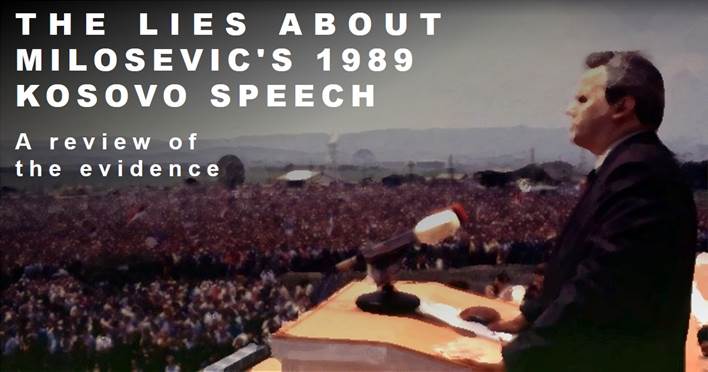
question. Here I am primarily concerned with showing that Slobodan Milosevic
was, in fact, systematically and willfully misrepresented. As an example of
what has been done, I have assembled excerpts from various sources regarding
Milosevic’s famous 1989 speech at Gazimestan (the location is often referred
to as Kosovo Polje or Kosovo Field). I compare these excerpts to Milosevic’s
words so that you can see what was done. I
have scanned the microfilm of the BBC translation so my readers can compare
the US government and the BBC versions for themselves. To see the pdfs of the BBC microfilm
visit these pages: For an easy-to-read text version of
the BBC translation: To compare this to the US government
translation: Finally,
you may look at further instructions I provide in the footnote for those who
may wish to track down this text on their own.[1] As
you read the compilation (certainly not complete) of misquotations,
misrepresentations, misattributions, and mischaracterizations of Milosevic’s
speech in the media and by academics, it is important to keep something in
mind. If
Milosevic really was a hate-monger, the evidence would not be hard to
find. As Jared Israel wrote in his introduction
to the speech: “It
is impossible for a society to engage in genocide unless the population is
won to hate the target group. This has to be done in a systematic way. That
is, political leaders must support hate in deeds but also in words.” Incitement
to hatred, after all, is a public behavior. One cannot become an
ultra-nationalist populist politician without making ultra-nationalist
speeches—the masses cannot be incited in secret. Thus, if Milosevic
really was the man portrayed in the media, nobody would have to slander an
explicitly tolerant speech to make the case. They could just use a genuinely
hateful public statement, written document, radio interview, letter --
anything. It would make zero sense for the media to fabricate all sorts of
things about a tolerant speech if anything hateful by Milosevic really
existed. In
the first part of my analysis below I report the misrepresentations of the
speech. Following that, I quote reports in the media made on or immediately
after June 28, 1989, the day Milosevic spoke. These accounts, published
immediately after his speech, were accurate, and this demonstrates
that the truth was easily available if someone had wanted to report it later
on. Not only that, I go further to demonstrate that the same media services
which reported the speech accurately in 1989, then went on to lie about the
speech eight years later, when NATO needed to demonize Slobodan Milosevic, in
preparation for the bombing of Yugoslavia and takeover of Kosovo. Most
of my examples deal with media coverage of the Milosevic speech but
government officials are also on record lying about it. For example, on June
28, 1999, Robin Cook, then the Foreign Minister of the UK, said the following
about the speech: “Milosevic
used this important anniversary not to give a message of hope and reform.
Instead, he threatened force to deal with Yugoslavia's internal political
difficulties. Doing so thereby launched his personal agenda of power and
ethnic hatred under the cloak of nationalism. All the peoples of the region
have suffered grievously ever since.”[2] As the excerpts from Milosevic’s speech which I have quoted
below demonstrate, Robin Cook was not telling the truth. The Western media
and the highest officials apparently worked together in a campaign to sell
the public a falsified version of this speech in order to justify war. Summary of the evidence 1. The
Independent (British newspaper) 2. The
Irish Times (Irish newspaper) 3. THE HEAVYWEIGHTS: The Economist, TIME, The New
York Times, The Washington Post,
and National Public Radio 4. T.W. Carr (Assistant Publisher for
Defense & Foreign Affairs Publications, London) 5. International Crisis Group (an NGO) 6. The
Times (of London, a newspaper) 7. Newsday
(a newspaper) 8. Norman Cigar (an academic) 9. The BBC (British news service,
government owned) 10. Final Remarks An important British newspaper, The Independent, included this
in what it presented as a chronology of events: “June 1989 But no such threat appears in the text of the speech. Consider this by The Irish Times: “It was at Kosovo Polje in 1389 that Serbs fought their most
historic battle, losing to a Turkish army and later enduring 500 years of
Ottoman rule. From here they fled again nearly three centuries later, led by
their Orthodox patriarch, after a failed rebellion. And here,
10 years ago this month, the Yugoslav President, Mr Slobodan Milosevic, made
his name telling a crowd of 500,000 Serbs, ‘Serbia will never abandon Kosovo.’
” [4] They have put quotation
marks around a phrase that appears nowhere in the text. 3. THE HEAVYWEIGHTS: Economist,
TIME, New York Times, Washington Post, and National Public
Radio Let
us now look at what the biggest media heavyweights said. We shall begin with
The Economist, perhaps the most prestigious and influential news magazine in
the world: “But
it is primitive nationalism, egged on by the self-deluding myth of Serbs as
perennial victims, that has become both Mr Milosevic’s rescuer (when
communism collapsed with the Soviet Union) and his nemesis. It was a stirringly virulent nationalist speech he made in Kosovo, in
1989, harking back to the Serb Prince Lazar’s suicidally brave battle against
the Turks a mere six centuries ago, that saved his leadership when the
Serbian old guard looked in danger of ejection. Now he may have become a
victim of his own propaganda.”[5] The
passages from Milosevic’s speech quoted above already make it clear that this
was not a “stirringly virulent nationalist speech.” The Economist would have
you believe that Milosevic was literally foaming at the mouth, and wanted to
use the memories of Prince Lazar and the defeat at Kosovo Polje as a catalyst
for arousing ultra-nationalistic feelings. This is how Milosevic introduced
his remarks about that historical event: [Quote
from Milosevic's
1989 Speech begins here] Today,
it is difficult to say what is the historical truth about the Battle of
Kosovo and what is legend. Today this is no longer important.
Oppressed by pain and filled with hope, the people used to remember and to
forget, as, after all, all people in the world do, and it was ashamed of
treachery and glorified heroism. Therefore it is difficult to say today whether the Battle of
Kosovo was a defeat or a victory for the Serbian people, whether thanks to it
we fell into slavery or we survived in this slavery. The answers
to those questions will be constantly sought by science and the people.
What has been certain through all the centuries until our time today is that
disharmony struck Kosovo 600 years ago. If we lost the battle, then this was
not only the result of social superiority and the armed advantage of the
Ottoman Empire but also of the tragic disunity in the leadership of the
Serbian state at that time. In that distant 1389, the Ottoman Empire was not
only stronger than that of the Serbs but it was also more fortunate than the
Serbian kingdom. [Quote
from Milosevic's
1989 Speech ends here] Is
this a virulent nationalist speaking? Milosevic sounds positively professorial.
He sounds like an academic, showing a grandfatherly understanding for
the human frailties that lead people to conveniently forget things in order
to make legends out of history in a romantic and nationalistic manner. And
he is talking about the famous battle at Kosovo Polje, in the very place
where that battle was fought! The
truth of what happened, he says, is for scientists to establish. Is this a
nationalist using a myth of the people to rouse their passions? Does he sound
‘injured’ and ‘insecure’? TIME
Magazine, perhaps the most widely-read news magazine in the world, had a
similar slant: “It
was St. Vitus’ Day, a date steeped in Serbian history, myth and eerie
coincidence: on June 28, 1389, Ottoman invaders defeated the Serbs at the
battle of Kosovo; 525 years later, a young Serbian nationalist assassinated
Austro-Hungarian Archduke Franz Ferdinand, lighting the fuse for World War I.
And it was on St. Vitus' Day, 1989, that Milosevic whipped a million
Serbs into a nationalist frenzy in the speech that capped his ascent to power.”[6] And
the same goes for the New York Times: “In
1989 the Serbian strongman, Slobodan Milosevic, swooped down in a helicopter
onto the field where 600 years earlier the Turks had defeated the Serbs at
the Battle of Kosovo. In a fervent speech before a million
Serbs, he galvanized the nationalist passions that two years later fueled the
Balkan conflict.”[7] And
the Washington Post: “A
military band and a dozen chanting monks from the Serbian Orthodox Church
struggled unsuccessfully this morning to lift the dour mood hanging over a
small crowd of Serbs marking the 609th anniversary of the Battle of
Kosovo here at the most revered site in Serbia's nationalist mythology. (…) And
here is what National Public Radio (NPR) said about this speech, through the
lips of Chuck Sudetic: “Mr.
SUDETIC: . . .the people were whipped up into a kind of
hysteria. You have to understand that the Serbs in Kosovo suffered a
kind of repression, a mild kind of repression, but repression nonetheless -
from 1974 until the mid to late 1980s at the hands of Albanian mafia - an
Albanian Communist mafia that was in control of Kosovo. They saw their
friends and neighbors depart to find better lives in Belgrade. And the people
who were left behind felt themselves to be endangered by Albanians. Milosevic comes along, whips it up into a hysteria of fear. . .He made
his speech at the Kosovo battlefield, the site of the famous battle from 1389
in 1989, on June 28th.”[9] First
of all, I apologize to loyal fans of NPR if this shatters their illusions
about a favorite institution, but the above is no aberration for NPR. In
fact, NPR’s president is a CIA man.[10] Beyond
this, there is the larger question of this piece: does Milosevic sound like
his purpose is “whipping a million Serbs into a nationalist frenzy” with his remembrance
of the events of 1389? Is this a “fervent speech” meant to “galvanize the
nationalist passions”? Is it a “rallying cry for nationalism”? Could people [be] whipped up into a kind of
hysteria” with Milosevic's words? I can’t see how. The
following excerpt is from T.W. Carr, who used to be Assistant Publisher for
Defense & Foreign Affairs Publications, London. It is relatively long but
worth reading because of the juxtaposition of Slobodan Milosevic (the Serbian
leader) with Franjo Tudjman (the Croatian leader) and Alija Izetbegovic
(leader of one of the Bosnian Muslim factions). [Quote
from T.W. Carr’s article begins here] Three
leaders emerged within the collapsing Federal Socialist Republic of
Yugoslavia. Each used the emotive appeal of patriotism (nationalism), history
and religious heritage in their bid for political control of one of the three
nation "nation states", Orthodox Christian Serbia, Roman Catholic
Christian Croatia and Islamic Bosnia-Herzegovina. Slobodan
Milosevic On June
28, 1989, Serbian leader Slobodan Milosevic marked the 600th anniversary of
the Battle of Kosovo against the "Ottoman Islamist Empire" at Gazimestan by
addressing more than one million Serbs, recounting the heroism of the Serbian
nation and their Christian Orthodox faith in resisting the spread of Islam
into Europe. He reassured his audience, that the Autonomous Province of
Kosovo would remain an integral part of Serbia and Yugoslavia, despite the
then current and often violent, problems of separatism demanded by the Muslim
Albanian majority living in Kosovo. In
the Serbian presidential election of November 12, 1989, Mr. Milosevic won
65.3 percent of the vote, his nearest rival, Mr. Vuk Draskovic,
polled only 16.4 of the votes cast. Alija Izetbegovic[11] At
the same time, Alija Izetbegovic,
who had been released early from jail in 1988 (serving only six years of a 14
year sentence for pro-Islamic anti-state activities), visited Islamic
fundamentalist states in the Middle East, returning to Bosnia-Herzegovina to
found the SDA (Muslim Party of Democratic Action). His 1970 manifesto, "Islamic
Declaration", advocating the spread of radical pan-Islamism-politicised Islam-throughout
the world, by force if necessary, was reissued in Sarajevo at
this time. His Islamic Declaration is imbued with intolerance towards Western
religion, culture and economic systems. This is also the theme projected in
his book, Islam between East and West, first published in the US in 1984, and
in Serbo-Croat in 1988, shortly after he was released from prison in the
former Yugoslavia. In his writings he states that Islam cannot co-exist with
other religions in the same nation other than a short-term expediency
measure. In the longer term, as and when Muslims become strong enough in any
country, then they must seize power and form a truly Islamic state. In
the multi-party elections held in Bosnia-Herzegovina on November 18, 1990,
the population voted almost exclusively along communal lines. The Muslim Democratic
Action Party secured 86 seats, the Serbian Democratic Party 72, and the
Croatian Democratic Union (ie: union with Croatia) Party 44 seats. As the
leader of the largest political party, Mr. Izetbegovic, became the first
President of Bosnia- Herzegovina, albeit for just one year, for under the new
constitution of B-H, the presidency was to revolve each year between the
three parties, each of which represented one ethnic community. Under
constitutional law, in January 1992, Mr. Izetbegovic should have handed over
the Presidency to Mr. Radovan Karadzic, the Serbian Democratic leader. He
failed to honor the constitution and being true to his writings, he seized
power, acting undemocratically and illegally. Therefore, at no time since
January 1992 should Mr. Izetbegovic have been acknowledged by the
international community as the legal President of B-H. Franjo Tudjman Towards
the end of World War II, while still a young man, Franjo Tudjman
took the pragmatic option and joined the communist Partisans. He had probably
realized that Germany could not win the war and that Tito and his Partisans
would gain control of Yugoslavia, with the full support of both Soviets and
the British Prime Minister Sir Winston Churchill. Some
time after the end of World War II, Tudjman joined the communist
Yugoslav Army as a regular officer and rose to the rank of Major-General
during the early part of President Tito´s period in office. During
the late 1960´s and in 1979, ultra right fascism began to
re-surface in Croatia, showing the same World War II fascist face of
nationalism and the requirement that a nation state must be racially pure.
This was the first attempt anywhere in Europe to resurrect German National
Socialism following the fall of the Third Reich in 1944. Hitler created
Croatia when his forces over-ran Yugoslavia in 1941, installing as Fuher,
Ante Pavelic, leader of the fascist Croatian Ustashi movement. Pavelic had
spent the previous 10 years in exile in Italy as head of a Croatian terrorist
group, shielded by the Vatican and the Italian Fascist party. Mr.
Tudjman was deeply involved in the attempted revival of fascism, allowing his
national socialism ethos to come to the fore with the publication of his
treatise, The Wastelands. In it he attempted to re-write major sections of
the history of World War II, downplaying the Holocaust, and with it , the
more than one-million Jews, Serbs and Gypsies murdered by the Croatian
ultra-nationalist Ustashi, which included priests of the Holy Roman
Church, at the Croatian Ustashi concentration camp of Jasenovac and
other locations within Yugoslavia. For
his nationalistic, anti-state activities at this time, Mr. Tudjman went to
jail for three years. After being released from jail, Mr. Tudjman went
politically low key for a few years, but re-emerged on the scene when
President Tito died in 1980, gradually building a power base among the
Croatian right wing and creating the HDZ Party. In
the multy-party elections held in Croatia in May 1990, Mr. Tudjman´s HDZ
Party won control of the Sabor (Croatian Parliament) and Mr.
Tudjman became President of Croatia when it was still part of the Yugoslav
Federation.[12] [Quote
from T.W. Carr's article ends here] Contrary
to Carr’s claim, Milosevic did not speak about the status of
Kosovo in the 1989 speech. It is
known from other sources, of course, that he certainly did not want Kosovo to
be split from Yugoslavia, for good reasons having to do with the security of
Serbs, Roma, Slavic Muslims, Jews, Albanians and everyone else in Kosovo, and
his conviction that Kosovo was legitimately part of the country he was after
all helping lead. How many leaders want their countries broken up? But that
does not mean that in his 1989 speech he said, “that the Autonomous Province
of Kosovo would remain an integral part of Serbia and Yugoslavia, despite the
then current and often violent, problems of separatism demanded by the Muslim
Albanian majority living in Kosovo.” So this is false. Moreover,
Milosevic never referred to the Ottoman Empire as “Islamist.” On the
contrary, Milosevic’s remarks in his speech concerning the Ottoman Empire
showed no real animosity. He even acknowledged certain strengths: “In
that distant 1389, the Ottoman Empire was not only
stronger than that of the Serbs but it was also more fortunate than
the Serbian kingdom.” More
importantly, however, notice that Carr pairs the three leaders, Milosevic,
Izetbegovic, and Tudjman, and prefaces his remarks by saying all three rose to prominence by
manipulating nationalism. But does Milosevic belong in this company? Whereas
a good and effortless case can be made for Izetbegovic and Tudjman being
ultra-nationalists (see above), all we get as evidence for Milosevic’s “ultra-nationalism”
is a false allusion to a declaration he never made in the Kosovo Polje speech
about the fact that he did not want Serbia to be partitioned, which in itself
would not even be evidence of intolerant ultra-nationalism anyway. Moreover,
the speech Carr refers us to is the antithesis of an ultra-nationalistic
speech. Milosevic
at his alleged worst, then, sounds not unlike Ghandi or
Martin Luther King. Finally,
I must observe that Carr is arguing that the US and Germany are carving zones
of interest in Europe and that this is the central reason for the troubles in
Yugoslavia. In other words, he is not sympathetic to the official
propaganda about the causes of the wars in Yugoslavia. Yet even he seems
blithely to assume that Milosevic is a virulent nationalist, though he
provides no evidence. On the other hand, Izetbegovic and Tudjman, both US
allies, certainly do sound like bad guys. The
propaganda against Milosevic has been so successful that even a critic like
Carr believes it, though he can only give us one short paragraph to support
his belief, and that paragraph refers to a consummately tolerant speech. Is
this the worst one can say about Milosevic? Here
is what the International Crisis Group said about Milosevic’s Speech: “On
this date in 1948, Tito’s Yugoslavia was expelled at Stalin’s behest from the
Communist Information Bureau (Cominform). It was also on this day in 1989
that Slobodan Milosevic addressed up to one million Serbs at Gazimestan in
Kosovo to commemorate the sixhundredth anniversary of the Kosovo Battle. That speech contained the first open threat of violent conflict by a
Socialist Yugoslav leader: 'Six centuries later, again, we are in battles and
quarrels. They are not armed battles, although such things cannot be excluded.’
”[13] This
quotation does appear in the speech. Any
observer of Yugoslavia at this time knew that it was possible that armed
battles could break out. Why should the observation of such an obvious fact be
interpreted as a threat? One
could just as well interpret it as a worry. Any
state trying to contain irredentist terrorists may find itself in the
position of having to deploy its army to protect its citizens—Milosevic was
just stating the obvious. It really is necessary to omit reference to any
other part of the speech, and to ignore the facts of Yugoslavia at this time,
for the quote—completely out of context—to appear as a threat. Even then it
does not look very threatening (you have to be told that it is
supposedly a threat, for otherwise how could you reliably infer it?). But
it pays to see this quote in its minimal context: the paragraph in which it
appears: [Quote
from Milosevic's
1989 Speech begins here] Six
centuries later, now, we are being again engaged in battles and are facing
battles. They are not armed battles, although such things cannot be excluded
yet. However, regardless of what kind of battles they are, they cannot be won
without resolve, bravery, and sacrifice, without the noble qualities that
were present here in the field of Kosovo in the days past. Our chief battle now concerns implementing the economic, political,
cultural, and general social prosperity, finding a quicker and more
successful approach to a civilization in which people will live in the 21st
century. For this battle, we certainly need heroism, of course of a somewhat
different kind, but that courage without which nothing serious and great can
be achieved remains unchanged and remains urgently necessary. [Quote
from Milosevic's
1989 Speech ends here] This
minimal context is already quite informative. The “chief battle” has nothing
to do with armed conflict. And it requires “heroism, of course of a somewhat
different kind.” If one further puts this paragraph into the larger context
of the speech it is obvious that Milosevic is hardly making threats. For
example, elsewhere in the speech Milosevic says: [Quote
from Milosevic's
1989 Speech begins here] For
as long as multinational communities have existed, their weak point has
always been the relations between different nations. The threat
is that the question of one nation being endangered by the others can be
posed one day -- and this can then start a wave of suspicions, accusations,
and intolerance, a wave that invariably grows and is difficult to stop. This
threat has been hanging like a sword over our heads all the time. Internal
and external enemies of multi-national communities are aware of this and
therefore they organize their activity against multinational societies mostly
by fomenting national conflicts. At this moment, we in Yugoslavia are
behaving as if we have never had such an experience and as if in our recent
and distant past we have never experienced the worst tragedy of national
conflicts that a society can experience and still survive. [Quote
from Milosevic's
1989 Speech ends here] Milosevic was warning that nationalism was being used by
“internal and external enemies of multi-national communities” to destroy
Yugoslavia. He was worrying out loud that people would listen to fear-mongers
and that waves of suspicion between national communities would get started
and then become “difficult to stop.” He was chiding his fellow Yugoslavs for
failing to remember World War II and other catastrophes during which the
Balkans “experienced the worst tragedy of national conflicts that a society
can experience and still survive.” Does this sound like a man whipping up the
population to go to war against other ethnic groups? Here
is what the London Times had to say: “Vidovdan,
the feast of St Vitus, is one of the most sacred in the Orthodox church, but
it is also the day on which Mr Milosevic began his political career. Twelve years before, in a dusty and sweltering field at Kosovo Polje,
he had whipped up Serb nationalism among a ferocious and frustrated crowd. ‘No
one will ever beat you!’ he had shouted, commemorating the defeat of the
Serbs by the Turks at Kosovo Polje in 1389. Yesterday Mr Milosevic was
a beaten man on suicide watch in Scheveningen prison in The Netherlands.
Prison officials, who will interview the former Yugoslav President to check
that he is not worried about being threatened by other inmates, are also
believed to be paying particular attention to the threat he made earlier this
year, to shoot himself rather than submit to international justice.”[14] This
one comically gets it wrong. Milosevic probably never said, "No one will
ever beat you!" He more likely said something like "No one will be
allowed to beat you like that!" In any event, he did not say it at the
commemoration of the battle at Kosovo Polje (the speech we have been discussing
here). Those words were uttered at Kosovo Polje but
two years earlier, in 1987. At that time, Milosevic met with Serbs and
Montenegrins, mostly peasants, who had serious grievances: they said they were
being mistreated by prejudiced Albanian authorities in Kosovo and violently
harassed by radical Albanian terrorists. They wanted to speak directly with
Milosevic but he was only meeting with a relatively small group in the hall. Here
is an account of this: “When
members of the throng outside the hall again tried to break through police
lines and into the building, they were brutally clubbed and beaten back by
the police (composed mainly of Albanian officers, but including some Serbs). Informed
of what was taking place outside, Milosevic exited the building and
approached the still highly volatile crowd. According to eyewitness reports
at the time, the Serbian leader was visibly upset, physically shaken, and
trembling. When a dialogue ensued between the demonstrators and Milosevic,
they implored him to protect them from the police violence. Acting on a
journalist’s suggestion, Milosevic re-entered the hall, and proceeded to a
second floor window. From that vantage point he nervously addressed the
frenzied demonstrators, and uttered his soon-to-be legendary remarks:
"No one will be allowed to beat you! No one will be allowed to beat
you!" Milosevic also invited the demonstrators to send a delegation into
the hall to discuss their grievances.”[15] Milosevic
said, "No one will be allowed to beat you!" Is
this nationalistic incitement? Or is
he reassuring a nervous crowd that their civil rights will be respected?
After all, he is an official with responsibilities to citizens who were being
beaten by police before his very eyes. But
in the London Times article the context of the peasant Serbs getting beaten
is no longer evident. The utterance has been transformed into, “No one will
ever beat you” which has an eternal, mythical overtone, and which therefore
fits well with the new and excellent location that the Times has found for
this utterance: the speech to commemorate the battle of Kosovo Polje. Two
different events have been fused into one, and Serbian mythology has been
joined to an injured cry, providing a total impression of a syndrome of
victimization that lashes out as a reborn and vicious nationalism. "”No one
will be allowed to beat you” is supposed to mean, “We will beat them.” I
want to emphasize that Cohen’s book “Serpent in the bosom,” which I quoted
above, is an attack on Milosevic. If Cohen’s description has a bias it is to
suggest that Milosevic is a virulent nationalist. For example, although Cohen
has Albanian policemen beating peasant Serbs brutally, this is not
described as ethnic animosity (the remark that some of these policemen are
Serbs seems to have been inserted in order to dispel any such impression).
But Milosevic’s attempt to reassure a crowd whose basic human rights are
being trampled right in front of his eyes—that is nationalism, as
Cohen goes on to explain in what remains of the chapter. Everybody
else has done the same. The 1987 events are supposed to mark a turning point
on Milosevic’s road to becoming a supposed virulent nationalist (Cohen calls
it “the epiphanal moment”). However, notice that despite these attempts, it is difficult
not to see Milosevic’s behavior as perfectly natural, indeed laudable. Why
not reassure a crowd of your constituents, who are being bludgeoned by
policemen, that this will not be allowed to happen? What else should he have
morally done? By what stretch of the imagination is this utterance
transformed into a nationalistic call to arms? Well, it helps to omit the
context in which the utterance was made, and it also helps to insert it into
a speech commemorating the defeat of the Serbs at Kosovo Polje, as the Times
has done. 7. Newsday And
here is what Newsday said: [Quote
from Newsday begins here] “Picture
this: Milosevic (pronounced mee-LOH-sheh-vitch) was sent to Kosovo Polje,
the small village near the sacred site of the Serbs defeat by the Turks in
1389. His orders were to speak to disgruntled Serbian and Montenegrin
activists who claimed they were being badly mistreated by the majority ethnic
Albanians who lived there. Serbs:
A Frightened Minority While
Milosevic was speaking in the town's cultural center, a huge crowd of angry
Serbs gathered outside the building, chanting in support of the party
activists inside. They were attacked by local police, most of them Albanians,
who began beating the Serbs with their clubs. [Quote
from Newsday ends here] Notice
what has happened here. First, for Newsday,
apparently, it is enough that Noel Malcolm said something. The same can
probably also be said for The Times of London, which paper, as we saw above,
parroted a similar line to the one we see here: utterances to the effect that
"nobody will beat you" are supposed to allude to the defeat of the
Serbs at Kosovo Polje in 1389. This
is a fusion of the events of 1987 and 1989 and, since this connection does
not seem to appear prior to 1999 (which is the year Noel Malcolm’s book
appeared), it is at least a reasonable guess that: a)
Malcolm is the originator of this confusion and b)
ever since, newspapers like The Times of London and Newsday have been fusing
remarks that Milosevic made in two different years and in two very different
contexts (neither of them even remotely damning). This
is worth a pause and a reflection. Academics
typically get their facts about what happened in a particular time and place
from journalists. But here we have newspapers getting their facts from an
academic. It would be fine for the newspaper to report the interpretation
or theory of an academic, but isn’t the world turned upside down when
a newspaper gets the basic facts of what happened from some bookish professor
who wasn’t there? The
second observation is that what Milosevic actually said, "no one will be
allowed to beat you!" has been changed to "no one should dare to
beat you!" With this change the utterance dovetails nicely with
Malcolm’s reference to Milosevic’s supposed lyricism concerning the “sacred
rights of the Serbs.” So not only is this fusing of the events of 1987
and 1989 apparently an innovation of Malcolm’s, it is one he seems to work
hard at, modifying other facts as well, to give the fusion plausibility. In any case, it should be obvious that it is quite a stretch
of interpretation to say that one is invoking a moment in history by making
assurances to peasant Serbs that no one should beat them, when those peasant
Serbs are at that very moment being “attacked by local police, most of
them Albanians.” How about the hypothesis that rather than making “an
eloquent extempore speech in defense of the sacred rights of the Serbs,”
Milosevic was saying that the Albanian policemen right below him should not
be beating the peasant Serbs? 8. Norman Cigar Here
is what another ‘academic’ said: “. .
.in an emotionally charged speech at Gazimestan on June 28, 1989, on the
sixth hundredth anniversary of the Battle of Kosovo, Milosevic had signaled
his government’s intention to extend the nationalist agenda beyond Serbia’s
borders. When coupled with active measures being undertaken in neighboring
republics, his emphasis that the "Serbs have always liberated themselves
and, when they had a chance, also helped others to liberate themselves" seemed
to commit Serbia to a forcible redrawing of Yugoslavia’s long-established
internal borders in pursuit of "liberating" the Serbs outside of
Serbia. . .”[17] The
quote from Milosevic's speech is accurate, but it is difficult to do justice
to the distortions in this paragraph with the appropriate superlatives. Cigar
is, in second-order Orwellian fashion, claiming that Milosevic’s
speech is Orwellian. When Milosevic contrasts Serbs to “others,” this means
(according to Cigar) other Serbs! That is a very interesting code. And when
Milosevic talks about liberation, he really means that Serbs should oppress
non-Serbs! But
just a tiny little bit of history suggests a different hypothesis. In
World War I, the Serbs were the only Balkan people to side with the allies.
This means they simultaneously fought for their independence against two
empires (Ottoman and Austro-Hungarian), while the Croats, Muslims, Albanians,
etc. fought on the side of the empires. The Serbs won, but instead of
creating a ‘Greater Serbia’, as many a victor might have, they spearheaded
the creation of a joint kingdom, and they even shared the name (the Kingdom
of Serbia, Croatia, and Slovenia, which later got an even more inclusive name
when it was renamed Yugoslavia—land of the Southern Slavs). Thus,
they had liberated these other peoples from the clutches of the empires, and
did not create an empire themselves. Contrast
this with the treatment that Germany got from the victorious allies. Then,
in World War II, the Croats, Slovenes, Yugoslav Muslims, and the Albanians,
for the most part betrayed Yugoslavia and allied themselves with the invading
Nazis. The Hungarians, Bulgarians, and Romanians also either allied
themselves outright or reached an understanding with the Nazis. The Serbs
were surrounded but fought the invaders anyway, even though they were
practically alone. Tito’s Partisans, who had dogmatic ideology of
ethnic tolerance, and who won the war in Yugoslavia, were mostly Serbs. Once
again, the result was not a ‘Greater Serbia,’ but a magnanimous recreation of
Yugoslavia (and this, despite the fact that Serbs had suffered a
Holocaust during the war very much like that of the Jews). Could it be that when Milosevic said the Serbs had always
fought for their liberation, and that of others when possible, he was merely
saying what he meant? 9. The BBC The
examples of how this speech has been maligned could be multiplied. But we
gain a valuable perspective by taking a look at how the speech was reported
the very moment it happened: “The
events in Kosovo to commemorate the 600th anniversary of the battle on 28th
June were relayed live by Belgrade radio. At the Gracanica monastery over
100,000 people attended a liturgical service conducted by Patriarch German,
head of the Serbian Orthodox Church, and at Gazimestan around 1,500,000 people
gathered at a central ceremony in the presence of SFRY President Janez
Drnovsek and Serbian President Slobodan Milosevic. The radio noted
that more people were expected to arrive at Gazimestan. Addressing the crowd,
Milosevic said that whenever they were able to the Serbs had helped others to
liberate themselves, and they had never used the advantage of their being a
large nation against others or for themselves, Tanjug reported. He added that
Yugoslavia was a multi-national community which could survive providing there
was full equality for all the nations living in it.”[18] It
does not appear that the BBC reporter had the impression Milosevic's speech
produced a nationalist incitement. On the contrary, the reporter has
explicitly highlighted the tolerance of the speech. The
British newspaper The Independent,
which had reporters covering the speech, had a similar impression: [Quote
from The Independent begins here] “ON
the poppy-flecked Kosovo Polje, the Field of Blackbirds, looking out
over a sea of a million people, Slobodan Milosevic yesterday assumed the
mantle of a statesman and Yugoslavia’s natural leader. ‘There
is no more appropriate place than this field of Kosovo to say that accord and
harmony in Serbia are vital to the prosperity of the Serbs and of all other
citizens living in Serbia, regardless of their nationality or religion,’ he
said. Mutual tolerance and co- operation were also sine qua non for
Yugoslavia: ‘Harmony and relations on the basis of equality among Yugoslavia’s
people are a precondition for its existence, for overcoming the crisis.’ The
cries of ‘Slobo, Slobo’ which greeted his arrival on the vast monument to the
heroes of 1389 soon gave way to a numb silence. ‘I think people were a little
disappointed, it became very quiet after the beginning,’ an educated-looking
woman from Belgrade said. But most others, in a straw poll, insisted the
occasion did not merit the raucous chanting characteristic of the heady
protest rallies of last year. ‘People were satisfied, after all it wasn’t a
protest rally,’ said another pilgrim. Everyone seemed a little stunned.”[19] [Quote
from The Independent ends here] The
quotes from Milosevic are accurate. This
account, a day after the event, suggests that the speech was not “emotionally
charged,” as Cigar claims, and neither was it a speech designed to whip up “a
million Serbs into a nationalist frenzy” -- as Time Magazine untruthfully
alleges. It is
clear that there was no “ferocious and frustrated crowd,” as the Times of
London would have it. It was not a “fervent speech …[that]… galvanized the
nationalist passions” as The New York Times states, and neither was it a
“stirringly virulent nationalist speech,” as The Economist claims. Finally,
for good measure, it was not a “fiery speech…to a million angry Serbs [and] a
rallying cry for nationalism,” as the Washington Post reported. From
the story above we even learn that one observer thought people had been
disappointed, although this impression is belied by the opinion of the locals
who said this was not a protest rally. Indeed,
it didn’t sound like one, if one reads the
speech. The framing of the events is that Milosevic was conciliatory. How
should we describe the fact that The
Independent, which paper had reporters on the ground, and which had
accurately reported this speech when it was given, later said that this was
Milosevic setting his agenda “as he openly threatens force to hold the
six-republic federation together” (see above)? Scandalous? Or
perhaps we should show sympathy for the harried journalists at The Independent, who apparently cannot
find the time to read their own paper! And
what about the other, 1987, speech? This is how it was reported by the New York Times, immediately after it
happened: [Quote
from the New York Times begins
begins here] The
police clashed briefly today with a crowd of about 10,000 in the ethnically
tense province of Kosovo, Yugoslav news organizations said. [Quote
from the New York Times begins ends
here] It is clear from how that speech was reported at the
time that Milosevic had simply meant to reassure the assembled Serb peasants
that the police certainly did not have the right to beat them like that. It
was not a nationalistic call to arms nor was it supposed to have overtones to
the battle of Kosovo Polje. Why should it? What was happening in front of his
eyes was not metaphorical. Policemen were beating peasants. 10. Final Remarks This
is how a myth is constructed: we hear the same story everywhere. The
repetition of the story convinces us that the story has been confirmed. But,
of course, repetition is hardly confirmation. If it were, every urban legend
would be true. It is
important to pause and reflect on what this means. If the media can lie so
blatantly about what Milosevic said in 1989, and if they do it consistently
and across the board, something is wrong. The
question is: how wrong? The
US government obviously has an interest in demonizing the people it bombed.
Although its own translation of the speech is a rebuke to how the speech has
been portrayed, we should not expect the US government to criticize the
misinformation. This is unjustifiable, and corrupt, but not unexpected. Explaining
the behavior of the BBC, on the other hand, is not so easy. The BBC is not
the US government. Its role is supposedly to give us the truth, as best it
can. Moreover, the BBC is supposed to be in competition with other media
outlets. Since the BBC translated the speech, they were in a position
to lay bare that what was being written about the speech was misinformation.
They have not done it, and this is a very serious sin of journalistic
omission. If
only this was their biggest sin! On
April 1, 2001, the BBC wrote the following: [Quote
from BBC begins here] In
1989, on the 600-year anniversary of the battle of Kosovo Polje, he
[Milosevic] gathered a million Serbs at the site of the battle to tell them
to prepare for a new struggle. He
then began to arm and support Serb separatists in Croatia and Bosnia. Other
nationalists were coming to power throughout the republics of the old
federation. Yugoslavia's
long nightmare of civil war was beginning.[21] [Quote
from BBC ends here] The
BBC here makes it seem as though Milosevic was indeed talking about preparing
the Serbs for aggression against other people. But
the BBC translated the live relay of the speech! They
know Milosevic did no such thing in 1989 at Kosovo Polje. The BBC piece
continues: [Back
To The BBC] Darker
motives Mr
Milosevic was never really a nationalist, never a true believer. He skillfully exploited the myth of Kosovo Polje - where the Serbs
refused to surrender even though that brought defeat and subjugation—but
he was always a pragmatist. [Quote
from BBC ends here] Again:
the BBC translated the speech! They know that he spoke in skeptical and
professorial tones about the famous battle at Kosovo Polje, rather than
manipulating it for ultra-nationalist ends. This
is not an isolated instance. Here is the BBC again, in a different piece: [Quote
from BBC begins here] Serbs
to remember Historic battle Religious
ceremonies are being held today in Kosovo to commemorate the anniversary of a
fourteenth century battle in which the Ottoman Turks crushed the Serbian
army. A BBC
correspondent in Kosovo says most Serbs will mark the anniversary of the
Battle of Kosovo Polje hesitantly, if at all. He
says some believe the security situation is still too fragile for any large
gathering; others feel too threatened to risk travelling on the roads. Ten
years ago, more than one-million Serbs turned out to celebrate the battle's
six-hundreth anniversary, when President Slobodan Milosevic vowed Serbia
would never again lose control of Kosovo.[22] [Quote
from BBC ends here] But.
. .but. . .the BBC knows that what it is reporting here is not true. They
translated the speech! Milosevic did not vow any such thing in 1989 at
the Kosovo Polje commemoration. He may have vowed it elsewhere (and the vow
in and of itself is perfectly consistent with his desire to keep Yugoslavia
whole, and does not indict him of anything). But he certainly made no such
vow in the 1989 speech. Why
is the BBC reporting things that it knows are false? Since
this level of dishonesty is possible, I am forced to wonder what else is
possible. What can we believe about what has been written about Milosevic in
particular, and Yugoslavia more generally? After all, the demonization of
Milosevic, and the Serbs more generally, perfectly fits with the propaganda
aims of the NATO powers that went to war against Yugoslavia, including the US
and Britain. Here we have seen that the media establishment in these two
countries has produced stories about Milosevic’s speech that are consistent
with such a deliberate propaganda campaign.
Footnotes and Further reading [1] The BBC microfilm can be obtained from
some university libraries. If you are an academic, you can get it at your
library or through an inter-library loan, in the same way that I did. If in
doubt, ask the people at the reference desk, for this is not the easiest item
to find. It is, however, much easier to find the BBC translation on
Lexis-Nexis. Restrict your search to 1989 and do a "full text"
search for "milosevic and speech and gazimestan" (do not include
the quotation marks). If you have a version of Lexis that forces you to
search by category, then select "World News" and also
"European News Sources." This will bring up the BBC translation,
which has the following reference: BBC Summary of World Broadcasts, June 30, 1989, Friday, Part 2
Eastern Europe; B. INTERNAL AFFAIRS; YUGOSLAVIA; EE/0496/B/ 1;, 2224 words,
SLOBODAN MILOSEVIC ADDRESSES RALLY AT GAZIMESTAN, Belgrade home service 1109
gmt 28 Jun 89Text of live relay of speech delivered at 28th June rally
celebrating the 600th anniversary of the Battle of Kosovo Polje (EE/0495 i) Finally, it is possible that your library has this volume,
which contains an English translation of the speech: Krieger, Heike, ed.
2001. The Kosovo conflict and international law: An analytical documentation
1974-1999, Cambridge International Documents Series, Volume II. Cambridge:
Cambridge University Press.(p.10) [2] Robin
Cook’s speech is no longer available at the Website of the Foreign Ministry
of the UK, but we recovered via Internet Archive. An anonymous Foreign Ministry
official added an introductory note to guarantee that readers approached Cook’s
speech in a ‘proper’ frame of mind, viewing the Serbian people as culturally
disposed to war: “The summer solstice on 28 June is celebrated in Serbia as
Vid's day. Vid is a pre-Christian Slavic sun and war god. He grew to
prominence in the nineteenth and early twentieth centuries and has since
acquired the status of patron of the nation. The date has considerable
resonance in the Serb calendar. It was the date of Serbia’s defeat by the
Turks at the Battle of Kosovo in 1389. In his speech at Kosovo Polje in 1989
Slobodan Milosevic marked the 600th anniversary of the Battle of Kosovo by
threatening for the first time the use of military force to reshape Yugoslavia" Notice the progression of the argument: 1) Vid is the Slavic
god of war; 2) Serbs worship him on the day the Battle of Kosovo was fought
and 3) as a leader in the Serbian tradition, Milosevic chose that day to
launch his campaign of war. Anyone reading Milosevic's speech can see that the claim that
he was “threatening...military force to reshape Yugoslavia” is untrue. The
Foreign Ministry introduction and Robin Cook's speech do not prove Milosevic
and the Serbs are war mongers; rather, they prove Robin Cook and the Ministry
misrepresented the truth, I asked Petar Makara, a well-read Serbian-American who grew up
in Serbia, if Serbian children are brought up to worship Slavic gods of
war. He said: “Nobody in Serbia celebrates this day because of Vid, that is,
St. Vitus, and I doubt that one in a thousand know whether Vid was a Slavic
god of war; I certainly don’t. Rather, June 28th is celebrated in memory of
the battle of 1389, in which the entire Serbian nobility and whoever else
could fight came to stand up to invaders who tried to impose their views and
way of life on Serbian people; it is celebrated as a heroic defense of the
basic principle of the right to exist on one’s own. It is true that the
Ottoman Turks did impose their Islamic empire but because Serbian people
resisted we won a moral victory, and therefore we were never destroyed as a
people. It took 500 years, but we regained our freedom. And that is what Serbian parents teach
their children.” [3] “Milosevic on Trial:
Fall of a Pariah”; Newspaper Publishing PLC, Independent on Sunday (London); July 1, 2001, Sunday, SECTION:
FOREIGN NEWS; Pg. 21 [4] “Serbs make ragged retreat from their historic
cradle”; The Irish Times; June 16,
1999, CITY EDITION; SECTION: WORLD NEWS; CRISIS IN THE BALKANS; Pg. 13 [5] “What next for Slobodan Milosevic?” The Economist, June 05, 1999,
U.S. Edition, 1041 words. [6] Time International, July 9, 2001 v158 i1 p18+ [7] The New
York Times, July 28, 1996,
Sunday, Late Edition - Final, Section 1; Page 10; Column 1; Foreign
Desk, 1384 words, Serbs in Pragmatic Pullout from Albanian
Region, By JANE PERLEZ, PRISTINA, Serbia, July 22 [8] The Washington Post, June 29, 1998,
Monday, Final Edition, A SECTION; Pg. A10, 354 words, “Bitter
Serbs Blame Leader for Risking Beloved Kosovo,” R. Jeffrey Smith, Washington
Post Foreign Service, KOSOVO POLJE, Yugoslavia, June 28 [9] National Public Radio (NPR), ALL THINGS CONSIDERED (9:00 PM ET),
March 31, 1999, Wednesday, 1304 words, CHUCK SUDETIC, AUTHOR AND FORMER NEW
YORK TIMES REPORTER, TALKS ABOUT THE YUGOSLAV WAR CRIMES TRIBUNAL INDICTMENT
OF SERB PARAMILITARY LEADER ZELJKO RAZNATOVIC, ALSO KNOWN AS ARKAN, LINDA
WERTHEIMER; NOAH ADAMS
[10] “One of the matters the NPR Board discussed
before hiring [current NPR President Kevin] Klose: how NPR's news staff
would react to a boss who had worked in government radio and for the Radios,
which were CIA-financed until the early 1970s. 'There was a question as to
how the NPR newsroom would receive Kevin Klose,' says board member Chase
Untermeyer, who headed Voice of America [also a CIA operation - FGW] during
the Bush years. But those questions were 'put aside' because of Klose's leadership
abilities and other assets, he said. Untermeyer argues that operations like
the Radios are congressionally mandated to be even-handed and so operate
'under far more desirable standards of journalism' than privately owned news
outlets.” SOURCE: “Kevin Klose: journalist, fan, NPR president”; Originally published in Current, Nov. 23, 1998; By Jacqueline Conciatore MY COMMENT: It is
certainly charming that a CIA man, the one who headed Voice of America
(Untermeyer), would vouch for the even-handedness of Klose, another CIA
man. And notice that Untermeyer was already on the NPR board and had a hand
in hiring Klose: the CIA hiring the CIA. The transformation of
NPR hardly began with Klose. [11] “What really happened in Bosnia?”; Investigative
and Historical Research; rev. 19 August 2005; by Francisco
Gil-White [12]
from “A
Careful Coincidence Of National Policies?” by T.W. Carr (Ass.
Publisher, Defense & Foreign Affairs Publications. London) [13] BALKANS Briefing,
Belgrade/Brussels, 6 July 2001; International Crisis Group. [14] From “Milosevic on
suicide watch in Dutch prison”; Times Newspapers Limited; The Times (London); June 30, 2001,
Saturday [15] Cohen, L. J. 2001. Serpent in the bosom: The rise and fall of
Slobodan Milosevic. Boulder, Colorado: Westview. [16] from “Student Briefing Page On The News”;
Newsday, Inc.; Newsday (New York,
NY); April 16, 1999, Friday, ALL EDITIONS; SECTION: NEWS; Page A48 [17] Cigar, Norman 1995. Genocide in Bosnia.
College Station, Texas: Texas A&M University Press. (p.34) [18] Copyright 1989 The British Broadcasting
Corporation; BBC Summary of World Broadcasts; June 29, 1989, Thursday;
SECTION: Part 2 Eastern Europe; 2. EASTERN EUROPE; EE/0495/ i; LENGTH: 249
words; HEADLINE: The anniversary of the Battle of Kosovo Polje [19] The Independent, June 29 1989,
Thursday, Foreign News ; Pg. 10, 654 words,
Milosevic carries off the battle honours, From EDWARD STEEN and MARCUS TANNER in
Kosovo Polje [20] The New York Times, April 25, 1987,
Saturday, Late City Final Edition,
Section 1; Page 5, Column 1; Foreign Desk, 356 words,
YUGOSLAVIA POLICE AND 10,000 CLASH DURING A PROTEST OVER ETHNIC
BIAS, AP, BELGRADE, Yugoslavia, April 24 [21] “The downfall of Milosevic,” BBC; Sunday, 1 April, 2001, 07:17 GMT 08:17
UK; [22] From the newsroom of the BBC World Service * Monday, June 28, 1999
Published at 09:21 GMT 10:21 UK * World: Europe |
|
Notify me of new HIR pieces!
|
||||||||||||||||||||||||||||||||||||||||||||||||||||||||||||||||||||||||||||||||||||||||||||||||||||||||||||||||||||||||||||||||||||||||||||||||||||